Spreading like wildfire? Maybe not always
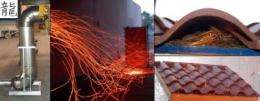
One of America's most costly natural disasters are wildland fires, and wildland-urban interface (WUI) fires rank among the worst of these. WUI is the threshold where wildfires consume not only the landscape, but also infrastructure. Once that threshold is crossed, flames can spread – well, like wildfire. In quick succession, when a racing fire crosses the WUI, houses first smolder, then burn, and finally fall like wooden dominoes. And it can happen very quickly, as we all know.
Half of all billion-dollar blazes are WUI fires, which can ignite as many as a dozen homes a minute. This type of fire is both a wall of flames and a wave of firebrands. Lofting onto shingles or floating into eaves, the firebrands smolder before setting their resting place ablaze. More intrusive firebrands drift through gable vents or down chimneys, torching the house from within and creating new firebrands.
Since 2008, the Department of Homeland Security (DHS)'s Science and Technology Directorate (S&T) has been funding experimental WUI fire research at the National Institute of Standards and Technology (NIST) to discover when, how, and how often embers start fires after they land.
"WUI fires rank among America's most costly catastrophes," says S&T Office of Standards Executive Bert Coursey. "These studies aren't about blowing smoke; they're science at its best."
Recent breakthroughs have overturned a number of existing myths about wildfires:
- 6 millimeter (1/4-inch) wire mesh, when used to cover outside vents, as required by code, keeps embers out. NIST found that mesh with 6mm holes actually allowed many embers to slip through and easily ignite building materials placed behind the vents. Safety was improved with 1mm mesh (1/25 inch). While firebrands smoldered and passed through the mesh, building materials placed behind the vents no longer ignited.
- Firebrands cool too quickly to ignite a ceramic-tile roof. In NIST's tests, firebrands actually blew under newly laid tiles, then scorched through the underlying insulating tar paper and ignited the sheathing material. The situation was worse with aging tiles, whose gaps often trap materials that increase the fire risk.
- Most WUI house fires are sparked by a single rogue firebrand. On the contrary, most house fires erupt from an insidious accumulation of glowing firebrands.
Working with international partners at Japan's Building Research Institute, NIST's Engineering Laboratory hatched the NIST Firebrand Generator. Referred to as "The Dragon," this 6-foot-tall, stainless-steel, fire-breathing stovepipe devours wood chips, releasing their remnants as smoldering firebrands. The NIST Firebrand Generator produces embers from evergreens, similar to the trees that set off California's Angora conflagration of 2007.
Thanks to S&T funding, "The Dragon" has been tested on a range of full-scale house parts, including gutters, siding, eaves, walls, vents, and roofs.
But before facing The Dragon, some advanced experiments are conducted using NIST's four-foot-tall Reduced-Scale Firebrand Generator, or "Baby Dragon." These small-scale experiments allow faster testing of the impact of firebrands on various materials and at various rates.
Together, these small and large-scale findings will lay the scientific foundation for new standards that will lead to more ember-resistant materials, treatments, barriers, and designs.
The firebrand research has sparked interest from academics and policymakers to home insurers — so much so that the Insurance Institute for Business & Home Safety (IBHS) cloned the NIST Dragon to rain firebrands in its own testing facility.
Researchers at NIST in Maryland are developing standard test methods and refining them as new materials, designs, and construction techniques are evaluated. For homeowners at nature's doorstep, S&T/NIST's firebrand research holds material importance. With one eye on the environment and the other on the economy, people need assurances that flame-retardant materials and add-ons will protect them better while lowering their insurance premiums.
"For the first time, we can determine the vulnerabilities that cause homes to ignite from firebrand showers," says Sam Manzello, a mechanical engineer in the NIST lab's Fire Measurements Group and visiting researcher at Japan's Building Research Institute. "This allows us to develop cost-effective fire protection codes and standards based on science, not on mere guesswork as it was in the past."
Provided by US Department of Homeland Security


