Researchers reconstruct genome of the Black Death
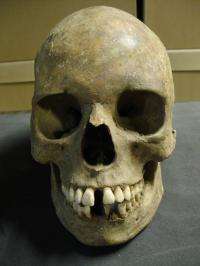
A skull from the East Smithfield plague pits in London, located under what is now the Royal Mint. Photo credit: Museum of London
led by researchers at McMaster University and the University of Tubingen in Germany -- has sequenced the entire genome of the Black Death, one of the most devastating epidemics in human history.
This marks the first time scientists have been able to draft a reconstructed genome of any ancient pathogen, which will allow researchers to track changes in the pathogen's evolution and virulence over time. This work -- currently published online in the scientific journal Nature -- could lead to a better understanding of modern infectious diseases.
Geneticists Hendrik Poinar and Kirsten Bos of McMaster University and Johannes Krause and Verena Schuenemann of the University of Tubingen collaborated with Brian Golding and David Earn of McMaster University, Hernán A. Burbano and Matthias Meyer of the Max Planck Institute for Evolutionary Anthropology and Sharon DeWitte of the University of South Carolina, among others.
In a separate study published recently, the team described a novel methodological approach to pull out tiny degraded DNA fragments of the causative agent of the Black Death, and showed that a specific variant of the Yersinia pestis bacterium, was responsible for the plague that killed 50 million Europeans between 1347 and 1351.
This video is not supported by your browser at this time.
Interview with Hendrik Poinar, associate professor and director of the McMaster Ancient DNA Centre and an investigator with the Michael G. DeGroote Insitute of Infectious Disease. Video: McMaster University
After this success, the next major step was to attempt to "capture" and sequence the entire genome, explains Poinar, associate professor and director of the McMaster Ancient DNA Centre and an investigator with the Michael G. DeGroote Institute of Infectious Disease Research, also at McMaster University."The genomic data show that this bacterial strain, or variant, is the ancestor of all modern plagues we have today worldwide. Every outbreak across the globe today stems from a descendant of the medieval plague," he says. "With a better understanding of the evolution of this deadly pathogen, we are entering a new era of research into infectious disease."
"Using the same methodology, it should now be possible to study the genomes of all sorts of historic pathogens," adds Krause, one of the lead authors of the study. "This will provide us with direct insights into the evolution of human pathogens and historical pandemics."
The direct descendants of the same bubonic plague continue to exist today, killing some 2,000 people each year.
"We found that in 660 years of evolution as a human pathogen, there have been relatively few changes in the genome of the ancient organism, but those changes, however small, may or may not account for the noted increased virulence of the bug that ravaged Europe," says Poinar. "The next step is to determine why this was so deadly."
Major technical advances in DNA recovery and sequencing have dramatically expanded the scope of genetic analysis of ancient specimens, opening new horizons in the understanding of emerging and re-emerging infections.

Mapping millions of small DNA fragments to the genome of modern plague pestis bacteria
DeWitte, Bos and Schuenemann analyzed skeletal remains from victims buried in the East Smithfield "plague pits" in London, located under what is now the Royal Mint. By targeting promising specimens -- which had been pre-screened for the presence of Y. pestis -- from the dental pulp of five bodies, they were able to extract, purify and enrich specifically for the pathogen's DNA, thereby decreasing the background DNA consisting of human, fungal and other non-plague DNA.Linking the 1349-1350 dates of the skeletal remains to the genomic data allowed the researchers to calculate the age of the ancestor of the Yersinia pestis that caused the medieval plague. This date coalesced sometime between the 12th and 13th centuries, indicating that earlier plagues such as the Justinian plague of the 6th Century -- once thought to have been caused by the same pathogen -- was likely caused by another, yet to be determined. The Justinian plague spread across the Eastern Roman Empire, killing an estimated 100 million people worldwide.
Provided by
McMaster University
-
From lemons to lemonade: Reaction uses carbon dioxide to make carbon-based semiconductor,
32 comments
-
Thioridazine kills cancer stem cells in human while avoiding toxic side-effects of conventional cancer treatments,
3 comments
-
SpaceX private rocket blasts off for space station (Update),
42 comments
-
Climate scientists say they have solved riddle of rising sea,
31 comments
-
SpaceX capsule has 'new car' smell, astronauts say (Update),
4 comments
-
What would stain as translucent on light-coloured fabric?
21 hours ago
-
How do I identify different bacteria on culture plates?
May 26, 2012
-
Why Do Dogs do Strange things...
May 25, 2012
-
What does exophillic and endophillic mean in terms of mosquito and their control?
May 24, 2012
-
Semen stains glows under black lights (uv light)?
May 23, 2012
-
Question on Human Chromosome 2
May 23, 2012
- More from Physics Forums - Biology
More news stories
Manufacturing genes to attack flu virus
An international research team has manufactured a new protein that can combat deadly flu epidemics.
2 hours ago |
not rated yet |
0
|
Scientist: Evolution debate will soon be history
(AP) -- Richard Leakey predicts skepticism over evolution will soon be history. Not that the avowed atheist has any doubts himself.
21 hours ago |
3.5 / 5 (20) |
81
More plant species responding to global warming than previously thought
(Phys.org) -- Far more wild plant species may be responding to global warming than previous large-scale estimates have suggested.
May 22, 2012 |
4.6 / 5 (14) |
18
|
Thousands of shellfish found dead in Peru
Thousands of crustaceans were found dead off the coast of Lima following the mystery mass death of dolphins and pelicans, the Peruvian Navy said Friday.
May 26, 2012 |
4.8 / 5 (5) |
7
For monogamous sparrows, it doesn't pay to stray (but they do it anyway)
It's quite common for a female song sparrow to stray from her breeding partner and mate with the male next door, but a new study shows that sleeping around can be costly.
May 22, 2012 |
5 / 5 (2) |
8
|
Land and sea species differ in climate change response: study
(Phys.org) -- Marine and terrestrial species will likely differ in their responses to climate warming, new research by Simon Fraser University and Australia’s University of Tasmania has found.
Almost half of new vets seek disability
(AP) -- America's newest veterans are filing for disability benefits at a historic rate, claiming to be the most medically and mentally troubled generation of former troops the nation has ever seen.
'Unzipped' carbon nanotubes could help energize fuel cells, batteries
Multi-walled carbon nanotubes riddled with defects and impurities on the outside could replace some of the expensive platinum catalysts used in fuel cells and metal-air batteries, according to scientists at ...
T cells 'hunt' parasites like animal predators seek prey, study shows
By pairing an intimate knowledge of immune-system function with a deep understanding of statistical physics, a cross-disciplinary team at the University of Pennsylvania has arrived at a surprising finding: T cells use a movement ...
Computer model used to pinpoint prime materials for efficient carbon capture
When power plants begin capturing their carbon emissions to reduce greenhouse gases and to most in the electric power industry, it's a question of when, not if it will be an expensive undertaking.
Change in developmental timing was crucial in the evolutionary shift from dinosaurs to birds: study
At first glance, it's hard to see how a common house sparrow and a Tyrannosaurus Rex might have anything in common. After all, one is a bird that weighs less than an ounce, and the other is a dinosaur that ...

Oct 12, 2011
Rank: 1 / 5 (1)
Oct 12, 2011
Rank: not rated yet
Oct 12, 2011
Rank: 4 / 5 (2)
Oct 12, 2011
Rank: not rated yet
http://medicalxpr...ath.html
Oct 12, 2011
Rank: 4.2 / 5 (5)
Oct 13, 2011
Rank: not rated yet
Nobody has any doubt that many if not most black death outbreaks were caused by Yersinia pestis. What I would like to see is dna seuences from the pathogen that caused deaths above the arctic circle for instance where rats cant live, or the english village that contained a black death outbreak through voluntary quarantine which rats of course would ignore.
Oct 13, 2011
Rank: not rated yet
If this particular sequence of Yersinia pestis cannot do that, then it clearly does not meet the observed transmission method of historical records and cannot hen be THE "black death"
Oct 13, 2011
Rank: not rated yet
So the "proof" of this being black death hinges ob it being pre-tested for the pathogen and then using its "discovery" as comfirmation.
Hardly meets double blind standards does it.