NASA continues critical survey of Antarctica's changing ice
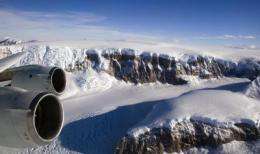
NASA’s Operation IceBridge mission comprises the largest airborne research campaign ever flown over Earth’s polar region. The mission is designed to continue critical ice sheet measurements in a period between active satellite missions and help scientists understand how much the major ice sheets of Greenland and Antarctica could contribute to sea level rise. Credit: Credit: Michael Studinger/NASA
Scientists with NASA's Operation IceBridge airborne research campaign began the mission's third year of surveys this week over the changing ice of Antarctica.
Researchers are flying a suite of scientific instruments on two planes from a base of operations in Punta Arenas, Chile: a DC-8 operated by NASA and a Gulfstream V (G-V) operated by the National Science Foundation and the National Center for Atmospheric Research. The G-V will fly through early November. The DC-8, which completed its first science flight Oct. 12, will fly through mid-November.
Ninety-eight percent of Antarctica is covered in ice. Scientists are concerned about how quickly key features are thinning, such as Pine Island Glacier, which rests on bedrock below sea level. Better understanding this type of change is crucial to projecting impacts like sea-level rise.
"With a third year of data-gathering underway, we are starting to build our own record of change," said Michael Studinger, IceBridge project scientist at NASA's Goddard Space Flight Center in Greenbelt, Md. "With IceBridge, our aim is to understand what the world's major ice sheets could contribute to sea-level rise. To understand that you have to record how ice sheets and glaciers are changing over time."
IceBridge science flights put a variety of remote-sensing instruments above Antarctica's land and sea ice, and in some regions, above the ocean floor. The G-V carries one instrument: a laser-ranging topography mapper. The DC-8 carries seven instruments, including a laser altimeter to continue the crucial ice sheet elevation record begun by the Ice, Cloud and land Elevation Satellite (ICESat) mission, which ended in 2009. The flying laboratory also will carry radars that can distinguish how much snow sits on top of sea ice and map the terrain of bedrock below thick ice cover.
While scientists in recent years have produced newer, more detailed data about the ice sheet's surface, the topography of the rocky surface beneath the ice sheet remains unknown in many places. Without knowing the topography of the bedrock, it is impossible to know exactly how much ice sits on top of Antarctica.
A gravimeter aboard the DC-8 will detect subtle differences in gravity to map the ocean floor beneath floating ice shelves. Data on bathymetry, or ocean depth, and ocean circulation from previous IceBridge campaigns are helping explain why some glaciers are changing so quickly.
Flights take off from Punta Arenas and cross the Southern Ocean to reach destinations including West Antarctica, the Antarctic Peninsula and coastal areas. Each lasts 10 to 11 hours.
"We will be re-surveying our previous flight lines to see how much glaciers and ice sheets have changed, and we'll cover new areas to establish a baseline for future years and the ICESat-2 mission in 2016," Studinger said.
Early high-priority DC-8 flights include several flight lines over sea ice near the Antarctic Peninsula, before too much of the ice melts in the southern spring. IceBridge sea ice flights are designed to help scientists understand why sea ice in the Southern Hemisphere is not following the steady decline of sea ice thickness and extent seen in the Arctic.
Other high priority flight lines follow ground traverses being made this year and next, during which NASA scientists will travel different sections of the West Antarctic Ice Sheet, measuring snowfall accumulation and the characteristics of Pine Island Glacier.
Many flight lines will retrace either previous ICESat-1 tracks or future ICESat-2 tracks. Some also will align with current observations made by the European Space Agency's CryoSat-2 satellite. The overlapping flight lines and satellite tracks ultimately will help scientists improve the accuracy of their data.
More information: http://www.nasa.go … s/icebridge/
Provided by
NASA's Goddard Space Flight Center
-
From lemons to lemonade: Reaction uses carbon dioxide to make carbon-based semiconductor,
32 comments
-
Thioridazine kills cancer stem cells in human while avoiding toxic side-effects of conventional cancer treatments,
3 comments
-
SpaceX private rocket blasts off for space station (Update),
42 comments
-
Climate scientists say they have solved riddle of rising sea,
31 comments
-
SpaceX capsule has 'new car' smell, astronauts say (Update),
3 comments
-
Hypothetical desert earth
16 hours ago
-
More human population = greater mass?
May 25, 2012
-
Conversion from aircraft bearing to normal degrees
May 23, 2012
-
Interpretation/Analysis of the Lab results(HEPA filter)
May 22, 2012
-
Has anyone here attended the The Urbino Summer School in Paleoclimatology?
May 22, 2012
-
Earthquakes: Mag 6 N. Italy and Mag 5.6 W. Bulgaria
May 21, 2012
- More from Physics Forums - Earth
More news stories
Yale study concludes public apathy over climate change unrelated to science literacy
Are members of the public divided about climate change because they don't understand the science behind it? If Americans knew more basic science and were more proficient in technical reasoning, would public consensus match ...
1 hour ago |
not rated yet |
8
|
10 million years needed to recover from mass extinction
It took some 10 million years for Earth to recover from the greatest mass extinction of all time, latest research has revealed.
Space & Earth / Earth Sciences
1 hour ago |
not rated yet |
1
|
Sophisticated simulations predict future warming
The chances of our planet being hit by a global warming of 3 degrees Celsius by 2050 is as likely as it being hit by an increase of 1.4 degrees, new research shows. Presented in the journal Nature Geoscience, the British study ...
Space & Earth / Earth Sciences
May 22, 2012 |
4.4 / 5 (9) |
51
Aliens don't want to eat us, says former SETI director
Alien life probably isnt interested in having us for dinner, enslaving us or laying eggs in our bellies, according to a recent statement by former SETI director Jill Tarter.
Space & Earth / Space Exploration
May 25, 2012 |
4.4 / 5 (14) |
39
Kyoto Protocol architect 'frustrated' by climate dialogue
UN climate talks are going nowhere, as politicians dither or bicker while the pace of warming dangerously speeds up, one of the architects of the Kyoto Protocol told AFP.
May 23, 2012 |
3.7 / 5 (7) |
39
'Unzipped' carbon nanotubes could help energize fuel cells, batteries
Multi-walled carbon nanotubes riddled with defects and impurities on the outside could replace some of the expensive platinum catalysts used in fuel cells and metal-air batteries, according to scientists at ...
T cells 'hunt' parasites like animal predators seek prey, study shows
By pairing an intimate knowledge of immune-system function with a deep understanding of statistical physics, a cross-disciplinary team at the University of Pennsylvania has arrived at a surprising finding: T cells use a movement ...
Computer model used to pinpoint prime materials for efficient carbon capture
When power plants begin capturing their carbon emissions to reduce greenhouse gases and to most in the electric power industry, it's a question of when, not if it will be an expensive undertaking.
Change in developmental timing was crucial in the evolutionary shift from dinosaurs to birds: study
At first glance, it's hard to see how a common house sparrow and a Tyrannosaurus Rex might have anything in common. After all, one is a bird that weighs less than an ounce, and the other is a dinosaur that ...
Same gene that stunts infants' growth also makes them grow too big: research
UCLA geneticists have identified the mutation responsible for IMAGe* syndrome, a rare disorder that stunts infants' growth. The twist? The mutation occurs on the same gene that causes Beckwith-Wiedemann syndrome, which makes ...
Scientists develop ultra-sensitive test that detects diseases in their earliest stages
Scientists have developed an ultra-sensitive test that should enable them to detect signs of a disease in its earliest stages, in research published today in the journal Nature Materials.