LANL develops first genetically engineered 'magnetic' algae
Oct 19, 2011
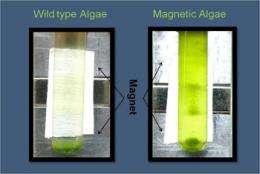
The photos show wild type algae and magnetic algae placed in a test tube next to a permanent magnet. The wild type (left) settles to the bottom of the tube under the influence of gravity. The genetically transformed algae (right) stick to the wall due to magnetic attractions.

LANL scientists have genetically engineered "magnetic" algae to investigate alternative, more efficient harvesting and lipid extraction methods for biofuels. The researchers seek to reduce the cost of algae-based biofuel production.

Currently, used algae-harvesting and lipid-extraction technology accounts for almost 30 percent of the total cost of algae-based biofuel production.

By inducing paramagnetic properties in algae, a permanent magnet-based separation could provide a low-cost alternative to current technologies.

How?

The project, led by Pulak Nath of the Lab's Applied group and Scott Twary of LANL's Biosecurity and Public Health group took a gene that is known to form in magnetotactic bacteria and expressed it in .

Magnetotactic bacteria are anaerobic microorganisms that follow the earth’s magnetic field to avoid exposure to oxygen.

A can be used to separate the transformed algae from a solution.

The scientists think that the magnetic nanoparticles formed within the algae cause the cells to respond to magnetic fields.

These biogenic magnetic nanoparticles could also be harvested separately and used as a valuable coproduct for biomedical imaging and cancer treatments.

Other LANL team members include student Maria Avrutsky and postdoctoral researcher Chaitanya Chandrana.

Explore further: Sweet solutions for detecting disease

add to favorites email to friend print save as pdf

Related Stories

Algae-Based Biofuel From Fish

Sep 01, 2009

Right now, when biofuel is produced using algae, cultures are grown and then processed into fuel. But the process is expensive and difficult. Now a company in Texas, LiveFuels, Inc., hopes that it will be ...

Algae biodiesel production has to be three times cheaper

Oct 01, 2010

The cost of producing biodiesel from algae is now three and a half times more than producing it from oil, and twice as much as producing fuel from rapeseed. Investments in biotechnology would however make it feasible for ...

Technology strikes a chord with algal biofuels

Sep 03, 2009

An award-winning Los Alamos National Laboratory sound-wave technology is helping Solix Biofuels, Inc. optimize production of algae-based fuel in a cost-effective, scalable, and environmentally benign fashion—paving the ...

Pilot plant cleans waste water and creates fuel

Sep 16, 2011

A new industrial plant that uses algae to clean waste water has opened in Gloucestershire, run by scientists from the University’s Department of Biology and Biochemistry, and environmental innovation ...

Recommended for you

An environmentally friendly battery made from wood

7 hours ago

Taking inspiration from trees, scientists have developed a battery made from a sliver of wood coated with tin that shows promise for becoming a tiny, long-lasting, efficient and environmentally friendly energy ...

Sound waves precisely position nanowires

7 hours ago

(Phys.org) —The smaller components become, the more difficult it is to create patterns in an economical and reproducible way, according to an interdisciplinary team of Penn State researchers who, using ...

Sweet solutions for detecting disease

9 hours ago

Based at the Institute of Chemistry in the Slovak Academy of Sciences, Ján Tkáč's research combines glycomics – the study of sugars in organisms – with biochip sensors based on nanoparticles and nanotubes. ...

Hybrid nanostructures: Getting to the core

9 hours ago

Material scientists expect the new multifunctional properties of hybrid nanostructures will transform the development of high-performance devices, including batteries, high-sensitivity sensors and solar cells. ...

3D printing tiny batteries

Jun 18, 2013

(Phys.org) —3D printing can now be used to print lithium-ion microbatteries the size of a grain of sand. The printed microbatteries could supply electricity to tiny devices in fields from medicine to communications, ...

User comments : 0

More news stories

Sound waves precisely position nanowires

(Phys.org) —The smaller components become, the more difficult it is to create patterns in an economical and reproducible way, according to an interdisciplinary team of Penn State researchers who, using ...

An environmentally friendly battery made from wood

Taking inspiration from trees, scientists have developed a battery made from a sliver of wood coated with tin that shows promise for becoming a tiny, long-lasting, efficient and environmentally friendly energy ...

Hybrid nanostructures: Getting to the core

Material scientists expect the new multifunctional properties of hybrid nanostructures will transform the development of high-performance devices, including batteries, high-sensitivity sensors and solar cells. ...

Sweet solutions for detecting disease

Based at the Institute of Chemistry in the Slovak Academy of Sciences, Ján Tkáč's research combines glycomics – the study of sugars in organisms – with biochip sensors based on nanoparticles and nanotubes. ...

US doctors' group labels obesity a disease

(HealthDay)—In an effort to focus greater attention on the weight-gain epidemic plaguing the United States, the American Medical Association has now classified obesity as a disease.

Sexually transmitted HPV declines in US teens

The number of US girls with the sexually transmitted disease HPV has dropped by about half even though relatively few youths are getting the vaccine, research showed on Wednesday.