The talking kitchen that teaches you French
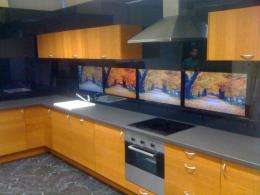
An innovative kitchen that gives step-by-step cooking instructions in French could spark a revolution in language learning in the UK.
Tracking your actions with motion-sensor technology similar to a Nintendo Wii, it speaks to you like a car's Sat Nav as you prepare a French dish.
The kitchen breaks new ground by taking language learning out of the classroom and linking it with an enjoyable and rewarding real-life activity.
It has been developed by language experts and computer scientists at Newcastle University. The research is supported by the Engineering and Physical Sciences Research Council through the RCUK Digital Economy Programme.
The kitchen builds on the proven technique of Task-Based Language Learning (TBLL), an effective teaching method where students are prompted by instructions in a foreign language to carry out specified tasks. But TBLL has never previously involved instruction in a fashionable life skill like cooking, which will help to inspire and motivate users and accelerate their learning.
The new kitchen is designed to be installed in schools, universities and even people's homes. The first version of the technology was trialled in the catering kitchens of project partner Newcastle College.
The kitchen could be available for schools and universities to use, and for the domestic market, by the end of 2012. A series of portable versions of the kitchen have been developed, which are being taken out on roadshows to schools across the North East.
The Newcastle University team is now working to explore routes to commercialisation. An EU grant of €400K has also been obtained to develop English, German, Spanish, Italian, Finnish and Catalan versions. Ultimately, versions could be developed for any language/cuisine in the world.
Professor Paul Seedhouse of the School of Education, Communication and Language Sciences has led the project in conjunction with Professor Patrick Olivier of the School of Computing Science.
Professor Seedhouse says: "By international standards, the UK is low down on the league table when it comes to learning languages – a problem that inevitably has an economic impact. We believe that simultaneously developing skills in a country's language and its cuisine will help reverse the trend".
On a tablet or laptop computer incorporated into the kitchen, the user first selects the French recipe they want to follow. Digital sensors built into utensils, ingredient containers and other equipment then communicate with the computer to make sure the right instructions are given at the right time, or to give feedback to the user if they go wrong.
At any time, the user can ask for an instruction or a piece of information to be repeated, or translated into English, simply by pressing the touch screen.
All grammar and vocabulary has been carefully selected to ensure that using the kitchen adds to basic proficiency in understanding French.
After a session, the user can test what they have learnt by carrying out a short test on the computer.
Three portable versions of the kitchen, comprising the computer and a set of sensor-enabled kitchen equipment, are now being prepared. These are to be installed in Newcastle College and at Institut Français, a London-based charity dedicated to teaching the French language.
"Our overriding objective is to make language learning more enjoyable, more effective and, by linking it to the development of another valuable life skill, more educational too," says Professor Seedhouse.
More information: More information is available at digitalinstitute.ncl.ac.uk/ilablearn/kitchen


