K-B mirrors harness X-rays for science
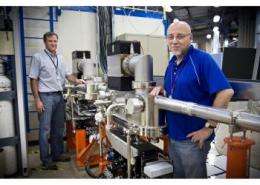
(PhysOrg.com) -- Up close, they look simple as can be: a pair of metal bars, each with one side polished to a brilliant shine. One bar faces up, the other to one side.
They’re known as K-B mirrors, sophisticated X-ray focusing tools that have a pedigree going back to the very birth of X-ray microscopy. The shiny sides can be within a nanometer of being perfectly smooth, are exquisitely shaped into a barely perceptible curve of an ellipse, and may have one or more atomically precise coatings of exotic elements like platinum or rhodium.
The “B” in K-B mirrors stands for Albert Baez, father of folk singer Joan Baez, who helped invent this ingenious focusing system in the late 1940s while a graduate student at Stanford University. The “K” is for his Ph. D. advisor and co-inventor Paul Kirkpatrick, then head of the physics department.
Their invention signaled the beginning of X-ray optics – the ability to manipulate X-rays, an energetic, penetrating form of light. Today, thousands of scientists worldwide use X-ray beams to examine the material world in atom-by-atom detail, fueling advances in energy production, electronics, environmental cleanup, new materials, nanotechnology, medicine and many other fields.
“All these years later, K-B mirrors have become an essential tool for focusing X-rays to the tiny spots that scientists need for their experiments,” said Piero Pianetta, Stanford Synchrotron Radiation Lightsource deputy director. “Between SSRL and the Linac Coherent Light Source, we have about a dozen of these mirror systems here at SLAC.” The world’s most accurate K-B mirror system currently in use, which was recently installed at LCLS, cost $1.2 million, when all of its alignment and stability aids are figured in.
For more than 50 years after Wilhelm Röntgen discovered X-rays in 1895, no one had figured out a way to focus this mysterious, penetrating form of light. Röntgen himself had proclaimed that it would be impossible to focus X-rays with lenses. In 1922, Arthur Compton reflected X-rays from polished surfaces at “grazing” or “glancing” angles of one degree or less. There matters sat for more than two decades, when Kirkpatrick began to explore the possibility of using Compton’s technique to focus X-rays.
Reflecting light with a single curved mirror produces a severe astigmatism, focusing rays from a point source to a line. “It was Kirkpatrick’s idea that a second curved mirror placed at a right angle to the first would ‘squeeze’ that line down to a point,” Baez said later in several retrospective articles and talks. He had been teaching calculus at Stanford and also working as a lab assistant in the Physics Department when Kirkpatrick asked if he’d like to work under him as a graduate student to develop this idea.
“I jumped at the chance,” Baez recalled.
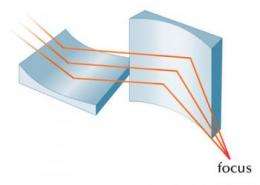
In a historic 1948 paper, Kirkpatrick and Baez introduced their mirror pair as part of the world’s first X-ray microscope. But it would be another quarter century before three other developments enabled scientists to use the mirrors productively: In the mid-1970s, machining, polishing and metal-coating techniques improved enough to make ultra-smooth surfaces that could reflect X-rays without significant scattering. Second, James Underwood, an X-ray optics pioneer who later worked at Stanford, showed how to flex the mirrors precisely into the elliptical shapes that eliminated unwanted optical aberrations. Thirdly, new X-ray sources called synchrotrons produced intense beams of X-rays for probing and unlocking the secrets of molecules and materials.
With more than 70 synchrotron light sources now operating or under construction around the world, K-B mirrors are made by six manufacturers: two in France and one each in Germany, Japan, the United Kingdom and United States. There are several other ways to focus X-rays, but these mirrors are popular because unlike technologies based on diffraction or refraction, they reflect most X-ray energies approximately uniformly.
Despite their simple design, crafting K-B mirrors has become much more complicated over the years. The first K-B mirrors were made of glass or quartz coated with a reflective metal film. Today’s mirrors are typically made from silicon crystals polished to near-atomic smoothness and then coated with ultra-thin layers of hard silicon carbide or dense metals. The shorter the X-ray wavelength being focused, the more precise the mirror surface must be.
“The mantra for X-ray mirror designers is ‘figure and finish,’” said Underwood. “Figure is the shape of the mirror and finish is its surface roughness. Many innovations over the years have improved our ability to make more accurate focusing figures and smoother mirror finishes.”
The mirror surface must be formed – or flexed – into the correct curved shape to focus the beam. This can be done in several ways. Most often, the mirror surface is polished while flat and then positioned in the beamline, supported on both ends. Then, an actuator motor applies a bending force near each end of the mirror, flexing the mirror into an ever-so-slight concave shape. Controlling the placement and amount of the force, as well as the mirror block’s shape and its supports, determines the resulting curve.
“For point-to-point focus you need an elliptical mirror shape,” said SSRL engineering physicist Tom Rabedeau. “Focusing a collimated beam to a point or vice versa requires a parabolic mirror shape.”
The mirror has to keep that shape despite being pummeled with intense high-energy X-rays. Although the X-rays are supposed to reflect off the mirror at a glancing angle, some of their energy is inevitably absorbed by the mirror, and the resulting heat buildup can warp or otherwise distort it.
The high energies of the X-ray laser pulses at the LCLS can also cause ablation, ejecting atoms from the mirror surface and reducing focus quality. Coatings can help minimize such damage. And while the mirrors are usually held in a vacuum, stray molecules owing to imperfect vacuum may stick to the mirror surface, degrading its focus.
Temperature fluctuations can deflect the mirrors’ focal point. And when using long mirrors, designers even have to account for sagging between the mirror’s end supports due to gravity, said Nicholas Kelez, LCLS mechanical engineer. Jitter in the actual location of the X-ray beam also affects its ultimate focus.
“K-B optics are nice, since you can adjust one axis at a time,” Rabedeau said. But even a tiny error in the adjustment can throw the beam’s focus way off. For a one-meter-long mirror, “a one-micron mirror deflection means a huge 60-micron move in the focus spot 30 meters distant,” he added. Increasingly, researchers are using automatic sensor-feedback “servo” controls to fine-tune the positions of the mirrors to keep the X-rays focused accurately onto their target.
“All in all, K-B mirrors give you much better control of the focused spot shape than other X-ray focusing methods,” said Dan Harrington, SSRL engineering physicist.
The world’s best K-B mirror system currently in use is in LCLS’ Coherent X-ray Imaging (CXI). Its $300,000 mirrors were made in Japan using a precision liquid-jet method to shape the desired elliptical figure directly into the silicon, avoiding the need for mirror-bending apparatus. Each of the 350 mm-long reflecting surfaces are smooth to better than 1 nanometer surface roughness over their entire length.
A German company then built the mirrors’ enclosure, alignment system and 6-ton granite base, bringing the total price tag of $1.2 million. It can focus to a one-micron spot, and its focal plane can be moved by about half a meter to accommodate the needs of various experiments, said Sebastien Boutet, CXI instrument scientist.
CXI’s current K-B system won’t be the star of the show very much longer, however. A near-twin of that system, designed to focus the LCLS pulses down to much smaller 0.1-micron-diameter spots, has been built in Japan and is being commissioned now in Germany. Installation should begin at CXI next month.
Provided by SLAC National Accelerator Laboratory


