Elaborate plumage due to testosterone?
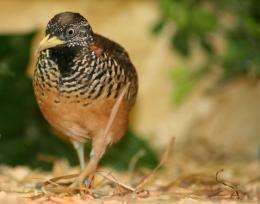
(PhysOrg.com) -- In many bird species males have a more elaborate plumage than females. This elaborate plumage is often used to signal body condition, to intimidate rivals or to attract potential mates. In many cases plumage colouration also depends on the hormone testosterone. Christina Muck and Wolfgang Goymann from the Max Planck Institute for Ornithology in Seewiesen have now investigated whether this also holds true for sex role reversed bird species. In barred buttonquails that live in Southeast Asia, females are polygamous and pair with several males that incubate the eggs and raise the young. However, not only the behaviour, but also secondary sexual ornaments that depend on the male hormone testosterone are reversed between sexes.
Women who use typical male strategies to promote their careers are often not successful. Recent findings suggest that this strategy often leads to the opposite effect.
Apparently certain behaviours are considered to be typical male, such as being offensive in business matters. Also in birds one can find clearly defined roles: The male defends a territory, courts a female and on top of has the better looks due to his elaborate plumage.
Colorful plumage and long feathers allow a male to express its quality and/or condition without further physical demonstration of its strength. With such features they may be able to avoid physical fights which are costly with respect to energy expenditure and the risk of injuries. The size and intensity of some parts of the plumage, for example the so-called black bib in house sparrows, depends on the male sex hormone testosterone; males with high testosterone levels also possess a larger and more intensely colored bib.
There is hardly anything known regarding function and regulation of plumage colouration in female birds: females mostly have a dull plumage with almost no variation between individuals. However, in a few bird species sex roles are reversed: here, the females aggressively defend territories and court males. The latter incubate the eggs and care for the young without any help from the females. Only very few species are known to show such sex role reversal in behaviour and the evolutionary background is still unsolved.
Christina Muck and Wolfgang Goymann now found a relationship between plumage colouration, body weight and testosterone concentrations in female barred buttonquail, a bird species that lives in Southeast Asia. The researchers kept the birds in pairs for one year in large breeding boxes and regularly took blood samples to monitor the time course of testosterone levels. In addition they weighed the birds and took photographs of the black throat patch of females to determine its size and colour intensity on the computer. Males of this species are smaller than females and do not possess such a patch.
The researchers could first show that testosterone levels were similar in males and females and did not exhibit large seasonal changes. Moreover, testosterone levels were rather low which is common is species that do not show a pronounced seasonality. Nevertheless they found a strong relationship between the size and the intensity of the black throat patch and the testosterone levels in females. Moreover, in females there was a correlation between testosterone levels and female body condition. No such correlations existed in males.
“It is really remarkable“, states Christina Muck, “that the sex role reversal in behaviours is accompanied by a reversed hormone dependency in the expression of secondary sexual characters“. Thus, female button quails succeed when they not only adopt male behavioural strategies but also use the underlying physiological mechanisms.
More information: Christina Muck, Wolfgang Goymann, Throat patch size and darkness co-varies with testosterone in females of a sex-role reversed species, Behavioral Ecology, in press
Provided by Max-Planck-Gesellschaft


