Who color-coded Christmas?

Red and green – the conventional colours of Christmas – are not, as many might suppose, a legacy of the Victorians. Instead, they hark back to the Middle Ages and perhaps even earlier, according to Cambridge research scientist Dr Spike Bucklow.
Jolly Father Christmas with his rosy cheeks and scarlet coat, shiny green holly with its bright red berries, glittering red decorations on a lush green Christmas tree – the clichéd color coding of the Christmas season seems as entrenched as the conventions in the West of wearing black to funerals and white to weddings. But where do the familiar Christmas colors come from and what do they really mean?
On Saturday 22 October, Dr. Spike Bucklow from the University of Cambridge’s Hamilton Kerr Institute will be examining artists’ materials to ask who came up with the colors of Christmas at the Festival of Ideas, the UK’s only festival devoted to the arts, humanities and social sciences (www.cam.ac.uk/festivalofideas).
“We associate Christmas with red and green because that’s the way we’ve always done it.” said Dr. Bucklow. “But one can trace the roots of this colour coding back through the centuries, to a time when the colors themselves had symbolic meaning, possibly as a way of accentuating a significant division or a boundary.”
Although the Victorians wholeheartedly embraced Christmas and introduced many of the traditions we see today – from cards to crackers and trees to turkeys – Dr. Bucklow believes that the Christmas colors were not inspired by the Victorians but rather revived by them, and that their significance draws on a history many centuries older.
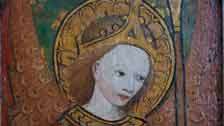
His research over the past three years, funded by the Leverhulme Trust, has focused on the art history of medieval rood screens, which date from the 14th to the 16th centuries and were used to separate the nave from the chancel of churches. “Although many were defaced or even destroyed during the Reformation, on some of those that survive are beautiful painted panels depicting saints, as well as local donors, merchants and serfs. They were commissioned by parishioners and represent the biggest investment of corporate art that this country has ever seen,” he said.
Strikingly, the vast majority are painted in red and green. “The panels were painted by newly settled members of the Flemish immigrant population or by itinerant English and continental European artists who worked together,” he explained. “Choosing red and green would have been a question of pigment availability but it would also have represented a tradition based on a consciously chosen symbolic meaning. If you like, these colours would have been part of a common language of panel painting that everyone knew about but didn’t necessarily express.”
Dr. Bucklow speculates that this meaning is linked to an emphasising of the different spaces in the Church: at one side of the screen, the nave where the parishioners sat; at the other side, the priest’s holy sanctuary and the altar. He further suggests that the Victorians, who carried out some of the early restoration of the medieval churches, would have noticed the color coding and might have adopted it to accentuate another boundary – the end of one year and the beginning of another at Christmas.
However, he believes that although the medieval rood screen painters effectively left the biggest body of physical evidence for the existence of colour coding, the use of red and green as symbolic colours goes back even further. “As one example, the red–green colour coding appears in the Mabinogion, a collection of Welsh stories from the 13th century, but almost certainly based on an oral tradition that dates back to the pre-Christian Celts many centuries before. Here, the hero comes to a half-red, half-green tree that marks a boundary.”
Today though, in a world flooded with every hue imaginable, Dr. Bucklow believes we no longer consider color to be particularly meaningful. “The sensation of seeing color has become devalued and downgraded,” he observed. “Our life experience is impoverished by not acknowledging the possibility of symbolic meaning. By contrast, in the Middle Ages and earlier, colour was integrated into a cultural awareness and even an understanding of life. It touched all members of society and conveyed a deeper message.
“For red and green, our comparatively recent obsession with associating these colours with Christmas masks a profound and long-forgotten other history.”
‘Who color-coded Christmas?’ will take place on Saturday 22 October at the Faculty of Law 11 am – 12 noon as part of Cambridge University’s Festival of Ideas. Pre-booking is required. Suitable for age 14+.
Provided by University of Cambridge


.jpg)


