Borrowing from brightly-colored birds: Physicists develop lasers inspired by nature
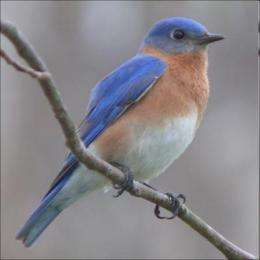
This is a male eastern bluebird (Sialia sialis, Turdidae). Credit: Image courtesy of Ken Thomas (image in public domain). Published in Soft Matter, 2009, 5, 1792-1795. E.R. Dufresne et al., “Self-assembly of amorphous biophotonic nanostructures by phase separation.” Royal Society of Chemistry. http://dx.doi.org/10.1039/B902775K
Researchers at Yale University are studying how two types of nanoscale structures on the feathers of birds produce brilliant and distinctive colors. The researchers are hoping that by borrowing these nanoscale tricks from nature they will be able to produce new types of lasersones that can assemble themselves by natural processes. The team will present their findings at the Optical Society's (OSA) Annual Meeting, Frontiers in Optics (FiO) 2011, taking place in San Jose, Calif. next week.
Many of the colors displayed in nature are created by nanoscale structures that scatter light strongly at specific frequencies. In some cases, these structures create iridescence, where colors change with the angle of viewlike the shifting rainbows on a soap bubble. In other cases, the hues produced by the structures are steady and unchanging. The mechanism by which angle-independent colors are produced stumped scientists for 100 years: at first glance, these steady hues appeared to have been produced by a random jumble of proteins. But when researchers zoomed in on small sections of the protein at a time, quasi-ordered patterns began to emerge. The scientists found that it is this short-range order that scatters light preferentially at specific frequencies to produce the distinctive hues of a bluebird's wings, for example.
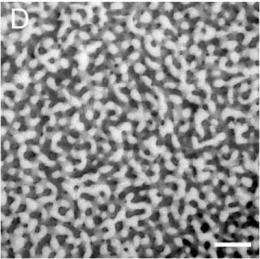
This is a closeup of a back contour feather barb from a male eastern bluebird; demonstrates a protein with channel-type nanostructure. (Scale bar = 500 nanometers.) Credit: Image courtesy of Richard Prum Lab / Yale University. Published in Soft Matter, 2009, 5, 1792-1795. E.R. Dufresne et al., “Self-assembly of amorphous biophotonic nanostructures by phase separation.” Royal Society of Chemistry. http://dx.doi.org/10.1039/B902775K
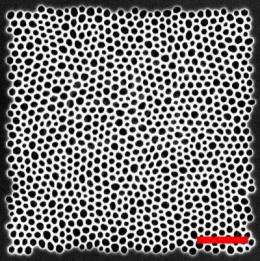
Inspired by feathers, the Yale physicists created two lasers that use this short-range order to control light. One model is based on feathers with tiny spherical air cavities packed in a protein called beta-keratin. The laser based on this model consists of a semiconductor membrane full of tiny air holes that trap light at certain frequencies. Quantum dots embedded between the holes amplify the light and produce the coherent beam that is the hallmark of a laser. The researchers also built a network laser using a series of interconnecting nano-channels, based on their observations of feathers whose beta-keratin takes the form of interconnecting channels in "tortuous and twisting forms." The network laser produces its emission by blocking certain colors of light while allowing others to propagate. In both cases, researchers can manipulate the lasers' colors by changing the width of the nano-channels or the spacing between the nano-holes.This is a network laser based on feathers with the channel-type nanostructure. This laser consists of interconnecting nano-channels (white) in a semiconductor membrane. (Scale bar = 2 micrometers.) Credit: Image courtesy of Hui Cao Research Laboratory / Yale University
What makes these short-range-ordered, bio-inspired structures different from traditional lasers is that, in principle, they can self-assemble, through natural processes similar to the formation of gas bubbles in a liquid. This means that engineers would not have to worry about the nanofabrication of the large-scale structure of the materials they design, resulting in cheaper, faster, and easier production of lasers and light-emitting devices.
One potential application for this work includes more efficient solar cells that can trap photons before converting them into electrons. The technology could also yield long-lasting paint, which could find uses in processes such as cosmetics and textiles. "Chemical paint will always fade," says lead author Hui Cao. But a physical "paint" whose nanostructure determines its color will never change. Cao describes a 40-million-year-old beetle fossil that her lab examined recently, and which had color-producing nanostructures. "With my eyes I can still see the color," she said. "It really lasts for a very long time."
More information: Presentation FWW1, "Bio-inspired photonic nanostructures and lasers," by Hui Cao is at 4 p.m. on Wednesday, Oct. 19. http://www.frontiersinoptics.com/
Provided by
Optical Society of America
-
From lemons to lemonade: Reaction uses carbon dioxide to make carbon-based semiconductor,
32 comments
-
Thioridazine kills cancer stem cells in human while avoiding toxic side-effects of conventional cancer treatments,
3 comments
-
SpaceX private rocket blasts off for space station (Update),
42 comments
-
Climate scientists say they have solved riddle of rising sea,
31 comments
-
SpaceX capsule has 'new car' smell, astronauts say (Update),
4 comments
-
Why does light move?
1 hour ago
-
How to calculate the repulsion force between a permanent and an electromagnet?
2 hours ago
-
Why does light allow us to see things?
2 hours ago
-
Room temperature superconductivity
3 hours ago
-
Water flow question
6 hours ago
-
16 year old solves 300 year old problem set by Isaac Newton
7 hours ago
- More from Physics Forums - General Physics
More news stories
Is a classical electrodynamics law incompatible with special relativity?
(Phys.org) -- The laws of classical electromagnetism that were developed in the 19th century are the same laws that scientists use today. They include Maxwell’s four equations along with the Lorentz la ...
Landmark calculation clears the way to answering how matter is formed
(Phys.org) -- An international collaboration of scientists, including Thomas Blum, associate professor of physics, is reporting in landmark detail the decay process of a subatomic particle called a kaon ...
May 25, 2012 |
4.3 / 5 (22) |
51
|
Lying in wait for WIMPs: Researchers seek to dramatically increase sensitivity of Large Underground Xenon detector
Although it's invisible, dark matter accounts for at least 80 percent of the matter in the universe. No one knows what it is, but most scientists would bet on weakly interacting massive particles, or WIMPs.
May 23, 2012 |
4 / 5 (7) |
16
|
Hawaii lab turns laser-powered bubbles into microrobots
(Phys.org) -- A team of scientists from the University of Hawaii are working on microrobots created from bubbles of air in a saline solution. The bubbles take on their title of robots as a laser ...
Sound increases the efficiency of boiling
Scientists at the Georgia Institute of Technology achieved a 17-percent increase in boiling efficiency by using an acoustic field to enhance heat transfer. The acoustic field does this by efficiently removing vapor bubbles ...
May 24, 2012 |
5 / 5 (2) |
2
Land and sea species differ in climate change response: study
(Phys.org) -- Marine and terrestrial species will likely differ in their responses to climate warming, new research by Simon Fraser University and Australia’s University of Tasmania has found.
'Unzipped' carbon nanotubes could help energize fuel cells, batteries
Multi-walled carbon nanotubes riddled with defects and impurities on the outside could replace some of the expensive platinum catalysts used in fuel cells and metal-air batteries, according to scientists at ...
T cells 'hunt' parasites like animal predators seek prey, study shows
By pairing an intimate knowledge of immune-system function with a deep understanding of statistical physics, a cross-disciplinary team at the University of Pennsylvania has arrived at a surprising finding: T cells use a movement ...
Computer model used to pinpoint prime materials for efficient carbon capture
When power plants begin capturing their carbon emissions to reduce greenhouse gases and to most in the electric power industry, it's a question of when, not if it will be an expensive undertaking.
Change in developmental timing was crucial in the evolutionary shift from dinosaurs to birds: study
At first glance, it's hard to see how a common house sparrow and a Tyrannosaurus Rex might have anything in common. After all, one is a bird that weighs less than an ounce, and the other is a dinosaur that ...
Nvidia trumpets Tegra 3 phone design wins for 2012
(Phys.org) -- Nvidias competitive war paint has a name, Tegra 3. On the heels of Nvidia announcements about lowering costs of its Tegra 3 processors and Nvidia-enabled tablets running Android Ice Cream ...


Oct 13, 2011
Rank: not rated yet