Wireless window contacts -- no maintenance, no batteries
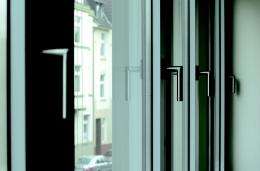
Window contacts tell us which of a house’s windows are open or closed. Researchers have now developed a fail-safe system that is particularly easy to use and needs no wiring or batteries. The sensors harvest the energy they need to run from ambient radio signals.
It is 7:30 a.m. and high time she left the house; she mustn’t be late for her 8 o’clock appointment. But the young lady still feels the need to check that she closed all her windows, because the forecast is for thunderstorms that afternoon. Later, in the car, she realizes that she forgot to check one of the rooms when she went round the house. In situations like this, window contacts can make life easier and give peace of mind. These little electronic helpers are fitted onto window handles, and they can tell from the position of the handle whether the window is wide open, tilted open or closed. They transmit this information to a base station, and the house’s occupants can then see at a glance which windows are open.
Research scientists at the Fraunhofer Institute for Microelectronic Circuits and Systems IMS in Duisburg have now developed a version of this sensor arrangement that is particularly reliable and easy to use and which needs no wiring or batteries. “Our wireless window contacts draw all their energy from ambient radio signals,” explains Dr. Gerd vom Bögel, a scientist at the IMS. Until now, wireless models have been reliant on either batteries or solar cells, but both of these approaches have drawbacks. Batteries need to be changed regularly to keep window contacts operational. Solar-powered systems avoid this problem, but they too are liable to fail: all it takes is for the sunlight to be blocked by something casting an unintentional shadow over the solar cell. Solar systems are also aesthetically less pleasing because they cannot be tucked away in a dark corner of the window. Which leaves the classic setup: window contacts with cable connections. Such systems have been on the market for years. The main argument against these is the effort it takes to install them – quite apart from the fact that it is often impossible to retrofit them to existing buildings.
The new system, however, can be fitted with little effort – and they can be positioned very discreetly. Aside from window contacts, each room is equipped with a room controller. This transmitter module not only receives the data from individual window contacts, it also actively provides the sensors with energy via its radio signal. The room controller also has the function of passing the sensor data on to a central base station in the building, from which users can query the status of all windows. Alternatively, the system can be configured to permit remote querying, for instance from a user’s smartphone. The only prerequisite for this is a DSL connection for the base station.
Energy management was the issue which caused the most headaches during development. “Room controllers, too, have to comply with certain limits on the strength of their radio output. This makes it particularly tricky to get enough energy to all the window contacts in bigger rooms,” vom Bögel points out. “But we have made sure all the sensor modules, antennas and components are so finely tuned to each other that the system works reliably even over considerable distances.”
The IMS research scientists have already constructed an initial prototype, and they know which way they want to head next: They are hoping to integrate other types of sensor into the system along the same lines – to regulate room temperature, for example. At the moment, thermostats are generally fitted somewhere just inside the room. If a door is open, the temperature by the door will be lower than in the middle of the room. As a result, the thermostat will then unnecessarily regulate the temperature upwards. The new system would allow a temperature sensor to be placed unobtrusively precisely where a particular temperature is desired – for instance on the display cabinet by the dining room table.
Provided by Fraunhofer-Gesellschaft


