Tools of the trade: Diamonds are forever ... for focusing intense X-rays
September 22, 2011 by Mike Ross

Tools of the trade: Diamonds are forever ... for focusing intense X-rays

Enlarge

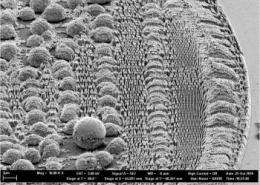
After it was exposed to the LCLS X-ray laser beam for only 15 seconds (1,000 pulses at 60 pulses per second), this gold-on-silicon nitride Fresnel zone plate showed significant damage due to the heat built up from the X-ray energy absorbed by the gold. Image copyright Paul Scherrer Institute

(PhysOrg.com) -- Diamonds can add more than sparkle and style to X-ray experiments at the Linac Coherent Light Source.

They are giving scientists a way to focus the LCLS’s powerful X-rays to a much tinier, brighter point without destroying the very device that does the focusing, according to a report from the Swiss team that created the new diamond-based technology.

The focusing device is called a Fresnel zone plate (see "Word of the Week" in Feb. 29, 2008 SLAC Today), a cousin of the lenses that send out bright beams from lighthouses. It’s been used since the 1960s to focus X-rays. But the X-ray pulses at the LCLS, which are a billion times brighter than at any previous light source, damage today’s sturdiest zone plates within a few seconds. Other focusing methods are more complicated and expensive.

Now, in a study reported last month in Nature’s Scientific Reports journal, a team led by Christian David from the Paul Scherrer Institute in Switzerland demonstrated that a Fresnel zone plate with a nanoscale bulls-eye pattern of iridium rings on a base of pure diamond can focus LCLS’s intense X-rays by a factor of 100,000, yet withstand the repeated brutal bombardment of the X-ray pulses.

“For some applications, it’s advantageous to use a zone plate to focus X-rays to a tiny, sub-micron spot,” said David Fritz, an instrument scientist for the LCLS X-Ray Pump Probe. “But LCLS’s high-intensity beam creates very challenging requirements for the optical elements we need to use.”

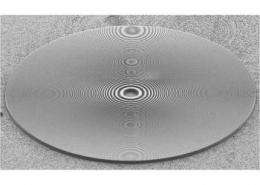
A zone plate is a set of circular, concentric ridges that get progressively narrower and closer together as they go from the middle out to the edge.  Light passing through the ridges creates a diffraction pattern of constructive interference that focuses the light to a spot. For X-rays, the effect is enhanced by making the ridges out of heavy elements. But those elements absorb the X-ray energy and can melt under intense illumination.

Today’s zone plates consist of gold rings on a silicon nitride substrate. In experiments conducted last October at the XPP instrument, David’s team determined why these zone plates didn’t hold up.

Tools of the trade: Diamonds are forever ... for focusing intense X-rays
Enlarge

The tiny white circle in the middle of a small square frame is the diamond/iridium Fresnel zone plate made by Christian David’s group at the Peter Scherrer Institute in Switzerland. Only a half-millimeter in diameter, the zone plate focused the already-intense LCLS X-ray laser beam by a factor of 100,000. Photo copyright Paul Scherrer Institute.

“We showed that the gold rings of traditional zone plates degraded after only 15 seconds in the LCLS beam because the silicon nitride couldn’t draw away the heat absorbed by the gold fast enough,” David said.

In contrast, the iridium rings on a diamond surface showed no damage or focus degradation after a full 12-hour shift.

“For us, diamond is the perfect substrate because it has extremely high thermal conductivity and does not melt,” David said. “We also used iridium, which has the advantages of being heavier than gold and having a much higher melting point.” He added that these zone plates could last for a month or more at the tested rate of 60 X-ray laser pulses per second and would probably cost a small fraction of the price of focusing mirror systems.
Tools of the trade: Diamonds are forever ... for focusing intense X-rays
Enlarge

A Fresnel zone plate is a set of circular, concentric rings that get progressively narrower and closer together as they go from the middle out to the edge. This diamond zone plate was etched into a diamond substrate by Christian David’s group at the Peter Scherrer Institute in Switzerland. It is a half-millimeter in diameter and focused the already-intense LCLS X-ray laser beam by a factor of 100,000. Image copyright Paul Scherrer Institute.

This new result is the latest advance by scientists trying to focus X-rays, a task that their discoverer, Wilhelm Roentgen, deemed impossible a century ago.

Traditional visible-light lens designs don’t work very well with . While visible light bends when it passes through a curved lens, an X-ray’s path barely changes at all. There are alternative systems available, such as grazing incidence mirrors that reflect light by an angle of less than one degree or sets of up to 10 concave beryllium lenses, but they have their own limitations and can be expensive. For many applications, Fresnel zone plates offer an attractive combination of simplicity, relatively low cost and reasonable focus quality. They are named for Augustin-Jean Fresnel (1788–1827), a French optical engineer who developed the theory behind their design, which he used to make lightweight glass lenses for lighthouses.

David’s team is back at LCLS this week to test some new all-diamond zone plates designed to focus a greater fraction of the beam without using iridium or any other heavy elements.

Provided by SLAC National Accelerator Laboratory search and more info website


Rank 5 /5 (1 vote)
Relevant PhysicsForums posts
  • Why does light move?
    created56 minutes ago
  • How to calculate the repulsion force between a permanent and an electromagnet?
    created2 hours ago
  • Why does light allow us to see things?
    created2 hours ago
  • Room temperature superconductivity
    created2 hours ago
  • Water flow question
    created5 hours ago
  • 16 year old solves 300 year old problem set by Isaac Newton
    created6 hours ago
  • More from Physics Forums - General Physics

More news stories

Is a classical electrodynamics law incompatible with special relativity?

(Phys.org) -- The laws of classical electromagnetism that were developed in the 19th century are the same laws that scientists use today. They include Maxwell’s four equations along with the Lorentz la ...

Physics / General Physics

created May 24, 2012 | popularity 4.7 / 5 (17) | comments 43 | with audio podcast feature

Landmark calculation clears the way to answering how matter is formed

(Phys.org) -- An international collaboration of scientists, including Thomas Blum, associate professor of physics, is reporting in landmark detail the decay process of a subatomic particle called a kaon – ...

Physics / General Physics

created May 25, 2012 | popularity 4.3 / 5 (22) | comments 51 | with audio podcast

Lying in wait for WIMPs: Researchers seek to dramatically increase sensitivity of Large Underground Xenon detector

Although it's invisible, dark matter accounts for at least 80 percent of the matter in the universe. No one knows what it is, but most scientists would bet on weakly interacting massive particles, or WIMPs.

Physics / General Physics

created May 23, 2012 | popularity 4 / 5 (7) | comments 16 | with audio podcast

Hawaii lab turns laser-powered bubbles into microrobots

(Phys.org) -- A team of scientists from the University of Hawaii are working on microrobots created from bubbles of air in a saline solution. The bubbles take on their title of “robots” as a laser ...

Physics / General Physics

created May 23, 2012 | popularity 5 / 5 (4) | comments 2 | with audio podcast weblog

Sound increases the efficiency of boiling

Scientists at the Georgia Institute of Technology achieved a 17-percent increase in boiling efficiency by using an acoustic field to enhance heat transfer. The acoustic field does this by efficiently removing vapor bubbles ...

Physics / Soft Matter

created May 24, 2012 | popularity 5 / 5 (2) | comments 2


Land and sea species differ in climate change response: study

(Phys.org) -- Marine and terrestrial species will likely differ in their responses to climate warming, new research by Simon Fraser University and Australia’s University of Tasmania has found.

'Unzipped' carbon nanotubes could help energize fuel cells, batteries

Multi-walled carbon nanotubes riddled with defects and impurities on the outside could replace some of the expensive platinum catalysts used in fuel cells and metal-air batteries, according to scientists at ...

T cells 'hunt' parasites like animal predators seek prey, study shows

By pairing an intimate knowledge of immune-system function with a deep understanding of statistical physics, a cross-disciplinary team at the University of Pennsylvania has arrived at a surprising finding: T cells use a movement ...

Computer model used to pinpoint prime materials for efficient carbon capture

When power plants begin capturing their carbon emissions to reduce greenhouse gases – and to most in the electric power industry, it's a question of when, not if – it will be an expensive undertaking.

Change in developmental timing was crucial in the evolutionary shift from dinosaurs to birds: study

At first glance, it's hard to see how a common house sparrow and a Tyrannosaurus Rex might have anything in common. After all, one is a bird that weighs less than an ounce, and the other is a dinosaur that ...

Nvidia trumpets Tegra 3 phone design wins for 2012

(Phys.org) -- Nvidia’s competitive war paint has a name, Tegra 3. On the heels of Nvidia announcements about lowering costs of its Tegra 3 processors and Nvidia-enabled tablets running Android Ice Cream ...