New technology uses solar UV to disinfect drinking water
September 29, 2011 By Emil Venere
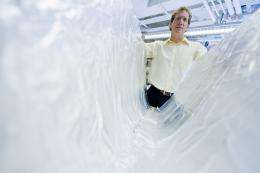
Civil engineering professor Ernest "Chip" R. Blatchley III inspects a parabolic reflector for a prototype water-disinfection system he built as part of an effort to help provide safe drinking water to a large segment of the world's population in developing nations. The system uses ultraviolet radiation from the sun to kill waterborne pathogens. Sunlight is captured by the reflector and focused onto a UV-transparent pipe though which water flows continuously. Credit: Purdue University photo/Andrew Hancock
(PhysOrg.com) -- A team of Purdue University researchers has invented a prototype water-disinfection system that could help the world's 800 million people who lack safe drinking water.
The system uses the sun's ultraviolet radiation to inactivate waterborne pathogens. Sunlight is captured by a parabolic reflector and focused onto a UV-transparent pipe though which water flows continuously.
"We've been working on UV disinfection for about 20 years," said Ernest "Chip" R. Blatchley III, a professor of civil engineering. "All of our work up until a couple years ago dealt with UV systems based on an artificial UV source. What we are working on more recently is using ultraviolet radiation from the sun."
Motivating the research is the need to develop practical, inexpensive water-treatment technologies for a large segment of the world's population in developing nations.
"More than 800 million people lack access to what we consider to be 'improved' water," Blatchley said. "The water available for people to drink in many developing countries hasn't been treated to remove contaminants, including pathogenic microorganisms. As a result, thousands of children die daily from diarrhea and its consequences, including dehydration. Half of the world's hospital beds are occupied by people who are sickened by the water they drink."
Blatchley built the parabolic reflector in his garage. The team, including an undergraduate student supported by a National Science Foundation program, finished the prototype in the lab, lining it with aluminum foil. The system was then tested on the roof of Purdue's Civil Engineering Building.
"It turns out that the solar radiation we receive in Indiana at some times of year is intense enough to inactivate some waterborne microorganisms with this type of system," he said. "We demonstrated that we can disinfect water using sunlight. The reactor was very inexpensive to build, less than $100 for the materials."
The natural UV system inactivated E. coli bacteria. However, the system must be able to kill dangerous pathogens such as Vibrio cholerae, which causes cholera, and Salmonella typhi, which causes typhoid, and Cryptosporidium parvum, which causes cryptosporidiosis, a parasitic disease that causes diarrhea.
"In the future we want to prove that our solar-UV system is going work against these other pathogens," said Blatchley, who has worked on the project with doctoral student Eric Gentil Mbonimpa, who is from Rwanda, and Bryan Vadheim, an undergraduate from Montana State University. "We also want to automate it and build sensors for it so that we know how fast the water should be pumped through the system, depending on how sunny it is at any particular time."
The NSF funded Vadheim's work through its Research Experiences for Undergraduates program.
The parabolic reflector is made out of a wood called paulownia.
"That material was selected because the tree grows very rapidly in regions near the equator, where many people lack safe drinking water," Blatchley said. "It is very light, strong and stable, so it's not going to twist or warp or bend or crack in a climate that's alternating between humid and dry."
Natural UV has a longer wavelength than most artificial UV sources, which means it has less energy. Blatchley's hypothesis, however, is that UV from sunlight will inactivate pathogens via the same mechanism as artificial UV: The radiation damages the genetic material of microbes, preventing them from reproducing.
"We are looking at other inexpensive reflecting materials, for example metalized plastic," Blatchley said. "It's similar to the material that's used to make potato chip bags. We've done measurements, and some of these materials are about twice as reflective as aluminum foil."
Improving water quality in developing countries is one of 14 "grand challenges" established by the National Academy of Engineering and also has been named a "millennium development goal" by the United Nations.
Blatchley also is working on an inexpensive filtration system that uses layers of sand and gravel to clean water. The filters were developed by Aqua Clara International, a Michigan-based non-profit corporation. Purdue and Aqua Clara are teaming up with Moi University in Kenya on that project. Purdue students tested the behavior of the filters in a Global Design Team project in Africa through Purdue's Global Engineering Program.
Water flows slowly through the filter, allowing a bacterial film to establish near the top of the filter to remove organic contaminants while certain pathogens also are removed by attachment to the sand.
However, the water may still require disinfection to kill remaining pathogens, and it might be possible to use the slow-sand filters in combination with a water-disinfection system like the new solar UV approach.
"We want to develop drinking water treatment systems that improve water quality for people in developing countries, using Kenya as an example," Blatchley said.
Aqua Clara has developed a business model for the filtration system.
"This provides business opportunities for local entrepreneurs who are trained how to make these filters out of locally available materials," he said. "You can build one of these things for $10, and it's capable of producing something like 40 liters of water a day. It's intended to produce enough water for a family of four."
The use of the filters is becoming more widespread.
"About 1,900 of the sand filters have been installed in villages throughout Kenya," said William Anderson, director of the Global Engineering Program. "More and more, Purdue's faculty and students are extending our land-grant tradition for the benefit of people throughout the world."
Provided by
Purdue University
-
From lemons to lemonade: Reaction uses carbon dioxide to make carbon-based semiconductor,
32 comments
-
Thioridazine kills cancer stem cells in human while avoiding toxic side-effects of conventional cancer treatments,
3 comments
-
SpaceX private rocket blasts off for space station (Update),
42 comments
-
Climate scientists say they have solved riddle of rising sea,
31 comments
-
SpaceX capsule has 'new car' smell, astronauts say (Update),
4 comments
-
Hypothetical desert earth
19 hours ago
-
More human population = greater mass?
May 25, 2012
-
Conversion from aircraft bearing to normal degrees
May 23, 2012
-
Interpretation/Analysis of the Lab results(HEPA filter)
May 22, 2012
-
Has anyone here attended the The Urbino Summer School in Paleoclimatology?
May 22, 2012
-
Earthquakes: Mag 6 N. Italy and Mag 5.6 W. Bulgaria
May 21, 2012
- More from Physics Forums - Earth
More news stories
Land and sea species differ in climate change response: study
(Phys.org) -- Marine and terrestrial species will likely differ in their responses to climate warming, new research by Simon Fraser University and Australia’s University of Tasmania has found.
2 hours ago |
5 / 5 (2) |
2
|
Yale study concludes public apathy over climate change unrelated to science literacy
Are members of the public divided about climate change because they don't understand the science behind it? If Americans knew more basic science and were more proficient in technical reasoning, would public consensus match ...
4 hours ago |
4 / 5 (1) |
11
|
10 million years needed to recover from mass extinction
It took some 10 million years for Earth to recover from the greatest mass extinction of all time, latest research has revealed.
Space & Earth / Earth Sciences
4 hours ago |
not rated yet |
1
|
Sophisticated simulations predict future warming
The chances of our planet being hit by a global warming of 3 degrees Celsius by 2050 is as likely as it being hit by an increase of 1.4 degrees, new research shows. Presented in the journal Nature Geoscience, the British study ...
Space & Earth / Earth Sciences
May 22, 2012 |
4.4 / 5 (9) |
51
Aliens don't want to eat us, says former SETI director
Alien life probably isnt interested in having us for dinner, enslaving us or laying eggs in our bellies, according to a recent statement by former SETI director Jill Tarter.
Space & Earth / Space Exploration
May 25, 2012 |
4.4 / 5 (14) |
40
Nvidia trumpets Tegra 3 phone design wins for 2012
(Phys.org) -- Nvidias competitive war paint has a name, Tegra 3. On the heels of Nvidia announcements about lowering costs of its Tegra 3 processors and Nvidia-enabled tablets running Android Ice Cream ...
'Unzipped' carbon nanotubes could help energize fuel cells, batteries
Multi-walled carbon nanotubes riddled with defects and impurities on the outside could replace some of the expensive platinum catalysts used in fuel cells and metal-air batteries, according to scientists at ...
T cells 'hunt' parasites like animal predators seek prey, study shows
By pairing an intimate knowledge of immune-system function with a deep understanding of statistical physics, a cross-disciplinary team at the University of Pennsylvania has arrived at a surprising finding: T cells use a movement ...
Computer model used to pinpoint prime materials for efficient carbon capture
When power plants begin capturing their carbon emissions to reduce greenhouse gases and to most in the electric power industry, it's a question of when, not if it will be an expensive undertaking.
Change in developmental timing was crucial in the evolutionary shift from dinosaurs to birds: study
At first glance, it's hard to see how a common house sparrow and a Tyrannosaurus Rex might have anything in common. After all, one is a bird that weighs less than an ounce, and the other is a dinosaur that ...
Scientist: Evolution debate will soon be history
(AP) -- Richard Leakey predicts skepticism over evolution will soon be history. Not that the avowed atheist has any doubts himself.
Sep 29, 2011
Rank: 1.7 / 5 (6)
The spectrum of solar radiation - including extreme UV and even "cosmic rays" - has changed over time, as life evolved in response to the evolving Sun [1]
1. Journal of Modern Physics 2, 587-594 (2011)
http://dl.dropbox...5079.pdf
With kind regards,
Oliver K. Manuel
Former NASA Principal
Investigator for Apollo
http://myprofile....anuelo09
Sep 29, 2011
Rank: 5 / 5 (4)
Sep 29, 2011
Rank: 5 / 5 (2)
Sep 29, 2011
Rank: 5 / 5 (1)
Nothing new here.
Sep 29, 2011
Rank: 1.5 / 5 (4)
Oh, well.
Sep 29, 2011
Rank: 1.3 / 5 (6)
Sep 29, 2011
Rank: 5 / 5 (4)
Sigh. Are you not familiar with the COST of boiling water? I assure you that the poorest people are very familiar, and if they offer you tea--even if you are a soldier there as part of your duties--be very respectful and drink it.
But to boil all drinking water would make it too expensive, not to mention the forests cut down for firewood. Inexpensive solar stills are great, these people are looking to make something even less expensive. (Or the same price for more drinkable water.)
Sep 29, 2011
Rank: not rated yet
What I have noticed is that in many developing country towns and cities (I live in Jakarta) there are thousands of large redundant TV satellite dishes just sitting on roofs as people have switched to cable or the much smaller modern dishes. Lining these mesh dishes with metalised plastic foil could produce both a solar oven and, with a through flow coil of water pipe at the focus, possibly a UV/heat steriliser. The extra cost of the plasticed foil and moving the dish to a suitable location (labour is cheap here) could be a useful source of cheap high grade energy. We need an NGO to get working on this! I am sure many inhabitants would like to get rid of the unsitely junk on their roofs for free. Any ideas?
Sep 29, 2011
Rank: not rated yet
Oct 01, 2011
Rank: not rated yet
I didn't think about this. I'm wondering - how expensive is aluminum foil in these places. I suppose the cost of firewood could certainly add up. I'm just very cynical as to how effective such a far-fetched process could be. A square meter of metalized plastic foil can't be too expensive though, and the wood used would probably boil only a gallon or two of water anyways.