New technique maps twin faces of smallest Janus nanoparticles
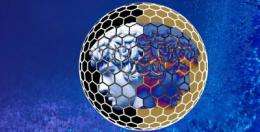
This is a Janus nanoparticle. Credit: Deborah Brewington / Vanderbilt University
(PhysOrg.com) -- New drug delivery systems, solar cells, industrial catalysts and video displays are among the potential applications of special particles that possess two chemically distinct sides. These particles are named after the two-faced Roman god Janus and their twin chemical faces allow them to form novel structures and new materials.
However, as scientists have reduced the size of Janus particles down to a few nanometers in diameter about the size of individual proteins, which has the greatest potential for drug therapy their efforts have been hampered because they havent had a way to accurately map the surfaces of the particles that they produce. This uncertainty has made it difficult to evaluate the effectiveness of these particles for various applications and to improve the methods researchers are using to produce them.
Now, a team of Vanderbilt chemists has overcome this obstacle by developing the first method that can rapidly and accurately map the chemical properties of the smallest of these Janus nanoparticles.
The results, published online this month in the German chemistry journal Angewandte Chemie, address a major obstacle that has slowed the development and application of the smallest Janus nanoparticles.
The fact that Janus particles have two chemically distinct faces makes them potentially more valuable than chemically uniformparticles. For example, one face can hold onto drug molecules while the other is coated with linker molecules that bind to the target cells. This advantage is greater when the different surfaces are cleanly separated into hemispheres than when the two types of surfaces are intermixed.
For larger nanoparticles (with sizes above 10 nanometers), researchers can use existing methods, such as scanning electron microscopy, to map their surface composition. This has helped researchers improve their manufacturing methods so they can produce cleanly segregated Janus particles. However, conventional methods do not work at sizes below 10 nanometers.
The Vanderbilt chemists Associate Professor David Cliffel, Assistant Professor John McLean, graduate student Kellen Harkness and Lecturer Andrzej Balinski took advantage of the capabilities of a state-of-the-art instrument called an ion mobilitymass spectrometer (IM-MS) that can simultaneously identify thousands of individual particles.
The team coated the surfaces of gold nanoparticles ranging in size from two to four nanometers with two different chemical compounds. Then they broke the nanoparticles down into clusters of four gold atoms and ran these fragments through the IM-MS.
Molecules from the two coatings were still attached to the clusters. So, by analyzing the resulting pattern, the chemists showed that they could distinguish between original nanoparticles where the two surface compounds were completely separated, those where they were randomly mixed and those that had an intermediate degree ofseparation.
There is no other way to analyze structure at this scale except X-ray crystallography, said Cliffel, and X-ray crystallography is extremely difficult and can take months to get a single structure.
IM-MS isnt quite as precise as X-ray crystallography but it is extremely practical, added McLean, who has helped pioneer the new instruments development. It can provide structural information in a few seconds. Two years ago a commercial version became available so people who want to use it no longer have to build one for themselves.
More information: http://onlinelibra … 882/abstract
Provided by
Vanderbilt University
-
From lemons to lemonade: Reaction uses carbon dioxide to make carbon-based semiconductor,
32 comments
-
Thioridazine kills cancer stem cells in human while avoiding toxic side-effects of conventional cancer treatments,
3 comments
-
SpaceX private rocket blasts off for space station (Update),
42 comments
-
Climate scientists say they have solved riddle of rising sea,
31 comments
-
SpaceX capsule has 'new car' smell, astronauts say (Update),
4 comments
-
What would stain as translucent on light-coloured fabric?
May 26, 2012
-
How do I identify different bacteria on culture plates?
May 26, 2012
-
Why Do Dogs do Strange things...
May 25, 2012
-
What does exophillic and endophillic mean in terms of mosquito and their control?
May 24, 2012
-
Semen stains glows under black lights (uv light)?
May 23, 2012
-
Question on Human Chromosome 2
May 23, 2012
- More from Physics Forums - Biology
More news stories
'Unzipped' carbon nanotubes could help energize fuel cells, batteries
Multi-walled carbon nanotubes riddled with defects and impurities on the outside could replace some of the expensive platinum catalysts used in fuel cells and metal-air batteries, according to scientists at ...
Nanotechnology / Nanomaterials
4 hours ago |
not rated yet |
0
|
Dopant gives graphene solar cells highest efficiency yet
(Phys.org) -- By taking advantage of graphenes favorable electrical and optical properties, and then adding an organic dopant, researchers have achieved the highest power conversion efficiency yet for ...
In nanorod crystal growth, nanoparticles seen as artificial atoms
In the growth of crystals, do nanoparticles act as "artificial atoms" forming molecular-type building blocks that can assemble into complex structures? This is the contention of a major but controversial theory ...
May 24, 2012 |
4.8 / 5 (6) |
0
|
First direct observation of oriented attachment in nanocrystal growth
Berkeley Lab researchers have reported the first direct observation of nanoparticles undergoing oriented attachment, the critical step in biomineralization and the growth of nanocrystals. A better understanding ...
May 24, 2012 |
4.7 / 5 (3) |
0
|
Synthetic nano-waste does not disappear
(Phys.org) -- Tiny particles of cerium oxide do not burn or change in the heat of a waste incineration plant. They remain intact on combustion residues or in the incineration system, as a new study by Swiss ...
Nanotechnology / Bio & Medicine
May 25, 2012 |
5 / 5 (2) |
1
|
Nvidia trumpets Tegra 3 phone design wins for 2012
(Phys.org) -- Nvidias competitive war paint has a name, Tegra 3. On the heels of Nvidia announcements about lowering costs of its Tegra 3 processors and Nvidia-enabled tablets running Android Ice Cream ...
T cells 'hunt' parasites like animal predators seek prey, study shows
By pairing an intimate knowledge of immune-system function with a deep understanding of statistical physics, a cross-disciplinary team at the University of Pennsylvania has arrived at a surprising finding: T cells use a movement ...
Computer model used to pinpoint prime materials for efficient carbon capture
When power plants begin capturing their carbon emissions to reduce greenhouse gases and to most in the electric power industry, it's a question of when, not if it will be an expensive undertaking.
Change in developmental timing was crucial in the evolutionary shift from dinosaurs to birds: study
At first glance, it's hard to see how a common house sparrow and a Tyrannosaurus Rex might have anything in common. After all, one is a bird that weighs less than an ounce, and the other is a dinosaur that ...
Land and sea species differ in climate change response: study
(Phys.org) -- Marine and terrestrial species will likely differ in their responses to climate warming, new research by Simon Fraser University and Australia’s University of Tasmania has found.
Scientist: Evolution debate will soon be history
(AP) -- Richard Leakey predicts skepticism over evolution will soon be history. Not that the avowed atheist has any doubts himself.