Symbiotic species reconnect across distances, study finds
(PhysOrg.com) -- Species that are mutually dependent on each other can, in some cases, become separated and reconnect again over distances of thousands of miles, a new study from UC Berkeley has found.
The researchers found evidence that leafflower trees (Glochidion) and leafflower moths (Epicephala), two species that rely upon each other, established themselves independently on islands in the South Pacific.
The findings, published this week in the Royal Society journal Biology Letters, contradict a long-standing paradigm in island biology, which holds that highly specialized species cannot colonize remote islands. It is a rare example of species in a symbiotic relationship – known as a "specialized mutualism" by biologists – that is resilient to disturbance.
"We found an unusual example of a mutualism that can be broken apart and actually puts itself back together," said study lead author David Hembry, graduate student in the Department of Environmental Science, Policy and Management. "Mutualisms are important because they are fundamental to ecosystem functioning. This is one reason they have received so much attention from biologists and environmental scientists in recent years."
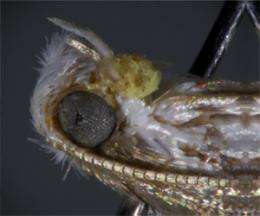
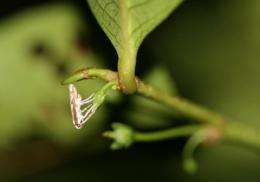
Leafflower moths are the only insects that pollinate the flowers of leafflower trees, but in exchange for this service, the moths’ caterpillars eat a fraction of the host plant’s seeds. To make things more complicated, each of the hundreds of species of leafflower trees appears to need one or two unique species of leafflower moth for pollination.
Leafflower trees and moths are found throughout the tropical forests of Asia and Australia. Their symbiosis was first reported in 2003 by Makoto Kato at Kyoto University. Hembry noted that dozens of unique species of leafflower trees had been reported from islands in the South Pacific, some of which are over six thousand kilometers from Australia, the nearest continent. However, leafflower moths had only been reported from three islands in the region.
"It would seem difficult for the trees to successfully colonize these islands if they were dependent on the moths," said Hembry, who studies in the lab of Professor Rosemary Gillespie, director of UC Berkeley’s Essig Museum of Entomology. "If a seed arrived on a new island with a moth caterpillar inside, the caterpillar would mature into a moth in a few weeks, but the seed would need years before it could grow into a mature tree with flowers. The plants and moths would have to colonize the islands separately."
To determine if leafflower moths were pollinating leafflower trees in the South Pacific, or if the trees acquired a new pollinator, Hembry and study co-author Tomoko Okamoto, then a student of Kato’s, traveled to the islands of Tahiti and Raiatea in French Polynesia. They photographed the moths interacting with the flowers in the same way the moths do in Asia.
Hembry then traveled to another 18 islands across French Polynesia and the Cook Islands, collecting leafflower fruit from patches of native forest in the mountains to see if leafflower moths would emerge. He found leafflower moths in all of them, except for three species that weren’t fruiting at the time of his visit. All but a few of these specimens were new species.
"When I started my research, I had no idea if there would be leafflower moths in Polynesia," said Hembry. "The fact that I consistently found the two species together indicates that arriving at the islands separately did not prevent them from finding each other again."
Unfortunately, the fact that this mutualism has been resilient in the past does not mean that it will continue to be so in the future.
“Leafflower trees are nearly extinct on a few islands because of human land-use change and invasive plants, and another species is threatened by rising sea levels. If their population drops too low, chances increase that for a given period in time on a given island, there will be no flowering trees and no food for leafflower moths,” said Hembry. "If this happens, the moths could easily become extinct, and the trees might be unable to reproduce in the future."
The authors say the new findings open up the possibility of using leafflower moths and leafflower trees in Polynesia as a model system for studying the way coevolution contributes to the evolution of new species, which is the subject of Hembry’s doctorate.
More information: Read the journal article here.
Provided by University of California - Berkeley


.jpg)


