Innovative superconductor fibers carry 40 times more electricity
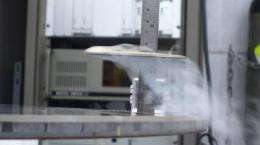
This is a demonstration of "quantum trapping" in Dr. Almog's laboratory. Credit: AFTAU
Wiring systems powered by highly-efficient superconductors have long been a dream of science, but researchers have faced such practical challenges such as finding pliable and cost-effective materials. Now researchers at Tel Aviv University have found a way to make an old idea new with the next generation of superconductors.
Dr. Boaz Almog and Mishael Azoulay working in the group of Prof. Guy Deutscher at TAU's Raymond and Beverly Sackler School of Physics and Astronomy have developed superconducting wires using fibers made of single crystals of sapphire to be used in high powered cables. Factoring in temperature requirements, each tiny wire can carry approximately 40 times more electricity than a copper wire of the same size. They have the potential to revolutionize energy transfer, says Dr. Almog.
High power superconductor cables take up much less space and conduct energy more efficiently, making them ideal for deployment across grids of electricity throughout a city. They will also offer a more effective method for collecting energy from renewable sources, such as solar and wind energy. Superconducting wires can also be used for energy storage and enable devices which enhance grid stability.
The new superconductors were first presented at the Israel Vacuum Society Conference in June 2011, and will be shown at both the European Conference on Applied Superconductivity and the Association of Science Technology Centers Conference this fall.
Beating the heat
One of the things that make our copper wires inefficient is overheating, Dr. Almog explains. Due to electrical resistance found in the metal, some of the energy that flows through the cables is cast off and wasted, causing the wires to heat up. But with superconductors, there is no resistance. A self-contained cooling system, which requires a constant flow of liquid nitrogen, keeps the wire in its superconducting state. Readily available, non-toxic, and inexpensive a gallon of the substance costs less than a gallon of milk liquid nitrogen provides the perfect coolant.
Even with the benefit of liquid nitrogen, researchers were still hard pressed to find a material that would make the ideal superconductor. Superconductors coated on crystal wafers are effective but too brittle, says Dr. Almog, and although superconductors on metallic tapes had some success, the product is too expensive to manufacture in mass quantities.
To create their superconductors, the researchers turned to sapphire fibers, developed by Dr. Amit Goyal at the Oakridge National Lab in Tennessee and lent to the TAU team. Coated with a ceramic mixture using a special technique, these single-crystal fibers, slightly thicker than a human hair, have made innovative superconductors.
Going macro
Dr. Almog is currently working to produce better superconductors that could transport even larger amounts of electric current.
One area where such superconductors could lend a hand is in collecting renewable energy sources. "Sources such as wind turbines or solar panels are usually located in remote places such as deserts or offshore lines, and you need an efficient way to deliver the current," explains Dr. Almog. These superconductors can traverse the long distances without losing any of the energy to heat due to electrical resistance.
Superconducting cables could also be an efficient way to bring large amounts of power to big cities "If you want to supply current for a section of a city like New York, you will need electric cables with a total cross-section of more than one meter by one meter. Superconductors have larger current capacities using a fraction of the space," says Dr. Almog. Different parts of a city could be cross-wired, he adds, so that in the event of a blackout, power can be easily rerouted.
Inspiring young scientists
Developing a superior superconductor is only part of TAU's mission. Dr. Almog is also dedicated to making this technology accessible and exciting as a way to capture the imagination of aspiring scientists. TAU has manufactured superconductor wafers which, filled with liquid nitrogen like their cable cousins, can be locked in place by strong magnets and levitate. Placed on a magnetic track, the wafer zooms through the air like George Jetson's space-age car. It might look like magic, but it's actually a phenomenon called "quantum trapping." Kits that demonstrate this "magnetic levitation" have been distributed in science museums throughout Israel, and Dr. Almog hopes to expand their distribution internationally.
And when the day's work is done? "We also make ice cream with the liquid nitrogen," Dr. Almog grins.
Provided by
Tel Aviv University
-
From lemons to lemonade: Reaction uses carbon dioxide to make carbon-based semiconductor,
32 comments
-
Thioridazine kills cancer stem cells in human while avoiding toxic side-effects of conventional cancer treatments,
3 comments
-
SpaceX private rocket blasts off for space station (Update),
42 comments
-
Climate scientists say they have solved riddle of rising sea,
31 comments
-
SpaceX capsule has 'new car' smell, astronauts say (Update),
4 comments
-
Why does light move?
2 hours ago
-
How to calculate the repulsion force between a permanent and an electromagnet?
3 hours ago
-
Why does light allow us to see things?
3 hours ago
-
Room temperature superconductivity
3 hours ago
-
Water flow question
7 hours ago
-
16 year old solves 300 year old problem set by Isaac Newton
8 hours ago
- More from Physics Forums - General Physics
More news stories
Is a classical electrodynamics law incompatible with special relativity?
(Phys.org) -- The laws of classical electromagnetism that were developed in the 19th century are the same laws that scientists use today. They include Maxwell’s four equations along with the Lorentz la ...
Landmark calculation clears the way to answering how matter is formed
(Phys.org) -- An international collaboration of scientists, including Thomas Blum, associate professor of physics, is reporting in landmark detail the decay process of a subatomic particle called a kaon ...
May 25, 2012 |
4.3 / 5 (22) |
51
|
Lying in wait for WIMPs: Researchers seek to dramatically increase sensitivity of Large Underground Xenon detector
Although it's invisible, dark matter accounts for at least 80 percent of the matter in the universe. No one knows what it is, but most scientists would bet on weakly interacting massive particles, or WIMPs.
May 23, 2012 |
4 / 5 (7) |
16
|
Hawaii lab turns laser-powered bubbles into microrobots
(Phys.org) -- A team of scientists from the University of Hawaii are working on microrobots created from bubbles of air in a saline solution. The bubbles take on their title of robots as a laser ...
Sound increases the efficiency of boiling
Scientists at the Georgia Institute of Technology achieved a 17-percent increase in boiling efficiency by using an acoustic field to enhance heat transfer. The acoustic field does this by efficiently removing vapor bubbles ...
May 24, 2012 |
5 / 5 (2) |
2
Nvidia trumpets Tegra 3 phone design wins for 2012
(Phys.org) -- Nvidias competitive war paint has a name, Tegra 3. On the heels of Nvidia announcements about lowering costs of its Tegra 3 processors and Nvidia-enabled tablets running Android Ice Cream ...
'Unzipped' carbon nanotubes could help energize fuel cells, batteries
Multi-walled carbon nanotubes riddled with defects and impurities on the outside could replace some of the expensive platinum catalysts used in fuel cells and metal-air batteries, according to scientists at ...
T cells 'hunt' parasites like animal predators seek prey, study shows
By pairing an intimate knowledge of immune-system function with a deep understanding of statistical physics, a cross-disciplinary team at the University of Pennsylvania has arrived at a surprising finding: T cells use a movement ...
Computer model used to pinpoint prime materials for efficient carbon capture
When power plants begin capturing their carbon emissions to reduce greenhouse gases and to most in the electric power industry, it's a question of when, not if it will be an expensive undertaking.
Change in developmental timing was crucial in the evolutionary shift from dinosaurs to birds: study
At first glance, it's hard to see how a common house sparrow and a Tyrannosaurus Rex might have anything in common. After all, one is a bird that weighs less than an ounce, and the other is a dinosaur that ...
Land and sea species differ in climate change response: study
(Phys.org) -- Marine and terrestrial species will likely differ in their responses to climate warming, new research by Simon Fraser University and Australia’s University of Tasmania has found.
Sep 07, 2011
Rank: 4.9 / 5 (7)
Unless you need a gallon per day for every mile of cable. It's mighty hard to insulate a long wire so well that there's no venting.
The embodied energy to make a kilogram of liquid nitrogen is about 0.2 kWh as far as I can figure it out, or somewhere around ½ kWh from the average primary energy sources.
A ballpark figure of 0.81 kg/L gives us the embodied energy of a gallon of liquid nitrogen at 1.5 kWh/gal, so if you need a gallon per day to counteract venting, you would be wasting 65 Watts all the time.
It does work out to be sensible at powers of over about 1-2 kW transferred, if we contrast it to a 5% loss in copper. The difficulty is that the power loss scales with power and lenght with copper, but only with lenght using superconductors, so longer lenghts of superconducting wire may need higher power to be economical
Sep 07, 2011
Rank: 4.5 / 5 (4)
Sep 07, 2011
Rank: 4.7 / 5 (3)
Plus, there's some power involved in pumping the LN2 over miles and miles of cable at a certain rate to stop it from developing insulating bubbles that would kill the superconductivity.
It has a certain idling power requirement, which necessitates a certain minimum power draw to save any energy over traditional copper and aluminium wires.
Sep 07, 2011
Rank: 1.2 / 5 (5)
Sep 07, 2011
Rank: 1.2 / 5 (5)
http://www.iop.or...8/3/319/
Sep 07, 2011
Rank: 5 / 5 (4)
this WILL work for specialized applications of ALL SORTS. already superconducting systems are being used to scale down massive naval ship motors, they are used for powering mag-lev demonstration trains which one day will replace convetional airports as they can accelerate trains to multi-mach speeds within vaccum tunnels at under 10% of the energy requirements of moving a plane at 600 miles an hour.
the navy's magnetic rail and coil guns already need cooling. a future hand held coil gun will eventually replace silenced weapons for covert operations since there is NO explosion of any kind to make noise and no explosive residue left behind for detection.
superconducting and magnetism are the future. and the future is already here a bit.
Sep 07, 2011
Rank: 4.7 / 5 (3)
Very doubtful. They don't have any intrinsic value because they are Sapphire (unless you know of a microscopic civilization that wants to cut microscopic gems). Their value is strictly as a superconductor. Not much of a black market for superconducting wire.
Sep 07, 2011
Rank: 5 / 5 (1)
I was thinking though that a suitably long superconducting cable would have liquid nitrogen generators (air is full of the stuff!) along the cable itself (possibly along power lines where transformers currently are) just drawing current off as it needs it.
Sep 07, 2011
Rank: 4.8 / 5 (4)
Sep 07, 2011
Rank: not rated yet
Well, that would be mandatory, since nobody's going to go around delivering liquid hydrogen on a truck. That would take even more energy.
You need to section the powerline, and install coolers to keep the liquid nitrogen as a liquid, and pumps to circulate it within the sections so there's no nitrogen bubbles that could let the cable heat up locally.
A section that is too long risks having the nitrogen return back the other way as gas, because it gains too much heat along the way and boils. Pumping it around faster involves friction, which heats the liquid faster, so there's probably a maximum lenght of wire that can be effectively cooled.
Sep 07, 2011
Rank: not rated yet
I have pretty high confidence that sapphire in wires thinner than a human hair wouldn't have excessive value on the street for jewelry. And that's assuming you could get the ceramic off without turning it into duct, and also assuming that you can deal with the liquid N2 you would have to get through.
Sep 07, 2011
Rank: not rated yet
Just wanted to highlight the last part of this, since so many are concerned about thieves: IIRC, the overwhelming majority of long distance power lines are made of aluminum, not copper. 1/4 the price per pound. Also, IIRC, the vast majority of scrap metal theft is from construction sites, not high voltage power lines in use. haha There are softer targets.
Sep 07, 2011
Rank: 5 / 5 (2)
FWIW, our lab's liquid chromatography pumps had sapphire pistons, which were as colourless as good glass, so utterly un-gem like...
Uh, in UK, a major target for copper theft is railway signal cabling. However, several posthumous 'Darwin Awards' have been earned by thieves who've targeted grid sub-stations-- While they were 'live' !!
Sep 07, 2011
Rank: 5 / 5 (1)
I don't believe that sapphire is ideal, but it can be seeded like you would make a sugar crystal, at room temperature and pressure. Diamond cannot.
We are talking about several orders of magnitude of price difference.
http://en.wikiped...Sapphire
Please read the part about synthetic sapphire. This applies to like 6 of you commenters. They make it just like they make the silicon crystals for computer chips. high end watches have sapphire windows, Etc, etc. I didn't know that this would be so unknown amongst a bunch of nerds like us!!
Sep 07, 2011
Rank: 1 / 5 (1)
Sep 07, 2011
Rank: 2 / 5 (4)
Sep 07, 2011
Rank: 5 / 5 (2)
Sep 08, 2011
Rank: 5 / 5 (1)
As soon as I read his assumption of a seemingly electron cloud increasing in density, that by virtue of space availability suddenly become bosons forming Cooperpairs? I suddenly got the desire to throw the pdf away.
better keep it though, since I'm in the process of learning superconduction... even seemingly bad ideas raise good question and have novel ideas.
Sep 08, 2011
Rank: 5 / 5 (1)
Sep 08, 2011
Rank: 1 / 5 (2)
Sep 08, 2011
Rank: 5 / 5 (1)
Sep 08, 2011
Rank: 5 / 5 (1)
I knew what Prinns was getting at. the "?" was about "did he just say that in a science publication?"
let me ask you these two questions; It is known that resistance remains proportional to temperature except @ critical temp for superconductors where it goes to zero.
therefore
WHAT IS RESISTANCE in terms of the electron-electron interaction?
Can you answer that and still believe Prinns?
@ yoatmon.
yes, why not?
Sep 11, 2011
Rank: not rated yet