Superconductivity: The puzzle is taking shape
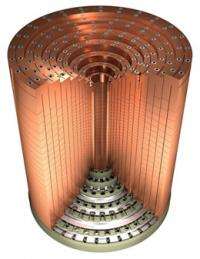
Central part of a resistive coil at the LNCMI in Grenoble, capable of generating a continuous magnetic field of 35 Tesla. The quality of the field obtained enables NMR experiments to be conducted at frequencies of around 1.5 GHz. Credit: Bertrand Maclet / CNRS
By destabilizing superconductivity with a strong magnetic field, the electrons of a "high temperature" superconductor align into linear filaments. This phenomenon has been demonstrated by a team of researchers at the CNRS Laboratoire National des Champs Magnetiques Intenses. Published in Nature on the 8 September 2011, these results add a new piece to the puzzle that condensed-matter physicists have been trying to put together for nearly twenty-five years.
Discovered a century ago, superconductivity is a spectacular phenomenon that is still intriguing researchers. What are known as "high temperature" superconductors are of particular interest to scientists, especially cuprates, i.e. copper oxides whose maximum superconducting temperature is around -140°C. How do electrons manage to organize themselves into a single wave in these cuprates, thereby allowing the material to become a superconductor? This is the question that researchers have been trying to answer for the last twenty-five years.
It is in this context that the team from the Laboratoire National des Champs Magnétiques Intenses, in collaboration with scientists from Vancouver, subjected samples of a cuprate known as YBaCuO to particularly strong magnetic fields (thousands of times more powerful than those of the small magnets used on fridge doors). Using the technique of nuclear magnetic resonance, the researchers probed this superconductor at the atomic scale and discovered that electrons, under such intense fields, tend to align into rectilinear filaments or stripes.
Such an alignment of charges has only ever been observed previously in non-superconducting or weakly superconducting materials but never in materials with high superconductivity. This discovery makes it possible to understand why this is so: a strong magnetic field must weaken superconductivity for the effect to be observed. The results also suggest that this alignment could be an underlying tendency in all cuprates. However, it is still not clear whether this new piece of the puzzle has any relation with the superconductivity mechanism of these materials.
More information: Magnetic-field-induced charge-stripe order in the high temperature superconductor YBa2Cu3Oy l T. Wu, et al. Nature, 8 September 2011.
Provided by
CNRS
-
From lemons to lemonade: Reaction uses carbon dioxide to make carbon-based semiconductor,
32 comments
-
Thioridazine kills cancer stem cells in human while avoiding toxic side-effects of conventional cancer treatments,
3 comments
-
SpaceX private rocket blasts off for space station (Update),
42 comments
-
Climate scientists say they have solved riddle of rising sea,
31 comments
-
SpaceX capsule has 'new car' smell, astronauts say (Update),
4 comments
-
Why does light move?
2 hours ago
-
How to calculate the repulsion force between a permanent and an electromagnet?
3 hours ago
-
Why does light allow us to see things?
3 hours ago
-
Room temperature superconductivity
3 hours ago
-
Water flow question
7 hours ago
-
16 year old solves 300 year old problem set by Isaac Newton
8 hours ago
- More from Physics Forums - General Physics
More news stories
Is a classical electrodynamics law incompatible with special relativity?
(Phys.org) -- The laws of classical electromagnetism that were developed in the 19th century are the same laws that scientists use today. They include Maxwell’s four equations along with the Lorentz la ...
Landmark calculation clears the way to answering how matter is formed
(Phys.org) -- An international collaboration of scientists, including Thomas Blum, associate professor of physics, is reporting in landmark detail the decay process of a subatomic particle called a kaon ...
May 25, 2012 |
4.3 / 5 (22) |
51
|
Lying in wait for WIMPs: Researchers seek to dramatically increase sensitivity of Large Underground Xenon detector
Although it's invisible, dark matter accounts for at least 80 percent of the matter in the universe. No one knows what it is, but most scientists would bet on weakly interacting massive particles, or WIMPs.
May 23, 2012 |
4 / 5 (7) |
16
|
Hawaii lab turns laser-powered bubbles into microrobots
(Phys.org) -- A team of scientists from the University of Hawaii are working on microrobots created from bubbles of air in a saline solution. The bubbles take on their title of robots as a laser ...
Sound increases the efficiency of boiling
Scientists at the Georgia Institute of Technology achieved a 17-percent increase in boiling efficiency by using an acoustic field to enhance heat transfer. The acoustic field does this by efficiently removing vapor bubbles ...
May 24, 2012 |
5 / 5 (2) |
2
Nvidia trumpets Tegra 3 phone design wins for 2012
(Phys.org) -- Nvidias competitive war paint has a name, Tegra 3. On the heels of Nvidia announcements about lowering costs of its Tegra 3 processors and Nvidia-enabled tablets running Android Ice Cream ...
'Unzipped' carbon nanotubes could help energize fuel cells, batteries
Multi-walled carbon nanotubes riddled with defects and impurities on the outside could replace some of the expensive platinum catalysts used in fuel cells and metal-air batteries, according to scientists at ...
T cells 'hunt' parasites like animal predators seek prey, study shows
By pairing an intimate knowledge of immune-system function with a deep understanding of statistical physics, a cross-disciplinary team at the University of Pennsylvania has arrived at a surprising finding: T cells use a movement ...
Computer model used to pinpoint prime materials for efficient carbon capture
When power plants begin capturing their carbon emissions to reduce greenhouse gases and to most in the electric power industry, it's a question of when, not if it will be an expensive undertaking.
Change in developmental timing was crucial in the evolutionary shift from dinosaurs to birds: study
At first glance, it's hard to see how a common house sparrow and a Tyrannosaurus Rex might have anything in common. After all, one is a bird that weighs less than an ounce, and the other is a dinosaur that ...
Land and sea species differ in climate change response: study
(Phys.org) -- Marine and terrestrial species will likely differ in their responses to climate warming, new research by Simon Fraser University and Australia’s University of Tasmania has found.
Sep 14, 2011
Rank: 1 / 5 (1)
Inside of superconductors the electrons are repelled mutually into chaotically moving fluid. The magnetic field introduces low dimensional frustration due the Lorentz forces: the electrons repulse mutually even more, but in one directions, whereas in other direction their repulsive forces weakens. Which leads into arrangement of electrons into stripes and breaking the superconductivity.
This effect can help superconductivity instead, if the orientation of stripes would be exactly perpendicular to the direction of magnetic field lines. Which is difficult to observe inside of polycrystalline samples of cuprates, where hole stripes are oriented rather randomly. But in thin layers of superconductors the external magnetic field can really help superconductivity instead of prohibiting it. The similar effect can be observed inside of organic superconductors, which could be oriented easily.
http://atmsp.whut...7172.pdf
Sep 15, 2011
Rank: not rated yet
I would appreciate comments from anyone who can explain why this is a surprise. The exact form of organization might be unexpected, but some order should result. Moreover, it is hard to see why this form--arising under extreme and unusual conditions--would be suprising in a cuprate superconductor, which only becomes superconducting under quite different circumstances.
I need to be pointed in the right direction to understand this report...
Sep 15, 2011
Rank: 1 / 5 (1)
Sep 15, 2011
Rank: 1 / 5 (1)
http://prb.aps.or.../e075130
Apparently we could find many such a similar systems. For example, recently it has been proposed, the superfluid in the core of neutron stars can condense into Mott crystal. With further increasing of pressure the asymptotic freedom of quarks applies again and the system will change into superfluid again.
http://www.techno...v/27074/
Apparently, whole Universe is arranged in such a way. The emergent zones of condensed phase are alternated with layers of superfluous vaccum etc.