Cleaning up with space tech
September 7, 2011

Cleaning up with space tech

Enlarge

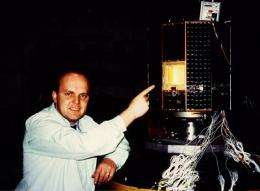
Heinrich Iglseder shows the dust detector mounted on the German 63 kg Bremsat microsatellite before launch from the Space Shuttle in 2004. The objective was to measure dust particles in low orbit. Credits: H. Iglseder

There’s just about nowhere that state-of-the-art space technologies cannot reach – from the martian atmosphere to those hard-to-clean spots under the couch. The search for space dust is giving us cleaner homes.

Just ask Heinrich Iglseder, the Austrian scientist who created a technique to study in that is now being used in a super-efficient Miele household .

“Dust particles in space are very important to get information about how matter is generated in the cosmos,” explained Dr. Iglseder.

He invented a detector to measure interstellar dust’s chemical composition, speed and direction. It was sent into space three times as part of Japanese and US–German space missions. Thanks to his device, these missions identified ‘dust tails’ in space, where dust was concentrated at levels 100 to 1000 times higher than usual.
Cleaning up with space tech
Enlarge

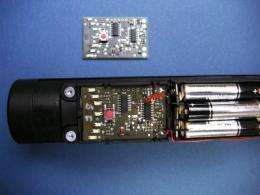
Heinrich Iglseder adapted his space sensor for a regular vacuum cleaner. The sensor is mounted in the extension tube and its electronics are mounted in the vacuum cleaner handle. Credits: H. Iglseder

This is important to know because high-speed space dust can seriously damage satellite parts such as solar cells.

But there are other reasons to study space dust. “Interstellar particles are the seeds for human biological life,” explained Dr. Iglseder.

Dust is a health problem
 
Here on Earth, dust – particularly the super-fine particles generated from human activities like diesel engine combustion – can have a deeply negative effect on people’s health.

“I have friends suffering from allergies,” Dr. Iglseder said. “They came to me and said, 'can’t you do something about this problem?'”
 
As a result, he started looking into ways to reduce dust in people’s homes, and the biggest problem he found was the carpets.

“Poisons like lead and cadmium, toxic particles and carcinogens accumulate in carpets. To get a hygienic environment, it’s absolutely necessary to clean the floors well.”

So Dr. Iglseder adapted his space sensor for a regular vacuum cleaner. Colored lights let you know if the area you are cleaning is actually dust-free, or still needs more work.

Miele incorporated this Allergotec Hygiene Sensor into their Medicair vacuum cleaner, geared towards people with allergies.

“I think it’s really practical,” said Miele press spokeswoman Reinhild Portmann of the straight-from-space technology.

“You have an objective measurement of how clean the floors are.”
Cleaning up with space tech
Enlarge

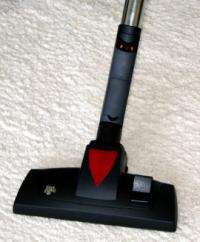
Miele household vacuum cleaner with dust detector in extension tube handle. Credits: H. Iglseder

Frank M. Salzgeber, Head of the ESA Technology Transfer Program Office, adds: “To foster more of those kinds of transfers in Austria from space to non-space, we are now teaming up with the Austrian Research Promotion Association to establish the national Austrian Technology Transfer Program initiative.”

“I expect that we will soon find more exciting projects and innovative transfers from Austrian companies.”
 
‘Green’ for all dust taken
 
Dr. Igelseder admits that it’s his wife who does the lion’s share of the vacuuming around their house – but says she likes the sensor.

Mounted in the vacuum cleaner manifold, his sensor checks the amount of dust passing. ‘Traffic lights’ on the nozzle show red for ‘still too much dust’, orange for ‘medium’, yellow for ‘slightly’ and green for ‘no more dust’.

“With the sensor, she can see that, in some areas, it’s clean after one or two strokes. In other areas, five or six strokes might be needed. She tells me she wouldn’t like to clean without the sensor now.”

Provided by European Space Agency search and more info website


Rank not rated yet
Relevant PhysicsForums posts

More news stories

Browser wars flare in mobile space

The browser wars are heating up again, but this time the fight is for dominance of the mobile Internet.

Technology / Software

created 12 hours ago | popularity 5 / 5 (1) | comments 3

Probability of contamination from severe nuclear reactor accidents is higher than expected: study

Catastrophic nuclear accidents such as the core meltdowns in Chernobyl and Fukushima are more likely to happen than previously assumed. Based on the operating hours of all civil nuclear reactors and the number ...

Technology / Energy & Green Tech

created May 22, 2012 | popularity 3.6 / 5 (22) | comments 56 | with audio podcast

HyperSolar shows dirty water no barrier to power world

(Phys.org) -- The Santa Barbara, California, company, HyperSolar, is set to transparently share the ups and downs of its research experiences toward the company’s ultimate vision, successfully producing ...

Technology / Energy & Green Tech

created May 24, 2012 | popularity 4.8 / 5 (16) | comments 17 | with audio podcast report

SpotterRF debuts Radar Backpack Kit (w/ Video)

(Phys.org) -- SpotterRF has announced a special radar backpack kit designed to enhance situational awareness for soldiers on the ground. The company says its special radar is designed for warfighters as part ...

Technology / Hi Tech & Innovation

created May 26, 2012 | popularity 5 / 5 (5) | comments 13 | with audio podcast report

Tesla to launch electric sedan in US on June 22

Tesla Motors said Tuesday it would begin deliveries of "the world's first premium electric sedan" on June 22, slightly ahead of schedule.

Technology / Energy & Green Tech

created May 22, 2012 | popularity 4.5 / 5 (12) | comments 18


Nvidia trumpets Tegra 3 phone design wins for 2012

(Phys.org) -- Nvidia’s competitive war paint has a name, Tegra 3. On the heels of Nvidia announcements about lowering costs of its Tegra 3 processors and Nvidia-enabled tablets running Android Ice Cream ...

'Unzipped' carbon nanotubes could help energize fuel cells, batteries

Multi-walled carbon nanotubes riddled with defects and impurities on the outside could replace some of the expensive platinum catalysts used in fuel cells and metal-air batteries, according to scientists at ...

T cells 'hunt' parasites like animal predators seek prey, study shows

By pairing an intimate knowledge of immune-system function with a deep understanding of statistical physics, a cross-disciplinary team at the University of Pennsylvania has arrived at a surprising finding: T cells use a movement ...

Computer model used to pinpoint prime materials for efficient carbon capture

When power plants begin capturing their carbon emissions to reduce greenhouse gases – and to most in the electric power industry, it's a question of when, not if – it will be an expensive undertaking.

Change in developmental timing was crucial in the evolutionary shift from dinosaurs to birds: study

At first glance, it's hard to see how a common house sparrow and a Tyrannosaurus Rex might have anything in common. After all, one is a bird that weighs less than an ounce, and the other is a dinosaur that ...

Land and sea species differ in climate change response: study

(Phys.org) -- Marine and terrestrial species will likely differ in their responses to climate warming, new research by Simon Fraser University and Australia’s University of Tasmania has found.