Rapid profiling of drug candidates
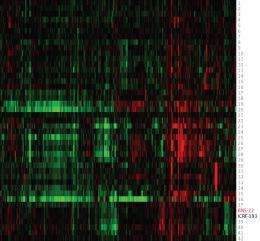
Figure 1: A heat map of protein production (columns) by cancer cells treated with BNS-22 and 42 different anticancer drugs (rows). BNF-22 and ICRF-193 have matching profiles. Proteins with increased levels of expression are colored red, and those with reduced levels are green. Credit: Reproduced, with permission, from Ref. 2 © 2011 Elsevier Inc.
In the hunt for new medicines, any technique that expedites drug candidates into the clinic is a welcome advance. A team led by Hiroyuki Osada at the RIKEN Advanced Science Institute, Wako, recently developed a faster way to unravel the mode of action of experimental anticancer drugs, an essential step in the drug development pathway. The teamincluding RIKEN researchers Makoto Kawatani and Makoto Muroiis now using this so-called proteomic profiling technique to assess new drug leads, including a promising compound dubbed BNS-22.
Like many drug candidates, BNS-22 was developed from a natural compound. In this case, Osada and his colleagues derived BNS-22 from a compound named GUT-70, which other researchers had isolated from the Brazilian plant Calophyllum brasiliense. Since tests with GUT-70 on a culture of cancer cells revealed some activity in killing these cells, Osada and team decided to synthesize a range of closely related compounds that might exert stronger anticancer activity.
Traditionally, assessing the usefulness of novel anticancer compounds and how they work was a time-consuming process, often giving ambiguous results. Osada and his colleagues improved this process using their proteomic profiling technique, which maps protein production in cancerous cells. As cellular conditions change, including administration of an anticancer drug, so does the range of proteins that the cells produce.
To assess BNS-22, the researchers first mapped the proteomic profiles of 42 anticancer compounds with well-established modes of action. They then compared the proteomic profile of BNS-22 to this library of profiles, using a heat map to identify any matches (Fig. 1). Matching profiles indicate that two compounds have the same mode of action.
Osada and colleagues found that BNS-22 matches the profile of ICRF-193, a compound known to inhibit an enzyme called TOP2. This enzyme is essential for numerous cellular processes, and is a good target for anticancer drugs. Surprisingly, the findings also show that BNS-22 works in a different way from GUT-70, despite its very similar structure. In the process of [creating derivatives of] compounds, single structural differences frequently cause a loss of activity, Kawatani and Muroi explain. However, the team was fortunate enough to find a promising drug candidate.
To further improve the accuracy of their proteomic profiling approach, the researchers plan to further analyze their protein maps and identify significant changes in the expression of specific proteins in response to a drug. They also plan to use this technique to re-assess RIKENs library of natural products for new drug leads.
More information: Muroi, M., et al. Application of proteomic profiling based on 2D-DIGE for classification of compounds according to the mechanism of action. Chemistry & Biology 17, 460470 (2010).
Kawatani, M., et al. Identification of a small-molecule inhibitor of DNA topoisomerase II by proteomic profiling. Chemistry & Biology 18, 743751 (2011).
Provided by
RIKEN
-
From lemons to lemonade: Reaction uses carbon dioxide to make carbon-based semiconductor,
32 comments
-
Thioridazine kills cancer stem cells in human while avoiding toxic side-effects of conventional cancer treatments,
3 comments
-
SpaceX private rocket blasts off for space station (Update),
42 comments
-
Climate scientists say they have solved riddle of rising sea,
31 comments
-
SpaceX capsule has 'new car' smell, astronauts say (Update),
4 comments
-
Gibbs Free Energy Change/Entropy
9 hours ago
-
What's the rule to covalent character
10 hours ago
-
Schwartz reagent-- NMR/MS/IR
May 26, 2012
-
High school chemistry EEI
May 25, 2012
-
oxidation of I- by KMnO4
May 25, 2012
-
Inversion temp
May 25, 2012
- More from Physics Forums - Chemistry
More news stories
Computer model used to pinpoint prime materials for efficient carbon capture
When power plants begin capturing their carbon emissions to reduce greenhouse gases and to most in the electric power industry, it's a question of when, not if it will be an expensive undertaking.
2 hours ago |
not rated yet |
0
|
Scientists develop ultra-sensitive test that detects diseases in their earliest stages
Scientists have developed an ultra-sensitive test that should enable them to detect signs of a disease in its earliest stages, in research published today in the journal Nature Materials.
Chemistry / Analytical Chemistry
2 hours ago |
not rated yet |
0
|
New CO2-removing catalyst can take the heat
(Phys.org) -- The current method of removing the greenhouse gas carbon dioxide (CO2) from the flues of coal-fired power plants uses so much energy that no one bothers to use it. So says Roger Aines, principal ...
May 24, 2012 |
5 / 5 (9) |
10
|
High-speed method to aid search for solar energy storage catalysts
Eons ago, nature solved the problem of converting solar energy to fuels by inventing the process of photosynthesis.
May 25, 2012 |
5 / 5 (3) |
4
|
Researchers demonstrate possible primitive mechanism of chemical info self-replication
(Phys.org) -- When scientists think about the replication of information in chemistry, they usually have in mind something akin to what happens in living organisms when DNA gets copied: a double-stranded molecule ...
May 25, 2012 |
5 / 5 (4) |
2
|
Land and sea species differ in climate change response: study
(Phys.org) -- Marine and terrestrial species will likely differ in their responses to climate warming, new research by Simon Fraser University and Australia’s University of Tasmania has found.
Almost half of new vets seek disability
(AP) -- America's newest veterans are filing for disability benefits at a historic rate, claiming to be the most medically and mentally troubled generation of former troops the nation has ever seen.
'Unzipped' carbon nanotubes could help energize fuel cells, batteries
Multi-walled carbon nanotubes riddled with defects and impurities on the outside could replace some of the expensive platinum catalysts used in fuel cells and metal-air batteries, according to scientists at ...
T cells 'hunt' parasites like animal predators seek prey, study shows
By pairing an intimate knowledge of immune-system function with a deep understanding of statistical physics, a cross-disciplinary team at the University of Pennsylvania has arrived at a surprising finding: T cells use a movement ...
Change in developmental timing was crucial in the evolutionary shift from dinosaurs to birds: study
At first glance, it's hard to see how a common house sparrow and a Tyrannosaurus Rex might have anything in common. After all, one is a bird that weighs less than an ounce, and the other is a dinosaur that ...
Yale study concludes public apathy over climate change unrelated to science literacy
Are members of the public divided about climate change because they don't understand the science behind it? If Americans knew more basic science and were more proficient in technical reasoning, would public consensus match ...