Engineering professor develops 'superlaminate' industrial pipe repair system
September 13, 2011

Arizona civil engineering professor develops 'superlaminate' industrial pipe repair system

Enlarge

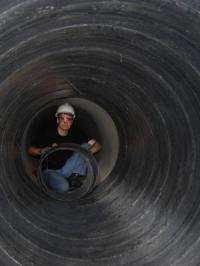
In the innovative PipeMedic repair system developed by University of Arizona civil engineering professor Mo Ehsani, the carbon fabrics of any design (up to a width of 60 inches) are saturated with the resin and run through a special press; the result is a solid "super" laminate with a thickness that can be set from 0.02 to 0.08 inches. Credit: PipeMedic.com

A University of Arizona engineering professor may have a solution to a U.S. infrastructure problem that's growing deadlier each year.

The national Gas Technology Institute (GTI) recently published a test report approving a new technology called PipeMedic that uses carbon and glass laminates to repair and replace failing . GTI is a nonprofit research and development organization serving the natural gas industry.

PipeMedic technology was developed by Mo Ehsani, professor emeritus of civil engineering at the University of Arizona College of Engineering, and a pioneer in the structural application of fiber-reinforced polymers, or FRPs.

Ehsani was a faculty member in the UA department of civil engineering and engineering mechanics for almost 30 years before he left in 2009 to focus on his structural engineering repair business, QuakeWrap, which he founded in 1994. His research at UA had focused on the seismic behavior of structures, and on innovative approaches to repairing and retrofitting civil structures using FRPs.

Ehsani describes PipeMedic as a "superlaminate" because it uses crisscrossing and layers of glass fabric that are saturated with resin, then pressurized and heat-treated to create strips about 0.025 inches thick.

"It works like a stent," Ehsani said. "We coil the laminate around what is essentially a balloon with wheels and insert it into the ." The area to be fixed might be 1,000 feet away from the pipe entry point, Ehsani said, which means that pipe can be treated even if it's buried under buildings or roads.

"When the balloon is at the repair area, we pump in air and the laminate unravels and presses against the pipe," he said. "After the epoxy has dried, we deflate the balloon and remove it."

The superlaminates created at Ehsani's production facility in Tucson, Ariz., are shipped in rolls hundreds of feet long, ready for insertion into leaky pipes. The main advantage of Ehsani's laminates over most current methods is that prefabrication enables them to be strength-tested and gives them rigidity. This allows the laminates to be inserted into pipes in cylindrical coil form, which is retained as the balloon presses the laminate against the inside of the pipe.

Currently, most pipe fixes use the "wet lay-up" method, which involves soaking fiber in resin, applying it manually to the problem area, and waiting for it to set, or cure. Precise control is not possible and the strength of the repair cannot be determined until curing is complete, when samples of the cured fiber-resin can be tested to determine whether the fix is up to specification.

Unlike Ehsani's laminates, the wet fiber-resin mix is too squashy to fix large areas. Health and safety are also a problem with wet lay-up because of harmful volatile organic compounds from the resin and associated accelerators and catalysts.

PipeMedic also has the capability to strengthen pipes, culverts and aqueducts made from steel, cast iron, corrugated metal, clay, brick, concrete, and wood. However, the GTI test showed that this superlaminate could actually replace, rather than strengthen, old pipes.

Utility owners are thinking about the next generation of subsurface pipework. Some want to line all new pipe with extra-thick superlaminates, so that when the external pipe eventually fails, the superlaminate becomes the de facto new pipe, but with no new construction.

"Carbon is much too expensive to construct a half-inch thick superlaminate liner that could withstand soil pressures and traffic loads," Ehsani said. "So we have taken a page from the book of the aerospace industry and built a liner using an internal honeycomb structure." This product, called StifPipe, is already in use in a rain catchment system in Brooklyn Bridge Park in New York.

Provided by University of Arizona College of Engineering

4.9 /5 (8 votes)  

Filter


Move the slider to adjust rank threshold, so that you can hide some of the comments.


Display comments: newest first

Jeddy_Mctedder
Sep 13, 2011

Rank: not rated yet
where exactly is the stiffpipe? anywhere visible? i'm by that park regularly
Roland
Sep 13, 2011

Rank: not rated yet
Steel pipelines are usually inspected and cleaned by specialized robots called "pigs". They come in different sizes for different pipes. How will this stand up to the abrasion from "pigging"? Looks like a good cure for water & sanitary pipelines, which are short and unpressurized, but useless for oil & gas pipelines. This is not the first post-install liner technology.

Rank 4.9 /5 (8 votes)
Relevant PhysicsForums posts

More news stories

Browser wars flare in mobile space

The browser wars are heating up again, but this time the fight is for dominance of the mobile Internet.

Technology / Software

created 9 hours ago | popularity 5 / 5 (1) | comments 3

Probability of contamination from severe nuclear reactor accidents is higher than expected: study

Catastrophic nuclear accidents such as the core meltdowns in Chernobyl and Fukushima are more likely to happen than previously assumed. Based on the operating hours of all civil nuclear reactors and the number ...

Technology / Energy & Green Tech

created May 22, 2012 | popularity 3.6 / 5 (22) | comments 56 | with audio podcast

SpotterRF debuts Radar Backpack Kit (w/ Video)

(Phys.org) -- SpotterRF has announced a special radar backpack kit designed to enhance situational awareness for soldiers on the ground. The company says its special radar is designed for warfighters as part ...

Technology / Hi Tech & Innovation

created May 26, 2012 | popularity 5 / 5 (5) | comments 13 | with audio podcast report

HyperSolar shows dirty water no barrier to power world

(Phys.org) -- The Santa Barbara, California, company, HyperSolar, is set to transparently share the ups and downs of its research experiences toward the company’s ultimate vision, successfully producing ...

Technology / Energy & Green Tech

created May 24, 2012 | popularity 4.8 / 5 (16) | comments 17 | with audio podcast report

Tesla to launch electric sedan in US on June 22

Tesla Motors said Tuesday it would begin deliveries of "the world's first premium electric sedan" on June 22, slightly ahead of schedule.

Technology / Energy & Green Tech

created May 22, 2012 | popularity 4.5 / 5 (12) | comments 18


Land and sea species differ in climate change response: study

(Phys.org) -- Marine and terrestrial species will likely differ in their responses to climate warming, new research by Simon Fraser University and Australia’s University of Tasmania has found.

Almost half of new vets seek disability

(AP) -- America's newest veterans are filing for disability benefits at a historic rate, claiming to be the most medically and mentally troubled generation of former troops the nation has ever seen.

'Unzipped' carbon nanotubes could help energize fuel cells, batteries

Multi-walled carbon nanotubes riddled with defects and impurities on the outside could replace some of the expensive platinum catalysts used in fuel cells and metal-air batteries, according to scientists at ...

T cells 'hunt' parasites like animal predators seek prey, study shows

By pairing an intimate knowledge of immune-system function with a deep understanding of statistical physics, a cross-disciplinary team at the University of Pennsylvania has arrived at a surprising finding: T cells use a movement ...

Computer model used to pinpoint prime materials for efficient carbon capture

When power plants begin capturing their carbon emissions to reduce greenhouse gases – and to most in the electric power industry, it's a question of when, not if – it will be an expensive undertaking.

Change in developmental timing was crucial in the evolutionary shift from dinosaurs to birds: study

At first glance, it's hard to see how a common house sparrow and a Tyrannosaurus Rex might have anything in common. After all, one is a bird that weighs less than an ounce, and the other is a dinosaur that ...