Modern humans interbred with more archaic hominin forms even before they migrated out of Africa: study
September 5, 2011

Modern humans interbred with more archaic hominin forms even before they migrated out of Africa: study

Enlarge

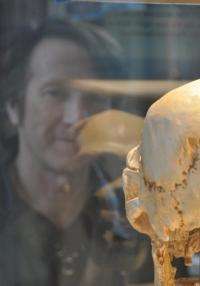
University of Arizona's Michael F. Hammer with an ancient hominid fossil. Credit: M. F. Hammer

It is now widely accepted that the species Homo sapiens originated in Africa and eventually spread throughout the world. But did those early humans interbreed with more ancestral forms of the genus Homo, for example Homo erectus, the "upright walking man," Homo habilis, – the "tool-using man" or Homo neanderthalensis, the first artists of cave-painting fame?

Direct studies of ancient DNA from Neanderthal bones suggest interbreeding did occur after anatomically had migrated from their evolutionary cradle in Africa to the cooler climates of Eurasia, but what had happened in Africa remained a mystery – until now.

In a paper published in the Proceedings of the National Academy of Sciences a team led by Michael Hammer, an associate professor and research scientist with the UA's Arizona Research Labs, provides evidence that anatomically modern humans were not so unique that they remained separate.

"We found evidence for hybridization between modern humans and archaic forms in Africa. It looks like our lineage has always exchanged genes with their more morphologically diverged neighbors," said Hammer, who also holds appointments in the UA's department ofecology and evolutionary biology, the school of anthropology, the BIO5 Institute and the Arizona Cancer Center.

Hammer added that recent advances in molecular biology have made it possible to extract DNA from fossils tens of thousands of years old and compare it to that of modern counterparts.

However, "We don't have fossil DNA from Africa to compare with ours," he said. "Neanderthals lived in colder climates, but the climate in more tropical areas make it very tough for DNA to survive that long, so recovering usable samples from fossil specimens is extremely difficult if not impossible."

"Our work is different from the research that led to the breakthroughs in Neanderthal genetics," he explained. "We couldn't look directly for ancient DNA that is 40,000 years old and make a direct comparison."

To get past this hindrance, Hammer's team followed a computational and statistical approach.

"Instead, we looked at DNA from modern humans belonging to African populations and searched for unusual regions in the genome."

Because nobody knows the DNA sequences of those now extinct archaic forms, Hammer's team first had to figure out what features of modern DNA might represent fragments that were brought in from archaic forms.

"What we do know is that the sequences of those forms, even the Neanderthals, are not that different from modern humans," he said. "They have certain characteristics that make them different from modern DNA."

The researchers used simulations to predict what ancient DNA sequences would look like had they survived within the DNA of our own cells.

"You could say we simulated interbreeding and exchange of genetic material in silico," Hammer said. "We can simulate a model of hybridization between anatomically modern humans and some archaic form. In that sense, we simulate history so that we can see what we would expect the pattern to look like if it did occur."

According to Hammer, the first signs of anatomically modern features appeared about 200,000 years ago.

First, the team sequenced vast regions of human genomes from samples taken from six different populations living in Africa today and tried to match up their sequences with what they expected those sequences to look like in archaic forms. The researchers focused on non-coding regions of the genome, stretches of DNA that do not contain genes, which serve as the blueprints for proteins.

"Then we asked ourselves what does the general pattern of variation look like in the DNA that we sequenced in those African populations, and we started to look at regions that looked unusual," Hammer said. "We discovered three different genetic regions fit the criteria for being archaic DNA still present in the genomes of sub-Saharan Africans. Interestingly, this signature was strongest in populations from central Africa."

The scientists applied several criteria to tag a DNA sequence as archaic. For example, if a DNA sequence differed radically from the ones found in a modern population, it was likely to be ancient in origin. Another telltale sign is how far it extends along a chromosome. If an unusual piece is found to stretch a long portion of a chromosome, it is an indication of being brought into the population relatively recently.

"We are talking about something that happened between 20,000 and 60,000 years ago – not that long ago in the scheme of things," Hammer said. "If interbreeding occurs, it's going to bring in a whole chromosome, and over time, recombination events will chop the chromosome down to smaller pieces. And those pieces will now be found as short, unusual fragments. By looking at how long they are we can get an estimate of how far back the interbreeding event happened."

Hammer said that even though the archaic DNA sequences account for only two or three percent of what is found in modern humans, that doesn't mean the interbreeding wasn't more extensive.

"It could be that this represents what's left of a more extensive archaic genetic content today. Many of the sequences we looked for would be expected to be lost over time. Unless they provide a distinct evolutionary advantage, there is nothing keeping them in the population and they drift out."

In a next step, Hammer's team wants to look for ancient DNA regions that conferred some selective advantage to the anatomically modern humans once they acquired them.

"We think there were probably thousands of interbreeding events," Hammer said. "It happened relatively extensively and regularly."

"Anatomically modern humans were not so unique that they remained separate," he added. "They have always exchanged genes with their more morphologically diverged neighbors. This is quite common in nature, and it turns out we're not so unusual after all."

More information: “Genetic evidence for archaic admixture in Africa,” by Michael Hammer, et al. Proceedings of the National Academy of Sciences (2011).

Provided by University of Arizona search and more info website

4.7 /5 (14 votes)  

Filter


Move the slider to adjust rank threshold, so that you can hide some of the comments.


Display comments: newest first

Onceler37
Sep 05, 2011

Rank: 5 / 5 (3)
I can almost hear the Neandthal woman yelling to her sapien captive "I want Snu Snu!".
typicalguy
Sep 05, 2011

Rank: 5 / 5 (2)
Onceler37, thats funny haha cause you are referencing an obscure episode of Futurama that most people never saw...if they even know what the show is.
hard2grep
Sep 05, 2011

Rank: not rated yet
yep. from clubs to crowbars...
Skepticus
Sep 06, 2011

Rank: not rated yet
This will make racism a nonsense, as everybody seemed to be busily screwing everybody else and propagate with their hybrid offsprings since the dawn of history!
hemitite
Sep 06, 2011

Rank: not rated yet
These would only be the interbreeding activities of our for bearers that we have evidence of...
SteveL
Sep 06, 2011

Rank: 5 / 5 (2)
This will make racism a nonsense, as everybody seemed to be busily screwing everybody else and propagate with their hybrid offsprings since the dawn of history!
While I agree with you, racism has always been nonsense, this research seems based on a lot of speculation. However with what we do know about hominidae there should be no suprise that there is a little this and that in all of our genomes. Racism is just another form of radicalism that has lasted far longer than it should have.
Egleton
Sep 06, 2011

Rank: not rated yet
On the contrary, it will make racism real.
Everyone outside Africa was breeding with Neanderthal.
Everyone in Africa was breeding with a variety of other homo.
That sharpens the divide.
We are different species.
jonnyboy
Sep 06, 2011

Rank: 2.6 / 5 (5)
duh!!!!!!!!!....men will stick it in almost anything unless you are talking about Vendicar who only likes little boys.
Noumenon
Sep 06, 2011

Rank: 4.8 / 5 (26)
How embarrassing. Couldn't they have covered that up.
Noumenon
Sep 06, 2011

Rank: 4.7 / 5 (28)
duh!!!!!!!!!....men will stick it in almost anything unless you are talking about Vendicar who only likes little boys.


"He was active in a number of groups, but apparently after breaking some serious internet posting laws, and someone reporting him, he was tracked down and arrested by police in Canada and charged. I don't have all the particulars. Some people claimed he was an American that left the U.S. and moved to Canada, working as a janitor in the school system of Hamilton, Ontario. He himself made that claim at one time. He hated his own country of the U.S.. so he left it."
complexChemicals
Sep 06, 2011

Rank: not rated yet
The mind is willing but the flesh is weak and spongy!
Rank 4.7 /5 (14 votes)
Relevant PhysicsForums posts

More news stories

Change in developmental timing was crucial in the evolutionary shift from dinosaurs to birds: study

At first glance, it's hard to see how a common house sparrow and a Tyrannosaurus Rex might have anything in common. After all, one is a bird that weighs less than an ounce, and the other is a dinosaur that ...

Other Sciences / Archaeology & Fossils

created 3 hours ago | popularity 5 / 5 (2) | comments 0 | with audio podcast

Social welfare cuts ultimately come with heavy price, researchers say

(Phys.org) -- Slashing government funding for Medicaid, food stamps and other programs that serve the poor – while politically popular with some lawmakers and many conservatives – may do more harm ...

Other Sciences / Social Sciences

created May 24, 2012 | popularity 4.3 / 5 (16) | comments 152

Ancient Bethlehem seal unearthed in Jerusalem

Israeli archaeologists have discovered a 2,700-year-old seal that bears the inscription "Bethlehem," the Israel Antiquities Authority announced Wednesday, in what experts believe to be the oldest artifact ...

Other Sciences / Archaeology & Fossils

created May 23, 2012 | popularity 3.5 / 5 (14) | comments 24

Oldest Jewish archaeological evidence on the Iberian Peninsula

German archaeologists of the Friedrich Schiller University Jena found one of the oldest archaeological evidence so far of Jewish Culture on the Iberian Peninsula at an excavation site in the south of Portugal, ...

Other Sciences / Archaeology & Fossils

created May 25, 2012 | popularity 4.2 / 5 (6) | comments 12

Dollars and sense: Why are some people morally against tax?

As the U.S. presidential election campaigns heat up, the economic debate is dominated by bailouts, austerity and, inevitably, taxation. Now a new study published in Symbolic Interaction asks why tax is such an important issue ...

Other Sciences / Social Sciences

created May 23, 2012 | popularity 3 / 5 (2) | comments 12


Land and sea species differ in climate change response: study

(Phys.org) -- Marine and terrestrial species will likely differ in their responses to climate warming, new research by Simon Fraser University and Australia’s University of Tasmania has found.

'Unzipped' carbon nanotubes could help energize fuel cells, batteries

Multi-walled carbon nanotubes riddled with defects and impurities on the outside could replace some of the expensive platinum catalysts used in fuel cells and metal-air batteries, according to scientists at ...

T cells 'hunt' parasites like animal predators seek prey, study shows

By pairing an intimate knowledge of immune-system function with a deep understanding of statistical physics, a cross-disciplinary team at the University of Pennsylvania has arrived at a surprising finding: T cells use a movement ...

Computer model used to pinpoint prime materials for efficient carbon capture

When power plants begin capturing their carbon emissions to reduce greenhouse gases – and to most in the electric power industry, it's a question of when, not if – it will be an expensive undertaking.

Almost half of new vets seek disability

(AP) -- America's newest veterans are filing for disability benefits at a historic rate, claiming to be the most medically and mentally troubled generation of former troops the nation has ever seen.

Nvidia trumpets Tegra 3 phone design wins for 2012

(Phys.org) -- Nvidia’s competitive war paint has a name, Tegra 3. On the heels of Nvidia announcements about lowering costs of its Tegra 3 processors and Nvidia-enabled tablets running Android Ice Cream ...