Opportunity begins study of martian crater, new samples 'unlike any seen before'
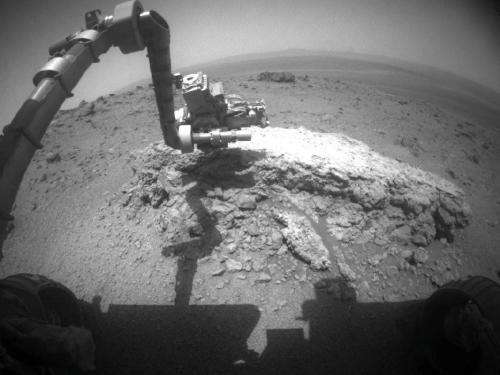
NASA's Mars Exploration Rover Opportunity used its front hazard-avoidance camera to take this picture showing the rover's arm extended toward a light-toned rock, "Tisdale 2," during the 2,695th Martian day, or sol, of the rover's work on Mars (Aug. 23, 2011). Tisdale 2 is about 12 inches (30 centimeters) tall. Image Credit: NASA/JPL-Caltech
(PhysOrg.com) -- The initial work of NASA's Mars rover Opportunity at its new location on Mars shows surface compositional differences from anything the robot has studied in its first 7.5 years of exploration.
Opportunity arrived three weeks ago at the rim of a 14-mile-wide (22-kilometer-wide) crater named Endeavour. The first rock it examined is flat-topped and about the size of a footstool. It was apparently excavated by an impact that dug a crater the size of a tennis court into the crater's rim. The rock was informally named "Tisdale 2."
"This is different from any rock ever seen on Mars," said Steve Squyres, principal investigator for Opportunity at Cornell University in Ithaca, N.Y. "It has a composition similar to some volcanic rocks, but there's much more zinc and bromine than we've typically seen. We are getting confirmation that reaching Endeavour really has given us the equivalent of a second landing site for Opportunity."
The diversity of fragments in Tisdale 2 could be a prelude to other minerals Opportunity might find at Endeavour. In the past two weeks, researchers have used an instrument on the rover's robotic arm to identify elements at several spots on Tisdale 2. Scientists have also examined the rock using the rover's microscopic imager and multiple filters of its panoramic camera.
Observations by Mars orbiters suggest that rock exposures on Endeavour's rim date from early in Martian history and include clay minerals that form in less-acidic wet conditions, possibly more favorable for life. Discontinuous ridges are all that remains of the ancient crater's rim. The ridge at the section of the rim where Opportunity arrived is named "Cape York." A gap between Cape York and the next rim fragment to the south is called "Botany Bay."
"On the final traverses to Cape York, we saw ragged outcrops at Botany Bay unlike anything Opportunity has seen so far, and a bench around the edge of Cape York looks like sedimentary rock that's been cut and filled with veins of material possibly delivered by water," said Ray Arvidson, the rover's deputy principal investigator at Washington University in St. Louis. "We made an explicit decision to examine ancient rocks of Cape York first."
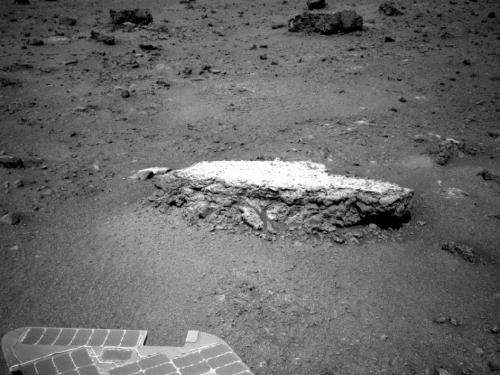
NASA's Mars Exploration Rover Opportunity used its navigation camera to take this picture showing a light-toned rock, "Tisdale 2," during the 2,690th Martian day, or sol, of the rover's work on Mars (Aug. 18, 2011). The rock is about 12 inches (30 centimeters) tall. Image Credit: NASA/JPL-Caltech
The science team selected Endeavour as Opportunity's long-term destination after the rover climbed out of Victoria crater three years ago this week. The mission spent two years studying Victoria, which is about one twenty-fifth as wide as Endeavour. Layers of bedrock exposed at Victoria and other locations Opportunity has visited share a sulfate-rich composition linked to an ancient era when acidic water was present. Opportunity drove about 13 miles (21 kilometers) from Victoria to reach Endeavour. It has driven 20.8 miles (33.5 kilometers) since landing on Mars."We have a very senior rover in good health for having already worked 30 times longer than planned," said John Callas, project manager for Opportunity at NASA's Jet Propulsion Laboratory in Pasadena, Calif. "However, at any time, we could lose a critical component on an essential rover system, and the mission would be over. Or, we might still be using this rover's capabilities beneficially for years. There are miles of exciting geology to explore at Endeavour crater."
Opportunity and its rover twin, Spirit, completed three-month prime missions in April 2004 and continued working for years of extended missions. Both have made important discoveries about wet environments on ancient Mars that may have been favorable for supporting microbial life. Spirit ended communications in March 2010.
"This is like having a brand new landing site for our veteran rover," said Dave Lavery, program executive for NASA's Mars Exploration Rovers at NASA Headquarters in Washington. "It is a remarkable bonus that comes from being able to rove on Mars with well-built hardware that lasts."
NASA will launch its next-generation Mars rover, Curiosity, between Nov. 25 and Dec. 18, 2011. It will land on Mars in August 2012. JPL, a division of the California Institute of Technology in Pasadena, manages the Mars Exploration Rover Project for NASA's Science Mission Directorate in Washington.
Provided by
JPL/NASA
-
From lemons to lemonade: Reaction uses carbon dioxide to make carbon-based semiconductor,
32 comments
-
Thioridazine kills cancer stem cells in human while avoiding toxic side-effects of conventional cancer treatments,
3 comments
-
SpaceX private rocket blasts off for space station (Update),
42 comments
-
Climate scientists say they have solved riddle of rising sea,
31 comments
-
SpaceX capsule has 'new car' smell, astronauts say (Update),
4 comments
-
Distance of planets from stars and revolution
3 hours ago
-
revamping general concept and cosmological principle
May 25, 2012
-
Transiting Exoplanet Light Curve
May 25, 2012
-
Math behind Theoretical Physics
May 24, 2012
-
Do we know whats at the center of galaxies yet?
May 23, 2012
-
Structure of the Milky Way?
May 20, 2012
- More from Physics Forums - General Astronomy
More news stories
Land and sea species differ in climate change response: study
(Phys.org) -- Marine and terrestrial species will likely differ in their responses to climate warming, new research by Simon Fraser University and Australia’s University of Tasmania has found.
1 hour ago |
not rated yet |
1
|
Yale study concludes public apathy over climate change unrelated to science literacy
Are members of the public divided about climate change because they don't understand the science behind it? If Americans knew more basic science and were more proficient in technical reasoning, would public consensus match ...
3 hours ago |
4 / 5 (1) |
10
|
10 million years needed to recover from mass extinction
It took some 10 million years for Earth to recover from the greatest mass extinction of all time, latest research has revealed.
Space & Earth / Earth Sciences
3 hours ago |
not rated yet |
1
|
Sophisticated simulations predict future warming
The chances of our planet being hit by a global warming of 3 degrees Celsius by 2050 is as likely as it being hit by an increase of 1.4 degrees, new research shows. Presented in the journal Nature Geoscience, the British study ...
Space & Earth / Earth Sciences
May 22, 2012 |
4.4 / 5 (9) |
51
Aliens don't want to eat us, says former SETI director
Alien life probably isnt interested in having us for dinner, enslaving us or laying eggs in our bellies, according to a recent statement by former SETI director Jill Tarter.
Space & Earth / Space Exploration
May 25, 2012 |
4.4 / 5 (14) |
39
'Unzipped' carbon nanotubes could help energize fuel cells, batteries
Multi-walled carbon nanotubes riddled with defects and impurities on the outside could replace some of the expensive platinum catalysts used in fuel cells and metal-air batteries, according to scientists at ...
T cells 'hunt' parasites like animal predators seek prey, study shows
By pairing an intimate knowledge of immune-system function with a deep understanding of statistical physics, a cross-disciplinary team at the University of Pennsylvania has arrived at a surprising finding: T cells use a movement ...
Computer model used to pinpoint prime materials for efficient carbon capture
When power plants begin capturing their carbon emissions to reduce greenhouse gases and to most in the electric power industry, it's a question of when, not if it will be an expensive undertaking.
Change in developmental timing was crucial in the evolutionary shift from dinosaurs to birds: study
At first glance, it's hard to see how a common house sparrow and a Tyrannosaurus Rex might have anything in common. After all, one is a bird that weighs less than an ounce, and the other is a dinosaur that ...
Almost half of new vets seek disability
(AP) -- America's newest veterans are filing for disability benefits at a historic rate, claiming to be the most medically and mentally troubled generation of former troops the nation has ever seen.
Nvidia trumpets Tegra 3 phone design wins for 2012
(Phys.org) -- Nvidias competitive war paint has a name, Tegra 3. On the heels of Nvidia announcements about lowering costs of its Tegra 3 processors and Nvidia-enabled tablets running Android Ice Cream ...

Sep 02, 2011
Rank: 3.3 / 5 (3)
Sep 02, 2011
Rank: 3.9 / 5 (7)
Yes. That is very unreasonable.
Landing a bot (or anything else) from orbit isn't trivial (at least if you want to have anything left that is more than a chunk of burnt up, warped metal). This takes a lot of packaging per landing (read: weight). So a swarm of bots is out of the question.
Sep 02, 2011
Rank: 3.2 / 5 (5)
http://web.mit.ed...ots.html
Sep 02, 2011
Rank: 4 / 5 (7)
The instruments you want to bring along to do precision testing have a certain size. Sure you could put 1000 balls into the drop vehicle - but what would they provide beyond pretty pictures? When you go down there it's better to have one state-of-the-art instrument along instead of 1000 cheap gadgets with no resuoltion to any of their instruments.
We're dealing with SCIENTIFIC missions here - not PR stunts.
Sep 02, 2011
Rank: 4.5 / 5 (4)
Those ball probes don't seem realistic in the near future. The cost of getting to mars is too high to waste a launch on low-value sensors. They don't even have an experimental prototype yet. Let's see them tested here on Earth before you start claiming that it's possible to do this on Mars. For now, as Antialias correctly stated, there's no practical way to send a swarm of robots to mars. This just doesn't exist yet.
Sep 02, 2011
Rank: 4 / 5 (4)
I'd like to point out that NASA is veeeeery careful in building their landers for mars. And lucky lucky lucky. It may seem like a walk in the park, but in fact, NASA is the only organization to have a better than 50% success rate to land something on mars. Consider that. That's why Nasa spends so much effort on each lander, rather than sending a bunch, because if they made landers like chinese toys, all the landers would break like chinese toys.
What do you think the chances are that opportunity takes pictures of the first martian astronaut? I hear an energizer commercial coming.
Sep 02, 2011
Rank: 5 / 5 (3)
Just scroll down that list and check out anything with a 'lander' element. Note that even most of the 'successful landings' were mission failures as the landers broke almost immediately afterwards.
Sep 02, 2011
Rank: 4.2 / 5 (6)
If there was one thing that I would defer to NASA's expertise on, putting something on the surface of mars would be it.
Sep 02, 2011
Rank: 3 / 5 (2)
These rovers could carry sligtly different probes, depending on where they are to land. If one compares the scientific value of a man walking aroud for maybe a week or two, to say, 12 Opportunities roving for 7 years each (total 84 years!!), I think it becomes a no-brainer which gives more bang for the buck.
Of course, politicians need to one-up the Russians, the Chinese, and the Indians. But now that the Cold War is fading into memory, this kind of thinking seems dinosaurian.
Sep 02, 2011
Rank: 1 / 5 (2)
MIT says a swarm is certainly worth considering for mars exploration.
Flocks of these are also being considered. Flocks are similar to swarms.
http://www.spaced...04a.html
Sep 02, 2011
Rank: 1 / 5 (2)
"The [lava] tubes could be entered through holes that formed on the Mars surface where sections of the tubes have collapsed, but these formations are too treacherous for today's rovers to explore. However, tiny bouncing probes could make their way inside the caves."
"Mars also features canyons that could have once had rivers flowing through them. The canyons, too, are inaccessible to rovers, but small probes might be able to make their way down the canyon faces."
-ETC
Sep 02, 2011
Rank: 2.3 / 5 (3)
"Dubowsky's team plans to test prototypes on Earth this fall and estimates that a trip to Mars is about 10 years away."-Except that antialias didnt assign his pronouncement a timeframe:...and so you doing it for him ex-post-factoid is disingenuous and easily disregarded.-So thats 3 of you who got it wrong. Otto will usually tend to side with the actual professionals who are developing these things using govt money. For NASA.
http://www.univer...balloon/
Sep 02, 2011
Rank: 3.7 / 5 (3)
Honestly though, the main reason I support that idea is because I'd like to say we conquered mars with guns.
Sep 02, 2011
Rank: not rated yet
Otto, I could see how a balloon might have some benefits (Mobility, good position for atmospheric sampling), but the balls are a different story. Each ball probe is basically a sensor in a shell. Each shell constitutes packaging weight, and a significan one at that. Also, they will still need a re-entry vehicle to get to the surface - so if you want to explore multiple places, you will need multiple re-entry vehicles. Then there's the part about locomotion after the balls have stopped bouncing. You are talking about a very significant weight increase per data gained. Rovers may be limited on certain levels, but they can keep moving, and find new targets after landing.
A couple balloons might be a good idea, but that wasn't mentioned in your first point. I find it disingenuous for you to misdirect like that. Even there, your sensor balls would have true potential for a single mission at best.
Sep 02, 2011
Rank: not rated yet
Sep 02, 2011
Rank: 1 / 5 (1)
"MIT engineers and scientist colleagues have a new vision for the future of Mars exploration: a swarm of probes, each the size of a baseball, spreading out across the planet in every direction."
-Sum total of effort = assume 1 man/year, plus considerable computer time.
I suggest you reread the article I posted and see how many of your objections were addressed in it (all of them). Jesus. Have you left your chair today I wonder?
Sep 02, 2011
Rank: 1 / 5 (1)
"A future Mars mission could include instruments attached to balloons"
-As well as suggesting to your fellow somnambulant antialias that GOOGLE can be a valuable tool for independent research?
Sep 02, 2011
Rank: 5 / 5 (1)
*facepalm*...ever considered that other parts of the world have different time zones?
Not every person on this planet with an internet connection lives in the US (despite what the media may tell you about the cavemanlike conditions outside its borders).
Missions have a certain purpose: bringing the best possible data back. Lots of low quality data isn't better than a bit less high quality data. When doing scientific missions we should get the best data we can - not the most.
Sep 02, 2011
Rank: 5 / 5 (2)
As for NASA considering the balls, balloons, etc. NASA considers a lot of different mission profiles, but that doesn't mean that it will implement impractical ones.
Swarm or flock missions have not been done yet specifically because they are so impractical to implement when you have strenuous weight requirements and difficult environments. They have been considered and rejected, and will for a long time.
You mentioned the balloons AFTER the balls and did not connect the 2. They are completely different things. Defending one thing with another completely unrelated thing is disingenuous.
I gave you the benefit of the doubt, and considered that combining the balls and balloons idea could present a single practical mission profile with the balloons carrying a handful of balls to drop
Sep 02, 2011
Rank: 5 / 5 (3)
Sep 02, 2011
Rank: 1 / 5 (1)
Like I just told your soporific pal, people from MIT and Stanford devised the ball concept for what I'm sure are a number of very good reasons. Shouldn't you maybe be asking 'I wonder WHY these experts came up with this design?' -rather than disregarding their expertise and substituting your own conspicuous lack of clue.
Sep 02, 2011
Rank: 1 / 5 (1)
-So I suppose you're going to keep making ignorant statements until I've posted the whole article here. Otto suspects he is being played like a fishy by couch-anglers.
Sep 02, 2011
Rank: 1 / 5 (1)
Sep 04, 2011
Rank: 5 / 5 (1)
And how do you propose to broadcast from underneath the surface? With such tiny units?
To do any geological science we'd need to land them and have them take off again without the deflating balloon
- covering the experiment
- covering the antenna
- getting entangled
- getting damaged
... and with no agency to help a tangled balloon on Mars that is a lot of uncalculable risks.
Sep 04, 2011
Rank: not rated yet
http://www.nasa.g...696.html
Sep 05, 2011
Rank: not rated yet
Well of course - germans were working on this since at least before 10 years already.
http://www.spacer...pid=4481
Uber alles. Graf Zeppelin.
"Eventually, a large aeroshell could fall into the Martian atmosphere containing nothing but a balloon. This would be a much larger, longer-lasting craft with navigational control. Such a balloon could perform the long-expected sky to ground tour, deflating at night to visit the surface, and inflating with solar heat during the day to lift off again."
Sep 05, 2011
Rank: not rated yet
Anything 'flexible' is a great risk because you can't precalculate what it's going to do or if it's going to snag on something if you do land it. The advantage of a rover is that you can stop, plan, and 15 minutes later when your commands arrive it will still be in the same spot/situation.
The only real use of a balloon will be high resolution pics - something we already have from the ground and space. So this would give us only intermediate level information.
Oh, I have plenty of faith in engineers. Its just that the best/least risky proposal is the one that should win. At those prices we can't afford too many "oh well - better luck next time" missions.
Sep 06, 2011
Rank: not rated yet
From the Mars wiki page -
Mars gravity is 39% of Earth's gravity, which somewhat offsets the low pressure, but balloons on Mars would have a very low payload capacity, even with an extremely large balloon. The max altitude of such a balloon would be extremely limited as well. I wouldn't think it would be practical for much more than exploring the deepest canyons, but don't expect a very long mission lifetime. Maintaining line of sight for broadcasting results back to an orbiter also becomes a problem inside a canyon.
In summary, a balloon is a high risk, low return mission, with just as much cost as any other robotic mission. I would favor exhausting the potential of ground rovers before spending time and money on less effective methods. Same goes for microprobes.