Review: Livescribe smartpen is iPad's opposite
September 14, 2011 By PETER SVENSSON , AP Technology Writer
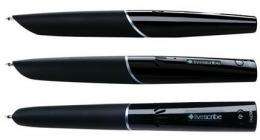
This product image provided by Livescribe, shows three views of the Livescribe Echo smartpen. (AP Photo/Livescribe)
Here's a consumer electronics riddle: What's the opposite of the iPad? Answer: the Livescribe Echo "smartpen." It's as if Livescribe and Apple both looked at the old pen-and-pad combination, but completely disagreed on how to take it into the digital age.
Apple put all the smarts into the pad. Livescribe put all the smarts in the pen.
I don't have to tell you which is the better idea - iPad sales have helped make Apple Inc. the most valuable company in the world. Livescribe is tiny.
But the Echo is interesting enough to be worth a look, particularly with some recent software updates. It starts at $100, making it more affordable than the iPad, and it could be a good tool for a student.
The Echo is a fat, cigar-like pen with a small screen near the top. It works as a regular ball-point pen, leaving ink marks on paper. But its reason for being is that it records what you write, and its microphone records what you're hearing at the same time.
It matches up the audio recording with the recorded writing, so that if you tap the pen on something you've already written, it will play back the audio recording, either through its built-in speaker or through headphones. This is useful in almost any situation where you want to record something for future reference, be it a lecture or an interview.
Certainly, you can do the same thing on the iPad, with apps that match up audio and writing. But writing on the iPad isn't easy. Styluses are awkward, and typing on the screen is not much better. You can use a PC instead - Microsoft's excellent OneNote application records audio and typing - but you need to sit down to use a PC, and their microphones can be iffy.
So, the Echo is still the best tool for note-taking, particularly when you're standing or when hammering away at a PC would seem rude, like in a meeting. I used Livescribe's earlier model, the Pulse, quite a bit in my reporting job, and found the ability to tap back into a conversation to get a verbatim quote useful on several occasions. (In the old days, reporters used to learn shorthand. Today, we scribble furiously.)
The Echo improves on the Pulse by replacing proprietary audio and data ports with a standard headphone and micro-USB port. The USB port also charges the pen.
On the software side, the pen now "talks" better to other programs. For instance, you can mark pages and have them sent in an email as soon as you connect your pen to your computer. You can also send them to Google Docs, for sharing, or to OneNote, to keep your notes tidy. You can also post them on Facebook, perhaps for sharing lecture notes with friends. The writing looks good on screen - much better than it would look if you simply wrote on a pad, then scanned or photographed it.
There's also an "app store" where you can buy little programs to download to the pen. One lets you measure the distance between two points on the pad, or compute the area of an enclosed space.
The coolest app, by far, is a version of the classic text-based adventure game "Zork." It's a pretty magical experience to write commands like "go north" and see replies like "You are in a clearing ..." scroll by on the pen's screen.
Another app lets the pen control your PC's cursor when connected by cable. Hover over the pad, and the cursor moves. Press down, and you register a click, or draw on the screen. It's equivalent to Wacom's PC input tablets, but it doesn't register different degrees of pressure, so it's unlikely to be useful to artists.
Speaking of pads, you do need a special pad to use the Echo. It works only on paper that's preprinted with a pattern of dots that looks like a faint speckling of the page. The dots are picked up by a small camera in the pen and allow it to figure out where it is on a page. You can buy a four-pack of additional notebooks from the site for $19.95 (one small notebook comes with the pen). It's also possible to print your own dotted paper if you have a color laser printer.
The biggest drawback to the pen is its tiny screen. It's not that hard to control this "pen computer" - you write things, and it responds. But it has a really hard time communicating anything back, since its screen shows less than 25 characters at time, in monochrome. It can also talk to you through its little speaker, but that's not a medium that can convey the complexity of a Web page. Even a phone screen can communicate a lot more.
The other big shortcoming is that the pen needs to be physically connected to your computer to send email, upload notes or control your cursor. A short-range wireless link like Bluetooth would be neat, but might not be fast enough to transfer notes. Wi-Fi would be better, but getting a pen to work well with Wi-Fi would be a big challenge, both in terms of the user interface and battery life.
I like the Livescribe pens and find them useful. But as computers, they are a dead end. They're just not flexible enough to be general-purpose devices, like tablets. An iPad that worked well with pen input would make me drop the Echo. Apple's competitors already have rudimentary pen-based tablets out, and who knows, maybe the iPad 3 will have some surprises for us.
©2011 The Associated Press. All rights reserved. This material may not be published, broadcast, rewritten or redistributed.
-
From lemons to lemonade: Reaction uses carbon dioxide to make carbon-based semiconductor,
32 comments
-
Thioridazine kills cancer stem cells in human while avoiding toxic side-effects of conventional cancer treatments,
3 comments
-
SpaceX private rocket blasts off for space station (Update),
42 comments
-
Climate scientists say they have solved riddle of rising sea,
31 comments
-
SpaceX capsule has 'new car' smell, astronauts say (Update),
4 comments
-
Need a rigid insulation material???
18 hours ago
-
magnets or EMF in car bumpers to protect from fender bender
May 26, 2012
-
length of wire in a coil of known dimensions?
May 25, 2012
-
India Engineering Powerhouse
May 25, 2012
-
electromagnet core dereference between hard and soft iron
May 25, 2012
-
Measuring water pressure in an open tank
May 24, 2012
- More from Physics Forums - General Engineering
More news stories
Nvidia trumpets Tegra 3 phone design wins for 2012
(Phys.org) -- Nvidias competitive war paint has a name, Tegra 3. On the heels of Nvidia announcements about lowering costs of its Tegra 3 processors and Nvidia-enabled tablets running Android Ice Cream ...
Dell tablet leak: 10.1-inch display, two-battery choice
(Phys.org) -- Headline after headline talks about vendors tablets in the wings as likely number-one contenders for the iPad. Such claims have justifiably been taken with a grain of salt, considering ...
Nvidia says Kai platform will turn price tide for tablets
(Phys.org) -- In March, Nvidia gave some signs that they were working to lower the cost of their Tegra 3 processors and they suggested consumers might see prices for Android tablets as low as $199. Connect ...
OmniVision tops up sensors for cameras, phones
(Phys.org) -- OmniVision has announced two high-resolution image sensors for the digital still and digital video camera market (DS/DVC) and higher end smartphones. In end-user language, it is a claim for superior ...
MIT researchers devise new means to synchronize a group of robots (w/ Video)
(Phys.org) -- For several years, roboticists have been working out ways to get a group of robots to perform synchronized activities as demonstrated most often in dance routines. Its not just about trying ...
Land and sea species differ in climate change response: study
(Phys.org) -- Marine and terrestrial species will likely differ in their responses to climate warming, new research by Simon Fraser University and Australia’s University of Tasmania has found.
'Unzipped' carbon nanotubes could help energize fuel cells, batteries
Multi-walled carbon nanotubes riddled with defects and impurities on the outside could replace some of the expensive platinum catalysts used in fuel cells and metal-air batteries, according to scientists at ...
T cells 'hunt' parasites like animal predators seek prey, study shows
By pairing an intimate knowledge of immune-system function with a deep understanding of statistical physics, a cross-disciplinary team at the University of Pennsylvania has arrived at a surprising finding: T cells use a movement ...
Computer model used to pinpoint prime materials for efficient carbon capture
When power plants begin capturing their carbon emissions to reduce greenhouse gases and to most in the electric power industry, it's a question of when, not if it will be an expensive undertaking.
Change in developmental timing was crucial in the evolutionary shift from dinosaurs to birds: study
At first glance, it's hard to see how a common house sparrow and a Tyrannosaurus Rex might have anything in common. After all, one is a bird that weighs less than an ounce, and the other is a dinosaur that ...
Almost half of new vets seek disability
(AP) -- America's newest veterans are filing for disability benefits at a historic rate, claiming to be the most medically and mentally troubled generation of former troops the nation has ever seen.
Sep 14, 2011
Rank: not rated yet
Getting any large-ish amount of text into an iPad is a right pain in the a*se unless you want to carry a bluetooth keyboard around with you and, really, that defeats the point of the iPad. However, pixels are by definition "a pattern of dots that looks like a faint speckling"; wouldn't it be great if this pen was able to "see" the pixels and use them instead of (or as well as) the dots on its special paper, and get text straight into the iPad while also doing its voice-recording for later reference?
I'd even shell out to buy one of those combos...
Sep 14, 2011
Rank: not rated yet
Sep 15, 2011
Rank: 5 / 5 (1)
You mean like paper and pencil? Works fine for me.
Sep 15, 2011
Rank: not rated yet
Sep 15, 2011
Rank: 4 / 5 (1)
This is completely unfair to say, Apple was huge long before the iPad came out... reading this really pissed me off actually.
Sep 15, 2011
Rank: not rated yet
Back in the 1970's, when all monitors were CRT's, Popular Electronics published an article how you could build a lightpen that detected where you were on the monitor by the vertical and horizontal timing. It would be harder now, but I can't imagine it being difficult.
Sep 16, 2011
Rank: not rated yet
It's not harder now. Van Eck phreaking works for LCDs just as well as it does for CRTs.
http://en.wikiped...hreaking
Sep 20, 2011
Rank: not rated yet
Also "Text-Browser", "Password Safe", "Tarot Divination", "Swissknife"... are very good apps.