Double jeopardy: Building codes may underestimate risks due to multiple hazards
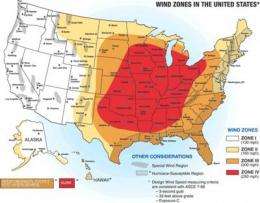
This wind zone map shows how the frequency and strength of extreme windstorms vary across the United States. Wind speeds in Zone IV (red), where the risk of extreme windstorms is greatest, can be as high as 250 miles per hour. Credit: Federal Emergency Management Agency
As large parts of the nation recover from nature's one-two punchan earthquake followed by Hurricane Irenebuilding researchers from the National Institute of Standards and Technology warn that a double whammy of seismic and wind hazards can increase the risk of structural damage to as much as twice the level implied in building codes.
This is because current codes consider natural hazards individually, explains NIST's Dat Duthinh, a research structural engineer. So, if earthquakes rank as the top threat in a particular area, local codes require buildings to withstand a specified seismic load. In contrast, if hurricanes or tornadoes are the chief hazard, homes and buildings must be designed to resist loads up to an established maximum wind speed.
In a timely article published in the Journal of Structural Engineering,* Duthinh, NIST Fellow Emil Simiu and Chiara Crosti (now at the University of Rome) challenge this compartmentalized approach. They show that in areas prone to both seismic and wind hazards, such as South Carolina, the risk that design limits will be exceeded can be as much as twice the risk in regions where only one hazard occurs, even accounting for the fact that these multiple hazards almost never occur simultaneously. As a consequence, buildings designed to meet code requirements in these double-jeopardy locations "do not necessarily achieve the level of safety implied," the researchers write.
Simiu explains by analogy: a motorcycle racer who takes on a second job as a high-wire performer. "By adding this new occupation, the racer increases his risk of injury, even though the timing and nature of the injuries sustained in a motorcycle accident or in a high-wire mishap may differ," he says. "Understandably, an insurer would raise the premium on a personal injury policy to account for the higher level of risk."
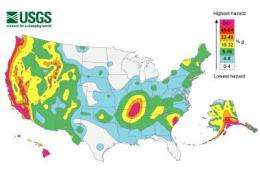
National seismic hazards maps display earthquake ground motions for various probability levels across the United States. These maps are the basis for seismic design provisions of building codes, insurance rate structures, and land-use planning. Credit: US Geological Survey
The researchers developed a method to assess risks due to wind and earthquakes using a common metric of structural resistance. With a consistent measure (the maximum lateral deflection), the combined risk of failure can be compared to the risk that design limits will be exceeded in regions vulnerable to only one of the hazards, the basis for safety requirements specified in current building codes.They demonstrate their approach on three different configurations of a 10-story steel-frame building. One of the configurations used so-called reduced beam sections (RBS) to connect girders to columns. RBS technology was developed after California's Northridge earthquake in 1994, which resulted in significant structural damage in new and old buildings due to unanticipated brittle fractures in frame connections. Shaped like a dog bone, tapered RBS connections made the frames more ductilebetter able to deflect without breaking.
In this case study, the researchers found that RBS connections do not decrease the risk that a steel-frame building will exceed its design limit when used in a region exposed to high winds or a region exposed to high winds and earthquakes. Consequently, the risk of failure doubled under dual-hazard conditions, when those conditions are of similar severity. However, they note that RBS connections can decrease the risk that limits associated with seismic design will be exceeded during the structure's life.
The researchers are continuing to extend their methodology and are proposing modifications to building codes.
More information: * C. Crosti, D. Duthinh and E. Simiu. Risk consistency and synergy in multi-hazard design. ASCE Journal of Structural Engineering. Vol. 3, No. 8, Aug. 2011.
Provided by
National Institute of Standards and Technology
-
From lemons to lemonade: Reaction uses carbon dioxide to make carbon-based semiconductor,
32 comments
-
Thioridazine kills cancer stem cells in human while avoiding toxic side-effects of conventional cancer treatments,
3 comments
-
SpaceX private rocket blasts off for space station (Update),
42 comments
-
Climate scientists say they have solved riddle of rising sea,
31 comments
-
SpaceX capsule has 'new car' smell, astronauts say (Update),
4 comments
-
Need a rigid insulation material???
18 hours ago
-
magnets or EMF in car bumpers to protect from fender bender
May 26, 2012
-
length of wire in a coil of known dimensions?
May 25, 2012
-
India Engineering Powerhouse
May 25, 2012
-
electromagnet core dereference between hard and soft iron
May 25, 2012
-
Measuring water pressure in an open tank
May 24, 2012
- More from Physics Forums - General Engineering
More news stories
Browser wars flare in mobile space
The browser wars are heating up again, but this time the fight is for dominance of the mobile Internet.
10 hours ago |
5 / 5 (1) |
3
Probability of contamination from severe nuclear reactor accidents is higher than expected: study
Catastrophic nuclear accidents such as the core meltdowns in Chernobyl and Fukushima are more likely to happen than previously assumed. Based on the operating hours of all civil nuclear reactors and the number ...
Technology / Energy & Green Tech
May 22, 2012 |
3.6 / 5 (22) |
56
|
HyperSolar shows dirty water no barrier to power world
(Phys.org) -- The Santa Barbara, California, company, HyperSolar, is set to transparently share the ups and downs of its research experiences toward the companys ultimate vision, successfully producing ...
SpotterRF debuts Radar Backpack Kit (w/ Video)
(Phys.org) -- SpotterRF has announced a special radar backpack kit designed to enhance situational awareness for soldiers on the ground. The company says its special radar is designed for warfighters as part ...
Tesla to launch electric sedan in US on June 22
Tesla Motors said Tuesday it would begin deliveries of "the world's first premium electric sedan" on June 22, slightly ahead of schedule.
Technology / Energy & Green Tech
May 22, 2012 |
4.5 / 5 (12) |
18
Land and sea species differ in climate change response: study
(Phys.org) -- Marine and terrestrial species will likely differ in their responses to climate warming, new research by Simon Fraser University and Australia’s University of Tasmania has found.
'Unzipped' carbon nanotubes could help energize fuel cells, batteries
Multi-walled carbon nanotubes riddled with defects and impurities on the outside could replace some of the expensive platinum catalysts used in fuel cells and metal-air batteries, according to scientists at ...
T cells 'hunt' parasites like animal predators seek prey, study shows
By pairing an intimate knowledge of immune-system function with a deep understanding of statistical physics, a cross-disciplinary team at the University of Pennsylvania has arrived at a surprising finding: T cells use a movement ...
Computer model used to pinpoint prime materials for efficient carbon capture
When power plants begin capturing their carbon emissions to reduce greenhouse gases and to most in the electric power industry, it's a question of when, not if it will be an expensive undertaking.
Change in developmental timing was crucial in the evolutionary shift from dinosaurs to birds: study
At first glance, it's hard to see how a common house sparrow and a Tyrannosaurus Rex might have anything in common. After all, one is a bird that weighs less than an ounce, and the other is a dinosaur that ...
Almost half of new vets seek disability
(AP) -- America's newest veterans are filing for disability benefits at a historic rate, claiming to be the most medically and mentally troubled generation of former troops the nation has ever seen.

Sep 13, 2011
Rank: 3.5 / 5 (2)
I thought this sort of thing was blatantly obvious.
Why is there so much incompetence in the contingency planning in this nation?
Maybe because people work all the time for all the wrong reasons, and never have time to actually "think".
It's pretty obvious that if you had a small, seemingly insignificant earthquake, and the damage to a building is too subtle to be noticed, and then like 5 or 10 years later an hurricane or a tornado hits, then the walls and foundations are weakened, yet weren't known, and so now the storm can do more damage than it would have done.
And the reverse would be similar. Maybe you had a flood or a hurricane, and the walls were weakened, and maybe the soil under the foundation weakened by the flood, and then 5 years later an earthquake happens and cracks the house in two...
Is it just me? or isn't this plain as day obvious that one disaster can make another one several years later have worse effects?
Sep 13, 2011
Rank: 1 / 5 (1)
You need a p.h.d. to realize this? Amazing!
I think a room full of third graders could have told you this for free.
I mean, where do they come up with this stuff?
This is almost as bad as the ignorance of the Republicans and Democrats in our government.
They do shake table tests and wind tunnel tests, as seen recently on the Weather Channel, but now the engineers need to pull out the stops.
We need buildings that can survive a shake table simulating an 8.0 earthquake in a wind tunnel with category 5 winds, WITH 8 inch per hour rainfall rates. Now THAT is engineering...
I suggest a dome...
Sep 13, 2011
Rank: not rated yet
No, THAT is a really bad day!
Sep 13, 2011
Rank: not rated yet
It actually happened in the Philipines (I think) a few years ago there was a big earthquake and a hurricane on the same day.
Sep 13, 2011
Rank: 5 / 5 (4)
The safer you build a building, the more it will cost. Are you willing to pay twice as much in rent for your new titanium/steel/concrete apartment building? Or $500,000 instead of $200,000 for your new house? Probably not, and both contractors and politicians know that.
Remember: it's all well and good to say that "a government should be afraid of it's people", but when individual politicians become afraid, they appeal to the lowest common denominator. In this case that means cheaper housing for the masses, even if it's unsafe if the long (but not short) run.
Life for a politician is a balancing act. Enact policies that raise housing prices too much? Voted out. Have cheap housing that collapses the first time an earthquake strikes? Voted out. But what if you can have fairly cheap housing and only a *few* people die, and even then only in major disasters... hmmmm. Sounds good to me!:P
Sep 13, 2011
Rank: 1 / 5 (1)
You're probably right, but...
It's not just that, but people are completely irrational, and perhaps more so than ever.
A while ago, I was watching "Pawn stars" for a few minutes, and I just couldn't help but be amazed at how many INSANE people come into that shop trying to sell something fake, or with completely irrational expectations.
It was a real eye opener at just how far away humanity is from being anything cooperative or peaceful or rational civilization, not because the technology would never exist, but because people are quite literally insane, maybe all of them are.
I guess most human beings really are insane, when you think about it.
We pay atheletes ten times more than doctors.
We build cities below sea level in a category 5 hurricane zone.
Cigarettes and alcohol are still legal forms of suicide, each used by 40% to 60% of the population.
We still use coal power, even though wind produces ten times more energy per unit cost...
Sep 13, 2011
Rank: 5 / 5 (1)
Also, typical building code is not written for tornado forces (but for 90mph sustained wind in most of the US), unlike in the figure that is shown at the beginning of the article.
Also, most of the areas, even comparing those two maps/figures, do not have two high level of hazards (earthquakes and winds) at the same time. And if the earthquake occurs at the same time as a heavy thunderstorm rolls in, it is very unlikely situation. Like the previous poster mentioned you can't design for such extreme conditions since the structure would be simply too costly.
Sep 14, 2011
Rank: 5 / 5 (2)
Sep 15, 2011
Rank: not rated yet