Jellyfish replacing fish in over-exploited areas
September 16, 2011 by Lin Edwards
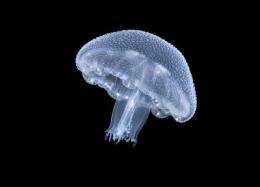
Moon jellyfish, Gijon Aquarium. Courtesy of José Luis Acuña and Julio Arrontes, University of Ontario
(PhysOrg.com) -- Over-fished commercial stocks of plankton-eating fish have been replaced in several locations by jellyfish species. This appears to be something of a paradox because fish move quickly and can see their prey, which suggests their capture of prey should be much more efficient than for jellyfish that move slowly and have to make contact with their prey to know they are present. Now a team of scientists in Spain and the US have discovered he jellyfishes' success is partly based on their large body size and its energy efficiency.
The team studied previously published data on jellyfish species and found that their relatively large body size, long tentacles, and their habit of pulsing their bodies to draw plankton-laden water past their tentacles, all increase the chances of capturing nearby prey, and this body design enables them to compete successfully with the plankton-eating fish such as anchovies and sardines, even though a larger body size is less efficient for swimming.
The study, published in the journal Science, compared mathematical models of factors such as energy efficiency, speed, and size for over 600 species of fish and jellyfish. The researchers, led by ecologist José Acuña of the Universidad de Ovied in Spain, found that their size and speed did not give fish as much of an advantage as previously assumed, when features such as the type of body, and a reliance on light were factored in.
The jellyfish swimming style is slow but turns out to be highly efficient in terms of energy expended, and since most jellyfish species are blind, they can continue to feed regardless of the light conditions. These factors enable jellyfish to closely compete with the fish, and when fish numbers are in decline, they can become the dominant species.
The type of body also had an effect on their success. The large, gelatinous jellyfish bodies are composed of around 96% water, and therefore contain disproportionately less carbon than fish bodies, which are made up of compact organic matter. When this was taken into account the researchers found jellyfish could clear the water of plankton to produce energy at a similar rate to the fish. Having a low-carbon body (and stinging cells on the tentacles of some species) also make jellyfish a less appetizing meal for predators than do their competitors.
In some areas where fish stocks are declining, often through over-fishing or pollution, jellyfish are becoming the dominant species. These areas include coastal waters off Japan, Northeastern US, the Black Sea, and the Mediterranean. The increasing numbers could change the nature of marine ecosystems, and in some areas, such as Japanese coastal areas, it is already causing problems for human beach-goers. In Japan, Scotland, and Israel, nuclear power plants drawing water from the sea have also experienced problems and have had to shut down at times through an over-abundance of jellyfish clogging water intake filters.
More information: Faking Giants: The Evolution of High Prey Clearance Rates in Jellyfishes, Science 16 September 2011: Vol. 333 no. 6049 pp. 1627-1629. DOI: 10.1126/science.1205134
ABSTRACT
Jellyfishes have functionally replaced several overexploited commercial stocks of planktivorous fishes. This is paradoxical, because they use a primitive prey capture mechanism requiring direct contact with the prey, whereas fishes use more efficient visual detection. We have compiled published data to show that, in spite of their primitive life-style, jellyfishes exhibit similar instantaneous prey clearance and respiration rates as their fish competitors and similar potential for growth and reproduction. To achieve this production, they have evolved large, water-laden bodies that increase prey contact rates. Although larger bodies are less efficient for swimming, optimization analysis reveals that large collectors are advantageous if they move through the water sufficiently slowly.
© 2011 PhysOrg.com
-
From lemons to lemonade: Reaction uses carbon dioxide to make carbon-based semiconductor,
32 comments
-
Thioridazine kills cancer stem cells in human while avoiding toxic side-effects of conventional cancer treatments,
3 comments
-
SpaceX private rocket blasts off for space station (Update),
42 comments
-
Climate scientists say they have solved riddle of rising sea,
31 comments
-
SpaceX capsule has 'new car' smell, astronauts say (Update),
4 comments
-
What would stain as translucent on light-coloured fabric?
22 hours ago
-
How do I identify different bacteria on culture plates?
May 26, 2012
-
Why Do Dogs do Strange things...
May 25, 2012
-
What does exophillic and endophillic mean in terms of mosquito and their control?
May 24, 2012
-
Semen stains glows under black lights (uv light)?
May 23, 2012
-
Question on Human Chromosome 2
May 23, 2012
- More from Physics Forums - Biology
More news stories
Manufacturing genes to attack flu virus
An international research team has manufactured a new protein that can combat deadly flu epidemics.
3 hours ago |
not rated yet |
0
|
Scientist: Evolution debate will soon be history
(AP) -- Richard Leakey predicts skepticism over evolution will soon be history. Not that the avowed atheist has any doubts himself.
21 hours ago |
3.5 / 5 (20) |
83
More plant species responding to global warming than previously thought
(Phys.org) -- Far more wild plant species may be responding to global warming than previous large-scale estimates have suggested.
May 22, 2012 |
4.6 / 5 (14) |
18
|
Thousands of shellfish found dead in Peru
Thousands of crustaceans were found dead off the coast of Lima following the mystery mass death of dolphins and pelicans, the Peruvian Navy said Friday.
May 26, 2012 |
4.8 / 5 (5) |
7
For monogamous sparrows, it doesn't pay to stray (but they do it anyway)
It's quite common for a female song sparrow to stray from her breeding partner and mate with the male next door, but a new study shows that sleeping around can be costly.
May 22, 2012 |
5 / 5 (2) |
8
|
Land and sea species differ in climate change response: study
(Phys.org) -- Marine and terrestrial species will likely differ in their responses to climate warming, new research by Simon Fraser University and Australia’s University of Tasmania has found.
'Unzipped' carbon nanotubes could help energize fuel cells, batteries
Multi-walled carbon nanotubes riddled with defects and impurities on the outside could replace some of the expensive platinum catalysts used in fuel cells and metal-air batteries, according to scientists at ...
T cells 'hunt' parasites like animal predators seek prey, study shows
By pairing an intimate knowledge of immune-system function with a deep understanding of statistical physics, a cross-disciplinary team at the University of Pennsylvania has arrived at a surprising finding: T cells use a movement ...
Computer model used to pinpoint prime materials for efficient carbon capture
When power plants begin capturing their carbon emissions to reduce greenhouse gases and to most in the electric power industry, it's a question of when, not if it will be an expensive undertaking.
Change in developmental timing was crucial in the evolutionary shift from dinosaurs to birds: study
At first glance, it's hard to see how a common house sparrow and a Tyrannosaurus Rex might have anything in common. After all, one is a bird that weighs less than an ounce, and the other is a dinosaur that ...
Almost half of new vets seek disability
(AP) -- America's newest veterans are filing for disability benefits at a historic rate, claiming to be the most medically and mentally troubled generation of former troops the nation has ever seen.
Sep 16, 2011
Rank: 3.6 / 5 (8)
Sep 16, 2011
Rank: 4.5 / 5 (2)
Jellies were everywhere. They were about the size of a golf ball and there was no way to swim. It was a jelly bath.
I was sad to discover that this was a chain-effect caused by fertilizer runoff overfeeding plankton and that it was not going to go away on it's own.
Sep 16, 2011
Rank: 4.1 / 5 (8)
Overpopulation and short-sightedness borne of individualistic greed are to blame. The first can be ameliorated; the second may prove more of a challenge.
Sep 16, 2011
Rank: 2.8 / 5 (4)
Brilliant contribution there.
Those darn humans. Any thoughts beyond that? Any notion of what the core problems are behind the phenomenon you have so brilliantly revealed? Since you obviously care so much, any thought as to how you could change your life and how you could advocate others to do the same to try and see such unsustainable management and habitat degradation reversed? Do you have any conviction to DO something about it other than denounce humans on the internet, which does absolutely nothing? Any thoughts as to what actually needs to happen to improve things?
Just some suggestions on how you might be able to create a worthwhile contribution next time, maybe even in your life.
You are whats wrong. People who see something, but do nothing. It's very easy to point and say "bad", but it can be very hard to actually do something about it. What DO you do about it, bewertow?
Sep 16, 2011
Rank: 4 / 5 (2)
The Chinese are already have various recipes to turn rapidly spreading jellyfish into delicious Chinese dishes as well as methods to turn the mostly water jellyfish into a meat like product of substance and body.
So by overfishing we are merely helping to create a far more productive biome where wild jellyfish can grow and thrive. LOL
Sep 16, 2011
Rank: 2.6 / 5 (5)
Good news though, we don't have do anything. In 2008 scientist studying our global mineable phosphate reserves concluded we had a 300 year supply left. In 2011 a review of these estimates concluded - "Wow! Not really!" (that's probably not a direct quote.) We have less than 30 years to peak phosphate and probably far less because of the simultaneous affects of peak petro/rising fuel prices increasing the rapidity of the economic infeasibility of mining phosphates as their concentrations become lower and lower and scarcer. The new study says all mineable phosphates will be gone in as little as 50 years. Now the killer (literally) - 95% of global food production is mined phosphate dependent and there are no equivalent replacements.
Sep 16, 2011
Rank: 4 / 5 (1)
http://www.aquati...acts.php
Sep 17, 2011
Rank: not rated yet
Sep 17, 2011
Rank: not rated yet
Sep 19, 2011
Rank: not rated yet