Graphene walls could make powerful electronics
September 27, 2011

Graphene walls could make powerful electronics

Enlarge

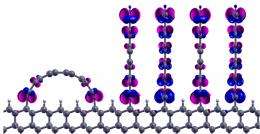
Researchers at Rice University and Hong Kong Polytechnic University calculated that graphene nanoribbons could stand up on diamond or nickel, or even form arches. Up to 100 trillion graphene walls could fit on a square centimeter chip. (Credit: Feng Ding/Hong Kong Polytechnic University)

(PhysOrg.com) -- To stand a ribbon of graphene upright, it needs diamond on the soles of its shoes.

A new paper by collaborators at Rice University and Hong Kong Polytechnic University demonstrates the possibility that tiny strips of graphene -- one-atom-thick sheets of carbon -- can stand tall on a with a little support. This leads to the possibility that arrays of graphene walls could become ultrahigh density components of electronic or spintronic devices.

The work was published this month in the online edition of the Journal of the American Chemical Society.

Calculations by Rice theoretical physicist Boris Yakobson, Assistant Professor Feng Ding of Hong Kong Polytechnic and their collaborators showed substrates not only of diamond but also nickel could chemically bind the edge of a strip of a graphene nanoribbon. Because the contact is so slight, the graphene walls retain nearly all of their inherent electrical or magnetic properties. 

And because they're so thin, Yakobson and Ding calculated a theoretical potential of putting 100 trillion graphene wall field-effect transistors (FETs) on a square-centimeter chip.

That potential alone may make it possible to blow past the limits implied by Moore's Law -- something Yakobson once discussed with Intel founder Gordon Moore himself.

"We met in Montreal, when nano was a new kid on the block, and had a good conversation," said Yakobson, Rice's Karl F. Hasselmann Chair in Engineering and a professor of materials science and mechanical engineering and of chemistry. "Moore liked to talk about silicon wafers in terms of real estate. Following his metaphor, an upright architecture would increase the of circuits on a chip -- like going from ranch-style houses in Texas to skyscraper condos in Hong Kong.

"This kind of strategy may help sustain Moore's Law for an extra decade," he said.

A sheet of material a fraction of a nanometer wide is pretty pliable, he said, but the laws of physics are on its side. Binding energies between carbon in the diamond matrix and carbon in graphene are maximized at the edge, and the molecules bind strongly at a 90-degree angle. Minimal energy is required for the graphene to stand upright, which is its preferred state. (Walls on a nickel substrate would be angled at about 30 degrees, the researchers found.)

Yakobson said the walls could be as close to each other as 7/10ths of a nanometer, which would maintain the independent electronic properties of individual nanoribbons. They could potentially be grown on silicon, silicon dioxide, aluminum oxide or silicon carbide.

The research illustrated differences between walls made of two distinct types of graphene, zigzag and armchair, so-called because of the way their edges are shaped. 

Sheets of graphene are considered semimetals that have limited use in electronics because electrical current shoots straight through without resistance. However, armchair nanoribbons can become semiconductors; the thinner the ribbon, the larger the band gap, which is essential for transistors.

Zigzag nanoribbons are magnetic. Electrons at their opposing edges spin in opposite directions, a characteristic that can be controlled by an electric current; this makes them suitable for spintronic devices.

In both cases, the electronic properties of the walls can be tuned by changing their height.

The researchers also suggested nanowalls could become nanoarches by attaching opposing ends of a graphene ribbon to the substrate. Rather than lie flat on the diamond or nickel surface, the energies at play along the binding edges would naturally force the strip to rise in the middle. It would essentially become a half-nanotube with its own set of potentially useful properties.

Precisely how to turn these two-dimensional building blocks into a three-dimensional device presents challenges, but the payoff is great, Yakobson said. He noted that the research lays the groundwork for subnanometer electronic technology. 

More information: Read the abstract at http://pubs.acs.or … 21/ja2037854

Provided by Rice University search and more info website

Filter


Move the slider to adjust rank threshold, so that you can hide some of the comments.


Display comments: newest first

gmurphy
Sep 27, 2011

Rank: not rated yet
Easier said than done, I'd imagine. The pay-off, needless to say, would be immense.
Nanobanano
Sep 27, 2011

Rank: not rated yet
Forbidden Planet

Oh well, I don't use a lot of music or movies, so I barely even use my hard drive anyway.

But by the time you had market saturation of computers of this advanced technology, I should think that implementing some sort of General A.I., even if through brute force, would be only a matter of time...

This is also actually the equivalent of around 18 or 19 doublings of existing 2d technology in terms of transistor density, which translates to the equivalent of almost 30 years worth of the naive "no limits" projection of Moore's law, not 10 years.

We're talking "The Matrix" here. The ability, at least in terms of computational power, to render the visual aspects of an entire 3d reality to a resolution that the human eyes and brain cannot discern from reality. think of the color depth and pixel counts of your monitor, and project it into 3d as big as a ROOM. A PC size computer with 100 trillion bits per cm could do the calculations to render that image...
Nanobanano
Sep 27, 2011

Rank: not rated yet
A single video card made with this level of technology would be capable of doing the calculations to render a 3d image of roughly 10ft CUBED worth of pixels at contemporary color depth and resolution as a visual image in space. That is, if you had the projector or hologram technology to actually project that image...

Ricochet
Sep 28, 2011

Rank: not rated yet
Yes, but could the computer, with that same technology in the CPU, also handle the memory and computational requirements to simulate the environment, including the people, making them interactive with the flesh participant(s)?
Have they actually calculated about how much memory/processing power it would take to actually simulate a human?
Rank 4 /5 (6 votes)
Relevant PhysicsForums posts
  • microstructure of titanium
    createdMay 26, 2012
  • Steam in My Espresso Machine
    createdMay 26, 2012
  • Density question
    createdMay 24, 2012
  • Mass transport originating from a point source at a solid gas interface
    createdMay 22, 2012
  • Ammonia dispersion in Air
    createdMay 22, 2012
  • Multi Choice Help
    createdMay 21, 2012
  • More from Physics Forums - Materials & Chemical Engineering

More news stories

'Unzipped' carbon nanotubes could help energize fuel cells, batteries

Multi-walled carbon nanotubes riddled with defects and impurities on the outside could replace some of the expensive platinum catalysts used in fuel cells and metal-air batteries, according to scientists at ...

Nanotechnology / Nanomaterials

created 3 hours ago | popularity not rated yet | comments 0 | with audio podcast

In nanorod crystal growth, nanoparticles seen as artificial atoms

In the growth of crystals, do nanoparticles act as "artificial atoms" forming molecular-type building blocks that can assemble into complex structures? This is the contention of a major but controversial theory ...

Nanotechnology / Nanophysics

created May 24, 2012 | popularity 4.8 / 5 (6) | comments 0 | with audio podcast

Dopant gives graphene solar cells highest efficiency yet

(Phys.org) -- By taking advantage of graphene’s favorable electrical and optical properties, and then adding an organic dopant, researchers have achieved the highest power conversion efficiency yet for ...

Nanotechnology / Nanophysics

created May 21, 2012 | popularity 5 / 5 (10) | comments 14 | with audio podcast feature

First direct observation of oriented attachment in nanocrystal growth

Berkeley Lab researchers have reported the first direct observation of nanoparticles undergoing oriented attachment, the critical step in biomineralization and the growth of nanocrystals. A better understanding ...

Nanotechnology / Nanophysics

created May 24, 2012 | popularity 4.7 / 5 (3) | comments 0 | with audio podcast

Synthetic nano-waste does not disappear

(Phys.org) -- Tiny particles of cerium oxide do not burn or change in the heat of a waste incineration plant. They remain intact on combustion residues or in the incineration system, as a new study by Swiss ...

Nanotechnology / Bio & Medicine

created May 25, 2012 | popularity 5 / 5 (2) | comments 1 | with audio podcast


Land and sea species differ in climate change response: study

(Phys.org) -- Marine and terrestrial species will likely differ in their responses to climate warming, new research by Simon Fraser University and Australia’s University of Tasmania has found.

T cells 'hunt' parasites like animal predators seek prey, study shows

By pairing an intimate knowledge of immune-system function with a deep understanding of statistical physics, a cross-disciplinary team at the University of Pennsylvania has arrived at a surprising finding: T cells use a movement ...

Computer model used to pinpoint prime materials for efficient carbon capture

When power plants begin capturing their carbon emissions to reduce greenhouse gases – and to most in the electric power industry, it's a question of when, not if – it will be an expensive undertaking.

Change in developmental timing was crucial in the evolutionary shift from dinosaurs to birds: study

At first glance, it's hard to see how a common house sparrow and a Tyrannosaurus Rex might have anything in common. After all, one is a bird that weighs less than an ounce, and the other is a dinosaur that ...

Almost half of new vets seek disability

(AP) -- America's newest veterans are filing for disability benefits at a historic rate, claiming to be the most medically and mentally troubled generation of former troops the nation has ever seen.

Nvidia trumpets Tegra 3 phone design wins for 2012

(Phys.org) -- Nvidia’s competitive war paint has a name, Tegra 3. On the heels of Nvidia announcements about lowering costs of its Tegra 3 processors and Nvidia-enabled tablets running Android Ice Cream ...