Fish farms less harmful than thought
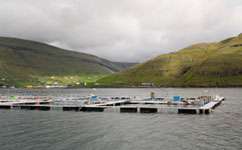
Coastal fish farms seem to do less harm to nearby plants and animals than previously believed, a new study reveals. And marine ecosystems can recover from this damage surprisingly fast.
But the analysis of a single trout farm in a Faroe Islands fjord over nearly a year also shows that these facilities need to be placed carefully, and that there's a limit to how many can operate in a particular area before its biodiversity suffers lasting harm.
In coastal farms, fish live in large cages hanging from pontoons on the surface. Fish faeces and uneaten food sink to the seabed, affecting its ecosystem. Badly-managed farms can also have serious effects on the surrounding water column.
The team monitored the cages, initially containing some 770,000 young trout. They measured the flow of the vital nutrients carbon and nitrogen through the system, also tracking the farmer's activities, changing water conditions and the quantity of waste deposited on the seabed below.
The results were better than they'd feared. 'We were surprised by how efficiently the food input is converted into fish biomass – particularly how much of the carbon is taken in,' says Professor Ronnie Glud, a marine biologist at Southern Danish University and one of the authors of the paper, published in Marine Ecology Progress Series. The work is part of Gunnvør á Norði's PhD thesis and was conducted in collaboration with researchers at the Scottish Association for Marine Science (SAMS).
"Earlier studies suggested the process was much less efficient," Glud adds. "This may be a sign of improvement in fish farming methods – farmers now know how to feed their fish much more efficiently so there's less waste and less environmental impact."
About a third of the carbon and nitrogen provided in fish food ended up in the fish, while only about 6 and 5 per cent respectively arrived on the seabed.
Changes to the sea floor were still noticeable, though; under the trout cages it was covered in much darker sediment than the surrounding area because of the build-up of fish waste. This dark sediment was at least 18cm deep, and contained bubbles of methane gas created as the waste rotted. Local ecology changed too; the whole sediment surface was quickly covered with bacterial mats made up of only a few species.
A 39-day break in all farming activity let the team assess how quickly the seabed rebounds from these effects. Again, the answer was hopeful. "It was astonishing how fast the seabed recovered once the farming stopped," Glud comments.
After the break the sea floor was still distinguishable from unaffected areas nearby – the sediment had returned to a lighter grey, though this was only for the top centimetre or so – but conditions had improved considerably and the original inhabitants were starting to return. Glud estimates full recovery might take six to eight months.
Seabed bacteria are very efficient at dealing with this organic matter, removing 56 and 38 per cent of carbon and nitrogen respectively. And Faroe Islands waters feature rough waves and currents that spread farm waste more widely. This reduces its impact on any particular area of seabed, particularly when powerful Atlantic storms churn up the waters and facilitate the breakdown of waste material as it is suspended in the water.
Coastal fish farming is an enormous growth industry all over the world. This has raised serious questions about its wider ecological impact. Glud says this research suggests that properly-managed coastal farms need not be unsustainable.
But he adds that they must be placed carefully and regulated so that there is enough unaffected area of seabed that normal plants and animals have places to take refuge and don't die out completely. "This has to be acknowledged when licenses are provided to the farming industry," says Glud. "We really need to know what the threshold for sustainability is. We've shown that these farms' footprint isn't that big, and that recovery is quite fast, but there is still a limit."
Another area of concern is the food being given to farmed fish – this often comes from unsustainable fishing elsewhere. "They basically vacuum clean the oceans to feed these fish," Glud notes. "The effect is to crash the populations of other fish species that aren't directly useful to us."
Team members are now investigating exactly how waste material that ends up on the seabed – usually as agglutinated pellets – is broken down by the microbes that live there. They will focus in particular on the effects of re-suspension of waste material and how this may reduce the waste's environmental impact. This should clarify the long-term impact of fish farming.
The study's implications go beyond the environmental impact of aquaculture. "Studying fish farms doesn't only tell us about their environmental impact; it also provides models for what's going on in the wider ocean," explains Glud. "It's much easier for us to investigate the processes here because gradients of impacted sediment are so close together, both in time and in space, compared to the natural ocean," he adds.
This story is republished courtesy of Planet Earth online, a free, companion website to the award-winning magazine Planet Earth published and funded by the Natural Environment Research Council (NERC).
More information: Environmental impacts of coastal fish farming: carbon and nitrogen budgets for trout farming in Kaldbaksfjørður (Faroe Islands). Gunnvør á Norði, Ronnie N. Glud, Eilif Gaard, Knud Simonsen. MEPS 431:223-241 (2011). DOI:10.3354/meps09113
Provided by PlanetEarth Online


