Researchers produce cheap sugars for sustainable biofuel production
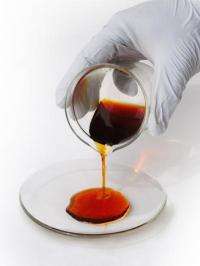
Iowa State researchers have developed thermochemical technologies that efficiently produce sugars from biomass. Lead researcher Robert C. Brown calls the sugars “pyrolytic molasses.” Naomi Friend photo. Credit: Naomi Friend/Iowa State Bioeconomy Institute photo.
Iowa State University's Robert C. Brown keeps a small vial of brown, sweet-smelling liquid on his office table.
"It looks like something you could pour on your pancakes," he said. "In many respects, it is similar to molasses."
Brown, in fact, calls it "pyrolytic molasses."
That's because it was produced by the fast pyrolysis of biomass such as corn stalks or wood chips. Fast pyrolysis involves quickly heating the biomass without oxygen to produce liquid or gas products.
"We think this is a new way to make inexpensive sugars from biomass," said Brown, an Anson Marston Distinguished Professor in Engineering, the Gary and Donna Hoover Chair in Mechanical Engineering and the Iowa Farm Bureau Director of Iowa State's Bioeconomy Institute.
That's a big deal because those sugars can be further processed into biofuels. Brown and other Iowa State researchers believe pyrolysis of lignocelluslosic biomass has the potential to be the cheapest way to produce biofuels or biorenewable chemicals.
Brown and Iowa State researchers will present their ideas and findings during tcbiomass2011, the International Conference on Thermochemical Conversion Science in Chicago Sept. 28-30. On Thursday, Sept, 29, Brown will address the conference with a plenary talk describing how large amounts of sugars can be produced from biomass by a simple pretreatment before pyrolysis. He'll also explain how these sugars can be economically recovered from the products of pyrolysis.
A poster session following Brown's talk will highlight thermochemical technologies developed by 19 Iowa State research teams, including processes that:
- increase the yield of sugar from fast pyrolysis of biomass with a pretreatment that neutralizes naturally occurring alkali that otherwise interferes with the release of sugars
- prevent burning of sugar released during pyrolysis by rapidly transporting it out of the hot reaction zone
- recover sugar from the heavy end of bio-oil that has been separated into various fractions
- separate sugars from the heavy fractions of bio-oil using a simple water-washing process.
Their work has been supported by the eight-year, $22.5 million ConocoPhillips Biofuels Program at Iowa State. The program was launched in April 2007.
Brown said Iowa State will literally take a bus load of students and researchers to the Chicago conference to present their work on thermochemical technologies, including production of sugars from biomass.
"The Department of Energy has been working for 35 years to get sugar out of biomass," Brown said. "Most of the focus has been on use of enzymes, which remains extremely expensive. What we've developed is a simpler method based on the heating of biomass."
Provided by
Iowa State University
-
From lemons to lemonade: Reaction uses carbon dioxide to make carbon-based semiconductor,
32 comments
-
Thioridazine kills cancer stem cells in human while avoiding toxic side-effects of conventional cancer treatments,
3 comments
-
SpaceX private rocket blasts off for space station (Update),
42 comments
-
Climate scientists say they have solved riddle of rising sea,
31 comments
-
SpaceX capsule has 'new car' smell, astronauts say (Update),
2 comments
-
Gibbs Free Energy Change/Entropy
5 hours ago
-
What's the rule to covalent character
6 hours ago
-
Schwartz reagent-- NMR/MS/IR
May 26, 2012
-
High school chemistry EEI
May 25, 2012
-
oxidation of I- by KMnO4
May 25, 2012
-
Inversion temp
May 25, 2012
- More from Physics Forums - Chemistry
More news stories
New CO2-removing catalyst can take the heat
(Phys.org) -- The current method of removing the greenhouse gas carbon dioxide (CO2) from the flues of coal-fired power plants uses so much energy that no one bothers to use it. So says Roger Aines, principal ...
May 24, 2012 |
5 / 5 (9) |
9
|
High-speed method to aid search for solar energy storage catalysts
Eons ago, nature solved the problem of converting solar energy to fuels by inventing the process of photosynthesis.
May 25, 2012 |
5 / 5 (3) |
4
|
Researchers demonstrate possible primitive mechanism of chemical info self-replication
(Phys.org) -- When scientists think about the replication of information in chemistry, they usually have in mind something akin to what happens in living organisms when DNA gets copied: a double-stranded molecule ...
May 25, 2012 |
5 / 5 (4) |
2
|
Building a better solar panel -- one molecule at a time
(Phys.org) -- One of the fundamental building blocks in modern chemistry, an organometallic chemical compound called ferrocene, has never been structurally defined - until now.
May 25, 2012 |
5 / 5 (3) |
0
|
Discarded data may hold the key to a sharper view of molecules
(Phys.org) -- There's nothing like a new pair of eyeglasses to bring fine details into sharp relief. For scientists who study the large molecules of life from proteins to DNA, the equivalent of new lenses have come in the ...
May 24, 2012 |
4.7 / 5 (3) |
0
|
Nvidia trumpets Tegra 3 phone design wins for 2012
(Phys.org) -- Nvidias competitive war paint has a name, Tegra 3. On the heels of Nvidia announcements about lowering costs of its Tegra 3 processors and Nvidia-enabled tablets running Android Ice Cream ...
Browser wars flare in mobile space
The browser wars are heating up again, but this time the fight is for dominance of the mobile Internet.
Scientist: Evolution debate will soon be history
(AP) -- Richard Leakey predicts skepticism over evolution will soon be history. Not that the avowed atheist has any doubts himself.
Dell tablet leak: 10.1-inch display, two-battery choice
(Phys.org) -- Headline after headline talks about vendors tablets in the wings as likely number-one contenders for the iPad. Such claims have justifiably been taken with a grain of salt, considering ...
Keep food safety in mind this memorial day weekend
(HealthDay) -- Picnics, parades and cookouts are as much a part of Memorial Day weekend as tributes to the United States' war veterans.
Social welfare cuts ultimately come with heavy price, researchers say
(Phys.org) -- Slashing government funding for Medicaid, food stamps and other programs that serve the poor while politically popular with some lawmakers and many conservatives may do more harm ...
Sep 29, 2011
Rank: not rated yet
Sep 29, 2011
Rank: 1 / 5 (1)
A few years from now, I'll let you know that i told you so, when all the packages come with following phrase in the ingredients list.
"Contains high xylose pyrolytic molassas"
It's the natural side business to this.
Sep 29, 2011
Rank: 1 / 5 (1)
I mean as an ingredient in your food of course.
Sep 30, 2011
Rank: 5 / 5 (1)
Every time I hear someone talk about turning corn into fuel I cringe.
Sep 30, 2011
Rank: not rated yet
Sep 30, 2011
Rank: 1 / 5 (1)
Why not just turn it into activated carbon for filtration systems?
Oct 04, 2011
Rank: not rated yet