Wrens eavesdrop on the neighbors
August 17, 2011

Wrens eavesdrop on the neighbors

Enlarge

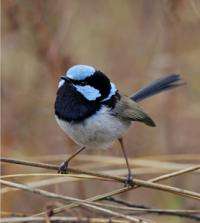
Male superb fairy-wren. Photo by Simon Bennet.

Superb fairy-wrens eavesdrop, learn to understand and react to the danger calls of other bird species that live nearby, according to new research published today in the Proceedings of the Royal Society B.

Associate Professor Robert Magrath and Thomas Bennett from the Research School of Biology at The Australian National University made the discovery by playing recordings of miner-bird danger calls to fairy-wrens and observed the wrens fleeing to safety.

“The ability of superb fairy-wrens to eavesdrop on other is remarkable, because alarm calls sound different for each different species,” Associate Professor Magrath said.

“We found that the fairy-wrens have to learn what the other species’ calls mean so that they know when they need to take action to avoid danger.”

Superb fairy-wrens are small blue wrens, common in the south-east corner of Australia.

“The behaviour we observed was particularly interesting because the fairy-wrens only reacted to the danger call recordings if miner birds were common in the immediate area,” Associate Professor Magrath explained.

“For example, fairy-wrens living on one side of a road where miners were present fled when noisy miner alarms were played back to them, while those over the road did not react.

“This supports the notion that fairy-wrens have to learn to understand other local bird calls, rather than simply reacting because danger calls are loud or rapid.”

Learning to listen to other species’ danger signals allows the fairy-wrens to react quickly to danger, whether it is spotted by fellow wrens or by other species in the local area.

The research suggests that birds can cope with a new environment by learning about the local community, and provides a valuable insight into how species like the superb fairy-wren will adapt to the rapidly changing world.

Provided by Australian National University

Filter


Move the slider to adjust rank threshold, so that you can hide some of the comments.


Display comments: newest first

Isaacsname
Aug 17, 2011

Rank: 5 / 5 (1)
You'd be surprised how many different animals understand, to some extent, what each others' calls mean. Squirrels know distress/alarm calls of birds, cats know squirrel calls, etc. I have a blind/feeder setup at my window and play with animal call soundboards when birds/squirrels are feeding. I have been very surprised by the reactions I get.

It's interesting because , for example, when we(humans) are in a country with a different language, if we were hearing somebody yelling to warn us about something we'd be clueless.

So, animals are , to some extent, multi-linguistic. When a Bluejay makes a warning call, and a Cardinal, a Sparrow, a Squirrel , and a crow all understand the meaning behind the call, you have admit that's impressive and points to much richer social dynamics and a depth we are blinded to.
Rank 5 /5 (2 votes)
Relevant PhysicsForums posts

More news stories

Manufacturing genes to attack flu virus

An international research team has manufactured a new protein that can combat deadly flu epidemics.

Biology / Biotechnology

created 34 minutes ago | popularity not rated yet | comments 0 | with audio podcast

Scientist: Evolution debate will soon be history

(AP) -- Richard Leakey predicts skepticism over evolution will soon be history. Not that the avowed atheist has any doubts himself.

Biology / Evolution

created 19 hours ago | popularity 3.3 / 5 (18) | comments 69

More plant species responding to global warming than previously thought

(Phys.org) -- Far more wild plant species may be responding to global warming than previous large-scale estimates have suggested.

Biology / Ecology

created May 22, 2012 | popularity 4.6 / 5 (14) | comments 18 | with audio podcast

Thousands of shellfish found dead in Peru

Thousands of crustaceans were found dead off the coast of Lima following the mystery mass death of dolphins and pelicans, the Peruvian Navy said Friday.

Biology / Ecology

created May 26, 2012 | popularity 4.8 / 5 (4) | comments 7

For monogamous sparrows, it doesn't pay to stray (but they do it anyway)

It's quite common for a female song sparrow to stray from her breeding partner and mate with the male next door, but a new study shows that sleeping around can be costly.

Biology / Plants & Animals

created May 22, 2012 | popularity 5 / 5 (2) | comments 7 | with audio podcast


Change in developmental timing was crucial in the evolutionary shift from dinosaurs to birds: study

At first glance, it's hard to see how a common house sparrow and a Tyrannosaurus Rex might have anything in common. After all, one is a bird that weighs less than an ounce, and the other is a dinosaur that ...

Computer model used to pinpoint prime materials for efficient carbon capture

When power plants begin capturing their carbon emissions to reduce greenhouse gases – and to most in the electric power industry, it's a question of when, not if – it will be an expensive undertaking.

'Unzipped' carbon nanotubes could help energize fuel cells, batteries

Multi-walled carbon nanotubes riddled with defects and impurities on the outside could replace some of the expensive platinum catalysts used in fuel cells and metal-air batteries, according to scientists at ...

T cells 'hunt' parasites like animal predators seek prey, study shows

By pairing an intimate knowledge of immune-system function with a deep understanding of statistical physics, a cross-disciplinary team at the University of Pennsylvania has arrived at a surprising finding: T cells use a movement ...

Yale study concludes public apathy over climate change unrelated to science literacy

Are members of the public divided about climate change because they don't understand the science behind it? If Americans knew more basic science and were more proficient in technical reasoning, would public consensus match ...

Same gene that stunts infants' growth also makes them grow too big: research

UCLA geneticists have identified the mutation responsible for IMAGe* syndrome, a rare disorder that stunts infants' growth. The twist? The mutation occurs on the same gene that causes Beckwith-Wiedemann syndrome, which makes ...