Southern South American wildfires expected to increase: study
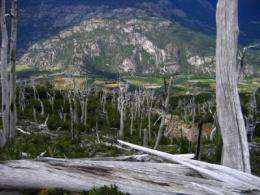
This 2010 photo shows the aftermath of a wildfire outside the town of Futaleufu in southern Chile. A new study by CU-Boulder researchers indicates that wildfires may intensify in southern South America in the coming decades. Credit: Andres Holz
A new University of Colorado Boulder study indicates a major climate oscillation in the Southern Hemisphere that is expected to intensify in the coming decades will likely cause increased wildfire activity in the southern half of South America.
The research team used tree rings dating to 1506 to track past wildfire activity in the forests of Patagonia tied to the Southern Annular Mode, or SAM, a climate oscillation that creates low atmospheric pressure in the Antarctic that is tied to warmer and drier conditions in southern South America. The tree rings showed that when SAM was in its positive phase, there were widespread fires in both dry woodlands and rainforests in Patagonia, a region that straddles Argentina and Chile, said CU-Boulder Research Associate Andres Holz, lead study author.
"Our study shows for about the past 250 years, the Southern Annular Mode has been the main driver in creating droughts and fires in two very different ecosystems in southern South America," said Holz. "Climate models suggest an increase in SAM beginning in the 1960s due to greenhouse gas increases and Antarctic ozone depletion probably will cause this region to be drought-prone and fire-prone for at least the next 100 years."
A paper on the subject by Holz and CU-Boulder geography Professor Thomas Veblen was published in Geophysical Research Letters.
Holz and Veblen compared past wildfire records for two ecologically distinct regions in Patagonia -- the relatively dry region of southern Patagonia in Argentina and the temperate rainforest of Patagonia in northern Chile. While the tree ring historical record showed increased fires in both regions correlated with a positive SAM, the trend has been less pronounced in northern Patagonia in the past 50 years, likely because of fire-suppression efforts there, Holz said.
But the decades of fire suppression have caused the northern Patagonian woodlands to become denser and more prone towildfire during hot and dry years, Holz said.
"Even in areas of northern Patagonia where fire suppression previously had been effective, record surface areas of woodlands and forests have burned in recent years of extreme drought," said Veblen. "And since this is in an area of rapid residential growth into wildland-urban interface areas, this climate-driven trend towards increasing fire risk is becoming a major problem for land managers and homeowners."
The two CU-Boulder researchers studied reconstructions of tree rings going back more than 500 years from 432 trees at 42 sample sites in northern Argentina and southern Chile -- the largest available data set of annual, readable tree ring records in the Southern Hemisphere. The tree rings, which indicate climate cycles and reveal the scars of old fires, showed that wildfires generally increased in both regions when SAM was in its strong, positive phase.
Although the Antarctic ozone hole stopped growing in about 2000 as a result of a ban on ozone-depleting gases and now appears to be slowly repairing itself, a 2011 paper by researchers at the National Center for Atmospheric Research in Boulder indicates ozone recovery and greenhouse gas influences essentially will cancel each other out, preventing SAM from returning to its pre-1960s levels.
"Before the Industrial Revolution, SAM intensified naturally at times to create drought situations in Patagonia," Holz said. "But in the last 80 years or so, the natural variation has been overwhelmed by a bias toward a positive SAM phase because of ozone-depleting chemicals and greenhouse gases we have put in the atmosphere."
The research effort was supported by the National Geographic Society, the National Science Foundation, the CU Beverly Sears Small Grants Program and the Council on Research and CreativeResearch of the CU Graduate School.
"As warming and drying trends continue, it is likely that wildfire activity will increase even in woodland areas where fire suppression has previously been effective," Holz and Veblen wrote in Geophysical Research Letters.
Provided by
University of Colorado at Boulder
-
From lemons to lemonade: Reaction uses carbon dioxide to make carbon-based semiconductor,
32 comments
-
Thioridazine kills cancer stem cells in human while avoiding toxic side-effects of conventional cancer treatments,
3 comments
-
SpaceX private rocket blasts off for space station (Update),
42 comments
-
Climate scientists say they have solved riddle of rising sea,
31 comments
-
SpaceX capsule has 'new car' smell, astronauts say (Update),
2 comments
-
Hypothetical desert earth
15 hours ago
-
More human population = greater mass?
May 25, 2012
-
Conversion from aircraft bearing to normal degrees
May 23, 2012
-
Interpretation/Analysis of the Lab results(HEPA filter)
May 22, 2012
-
Has anyone here attended the The Urbino Summer School in Paleoclimatology?
May 22, 2012
-
Earthquakes: Mag 6 N. Italy and Mag 5.6 W. Bulgaria
May 21, 2012
- More from Physics Forums - Earth
More news stories
Yale study concludes public apathy over climate change unrelated to science literacy
Are members of the public divided about climate change because they don't understand the science behind it? If Americans knew more basic science and were more proficient in technical reasoning, would public consensus match ...
2 minutes ago |
not rated yet |
0
|
10 million years needed to recover from mass extinction
It took some 10 million years for Earth to recover from the greatest mass extinction of all time, latest research has revealed.
Space & Earth / Earth Sciences
3 minutes ago |
not rated yet |
0
|
Sophisticated simulations predict future warming
The chances of our planet being hit by a global warming of 3 degrees Celsius by 2050 is as likely as it being hit by an increase of 1.4 degrees, new research shows. Presented in the journal Nature Geoscience, the British study ...
Space & Earth / Earth Sciences
May 22, 2012 |
4.4 / 5 (9) |
51
Aliens don't want to eat us, says former SETI director
Alien life probably isnt interested in having us for dinner, enslaving us or laying eggs in our bellies, according to a recent statement by former SETI director Jill Tarter.
Space & Earth / Space Exploration
May 25, 2012 |
4.4 / 5 (13) |
39
Kyoto Protocol architect 'frustrated' by climate dialogue
UN climate talks are going nowhere, as politicians dither or bicker while the pace of warming dangerously speeds up, one of the architects of the Kyoto Protocol told AFP.
May 23, 2012 |
3.7 / 5 (7) |
39
Change in developmental timing was crucial in the evolutionary shift from dinosaurs to birds: study
At first glance, it's hard to see how a common house sparrow and a Tyrannosaurus Rex might have anything in common. After all, one is a bird that weighs less than an ounce, and the other is a dinosaur that ...
Computer model used to pinpoint prime materials for efficient carbon capture
When power plants begin capturing their carbon emissions to reduce greenhouse gases and to most in the electric power industry, it's a question of when, not if it will be an expensive undertaking.
'Unzipped' carbon nanotubes could help energize fuel cells, batteries
Multi-walled carbon nanotubes riddled with defects and impurities on the outside could replace some of the expensive platinum catalysts used in fuel cells and metal-air batteries, according to scientists at ...
T cells 'hunt' parasites like animal predators seek prey, study shows
By pairing an intimate knowledge of immune-system function with a deep understanding of statistical physics, a cross-disciplinary team at the University of Pennsylvania has arrived at a surprising finding: T cells use a movement ...
Manufacturing genes to attack flu virus
An international research team has manufactured a new protein that can combat deadly flu epidemics.
Same gene that stunts infants' growth also makes them grow too big: research
UCLA geneticists have identified the mutation responsible for IMAGe* syndrome, a rare disorder that stunts infants' growth. The twist? The mutation occurs on the same gene that causes Beckwith-Wiedemann syndrome, which makes ...