New nanostructured glass for imaging and recording developed
Aug 15, 2011
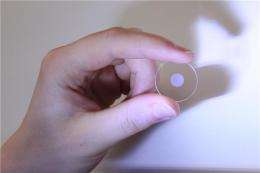
The new monolithic glass space-variant polarization converter

(PhysOrg.com) -- University of Southampton researchers have developed new nano-structured glass optical elements, which have applications in optical manipulation and will significantly reduce the cost of medical imaging.

In a paper entitled Radially polarized optical converter created by femtosecond laser nanostructuring of published in , a team led by Professor Peter Kazansky at the University's Optoelectronics Research Centre, describe how they have used nano-structures to develop new monolithic glass space-variant polarization converters. These millimetre-sized devices generate ‘whirlpools’ of light enabling: precise laser material processing, optical manipulation of atom-sized objects, ultra-high resolution imaging and potentially, table-top particle accelerators. They have since found that the technology can be developed further for optical recording.

According to the researchers, at sufficient intensities, ultra-short laser pulses can be used to imprint tiny dots (like 3D pixels) called voxels in glass. Their previous research showed that lasers with fixed polarization produce voxels consisting of a periodic arrangement of ultra-thin (tens of nanometers) planes. By passing polarized light through such a voxel imprinted in silica glass, the researchers observed that it travels differently depending on the polarization orientation of the light. This ‘form birefringence’ phenomenon is the basis of their new converter.

The advantage of this approach over existing methods for microscopy is that it is 20 times cheaper and it is compact.

"Before this we had to use a spatial light modulator based on liquid crystal which cost about £20,000," said Professor Peter Kazansky. "Instead we have just put a tiny device into the optical beam and we get the same result."

Since publication of the paper in May this year, the researchers have developed this technology further and adapted it for a five dimensional optical recording.

"We have improved the quality and fabrication time and we have developed this five dimensional memory which means that data can be stored on the glass and last forever," said Martynas Beresna, lead researcher for the project. "No one has ever done this before."

The researchers are working with the Lithuanian company Altechna to introduce this technology to the market.

Explore further: 3D printing tiny batteries

More information: "Radially polarized optical vortex converter created by femtosecond laser nanostructuring of glass", Applied Physics Letters apl.aip.org/resource/1/applab/v98/i20/p201101_s1

Related Stories

A table top 3D laserprinter for glass microsystems

May 13, 2010

Dr. Yves Bellouard of the Department of Mechanical Engineering is coordinator of a new European project, Femtoprint, to be started this month. The goal is to design a convenient 3D laser printer that will ...

New kind of optical fiber developed

Feb 25, 2011

(PhysOrg.com) -- A team of scientists led by John Badding, a professor of chemistry at Penn State University, has developed the very first optical fiber made with a core of zinc selenide -- a light-yellow ...

Five-Dimensional DVD Could Hold Data of 30 Blu-ray Discs

May 21, 2009

(PhysOrg.com) -- While many people think that Blu-ray will replace DVDs in the near future, a new study shows that DVDs may still have a lot to offer. Researchers have designed a five-dimensional DVD that ...

Recommended for you

3D printing tiny batteries

16 hours ago

(Phys.org) —3D printing can now be used to print lithium-ion microbatteries the size of a grain of sand. The printed microbatteries could supply electricity to tiny devices in fields from medicine to communications, ...

World's most powerful microscope ready for research

21 hours ago

(Phys.org) —The world's most powerful microscope, which resides in a specially constructed room at the University of Victoria, has now been fully assembled and tested, and has a lineup of scientists and businesses eager ...

Future looks bright for carbon nanotube solar cells

21 hours ago

(Phys.org) —In an approach that could challenge silicon as the predominant photovoltaic cell material, University of Wisconsin-Madison materials engineers have developed an inexpensive solar cell that exploits ...

A breakthrough in plasmonics

Jun 17, 2013

EPFL scientists have discovered how optical signal transmission can be controlled, paving the way for the integration of plasmonics with conventional electronic circuits.

User comments : 1

Adjust slider to filter visible comments by rank

Display comments: newest first

holoman
not rated yet Aug 15, 2011
Another company in Britain did the same thing 10 years
ago Polight Technologies, Cambridge England. Failed

More news stories

3D printing tiny batteries

(Phys.org) —3D printing can now be used to print lithium-ion microbatteries the size of a grain of sand. The printed microbatteries could supply electricity to tiny devices in fields from medicine to communications, ...

Future looks bright for carbon nanotube solar cells

(Phys.org) —In an approach that could challenge silicon as the predominant photovoltaic cell material, University of Wisconsin-Madison materials engineers have developed an inexpensive solar cell that exploits ...

Hybrid material as gold-leaf substitute

(Phys.org) —A team of researchers headed by Professor Raffaele Mezzenga has created a hybrid material out of gold and milk proteins that looks like a wafer-thin gold leaf. Thanks to its properties, it could ...

World's most powerful microscope ready for research

(Phys.org) —The world's most powerful microscope, which resides in a specially constructed room at the University of Victoria, has now been fully assembled and tested, and has a lineup of scientists and businesses eager ...

Dish won't submit revised bid for Sprint

Satellite TV operator Dish Network Corp. said Tuesday it would not submit a revised bid for Sprint, leaving the path open for the wireless carrier to accept what it already considers a superior offer from Japan's Softbank.

Cape Wind gets $200M investment from Danish fund

The Cape Wind offshore wind project has secured a $200 million investment from a Danish pension fund in what the wind farm's president said Tuesday is a milestone for the long-delayed project.