Engineers discover nanoscale balancing act that mirrors forces at work in living systems
August 23, 2011

Engineers discover nanoscale balancing act that mirrors forces at work in living systems

Enlarge

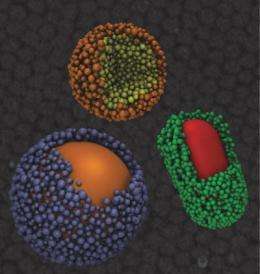
Engineering researchers have discovered that under the right circumstances, basic atomic forces can be exploited to enable nanoparticles to assemble into superclusters that are uniform in size and share attributes with viruses. Credit: T.D.Nguyen, Glotzer Group, University of Michigan

(PhysOrg.com) -- A delicate balance of atomic forces can be exploited to make nanoparticle superclusters that are uniform in size---an attribute that's important for many nanotech applications but hard to accomplish, University of Michigan researchers say.

The same type of forces are at work bringing the building blocks of viruses together, and the inorganic supercluster structures in this research are in many ways similar to viruses.

U-M chemical engineering professors Nicholas Kotov and Sharon Glotzer led the research. The findings are newly published online in Nature Nanotechnology.

In another instance of forces behaving in unexpected ways at the nanoscale, they discovered that if you start with small building blocks that are varied enough in size, the force and attraction force will balance each other and limit the growth of the clusters. This equilibrium enables the formation of clusters that are uniform in size.

"The breakthrough here is that we've discovered a generic mechanism that causes these to assemble into near perfect structures," Glotzer said. "The physics that we see is not special to this system, and could be exploited with other materials. Now that we know how it works, we can design new building blocks that will assemble the same way."

The inorganic superclusters---technically called "supraparticles"---that the researchers created out of red, powdery are not artificial viruses. But they do share many attributes with the simplest forms of life, including size, shape, core-shell structure and the abilities to both assemble and dissemble, Kotov said.

"Having these functionalities in totally inorganic system is quite remarkable," Kotov said. "There is the potential to combine them with the beneficial properties of such as environmental resilience, light and ."

Zhiyong Tang, a collaborating professor at the National Center of Nanoscience and Technology in China, said, "It is also very impressive that such supraparticles can be further used as the building blocks to fabricate three-dimensional ordered assemblies. This secondary self-assembly behavior provides a feasible way to obtain large-scale nanostructures that are important for practical application."

Kotov is currently working on "breeding" these supraparticles to produce synthetic fuels from carbon dioxide. The work also has applications in drug delivery and solar cell research and it could dramatically reduce the cost of manufacturing large quantities of supraparticles.

"By replicating the self-assembly processes that allow living organisms to grow and heal, we can simplify the production of many useful nanostructured systems from semiconductors and metals so much so that they can be made in any high school laboratory," Kotov said.

Provided by University of Michigan search and more info website

4.4 /5 (11 votes)  

Filter


Move the slider to adjust rank threshold, so that you can hide some of the comments.


Display comments: newest first

maxcypher
Aug 23, 2011

Rank: 5 / 5 (2)
I'm I wrong, or is this the seminal break through we've been waiting for?
fmfbrestel
Aug 23, 2011

Rank: 5 / 5 (3)
Another concrete example of self-assembly. All the closet intelligent designers will be voting this down in an attempt to bury it on the site. Every time something like this is demonstrated it weakens their central argument a little bit.
210
Aug 24, 2011

Rank: not rated yet
Yes, self-assemble, good, a balancing act between forces, but,...but self animate on the nanoscalular level, now THAT would be the"seminal breakthrough!"To animate matter, would be the focal point of more than forces balancing/cancelling each other out, indeed, it would be a force, akin to our understanding of the interplay between matter and energy. One becoming the other, in proper equivalence, matter being made, energy never being destroyed. It would be a force that sees the RESULT of forces balancing, that is; creating these structures that this article is talking about, for example, and then ANIMATING them because they do/have met the minimum collective functional groups TO BE animated...whatever that may ultimately be.
The basic structures and the forces that are balanced speak purely of the laws of physics that exist, EXISTED, and were merely waiting for human minds to discover. This all speaks of ORDER, in a material world that obeys the dominion of ENTROPY.
Word-2-ya-muthas
210
Aug 24, 2011

Rank: not rated yet
I'm I wrong, or is this the seminal break through we've been waiting for?

I for one do not believe you are wrong, you merely lapsed in your use of proper syntax/grammar/word-choice, in your haste to post - no biggy!
This discovery speaks of bigger things to come from the smallest things we humans have yet observed basic to the creation of much larger things.
Word-to-ya-muthas
Augusta_Tina
Aug 24, 2011

Rank: not rated yet
wow i like this interesting blog so cool thanks for posting and i will share this to my friends..keep it up
Rank 4.4 /5 (11 votes)
Relevant PhysicsForums posts
  • Water flow question
    created3 hours ago
  • [Drift velocity] Factors affecting velocity
    created5 hours ago
  • does cold gasoline have less energy
    created6 hours ago
  • distribution of molecules throughout the atmosphere
    created8 hours ago
  • The Global Positioning System !
    created9 hours ago
  • A Question relating Power
    created10 hours ago
  • More from Physics Forums - General Physics

More news stories

'Unzipped' carbon nanotubes could help energize fuel cells, batteries

Multi-walled carbon nanotubes riddled with defects and impurities on the outside could replace some of the expensive platinum catalysts used in fuel cells and metal-air batteries, according to scientists at ...

Nanotechnology / Nanomaterials

created 37 minutes ago | popularity not rated yet | comments 0 | with audio podcast

In nanorod crystal growth, nanoparticles seen as artificial atoms

In the growth of crystals, do nanoparticles act as "artificial atoms" forming molecular-type building blocks that can assemble into complex structures? This is the contention of a major but controversial theory ...

Nanotechnology / Nanophysics

created May 24, 2012 | popularity 4.8 / 5 (6) | comments 0 | with audio podcast

Dopant gives graphene solar cells highest efficiency yet

(Phys.org) -- By taking advantage of graphene’s favorable electrical and optical properties, and then adding an organic dopant, researchers have achieved the highest power conversion efficiency yet for ...

Nanotechnology / Nanophysics

created May 21, 2012 | popularity 5 / 5 (10) | comments 14 | with audio podcast feature

First direct observation of oriented attachment in nanocrystal growth

Berkeley Lab researchers have reported the first direct observation of nanoparticles undergoing oriented attachment, the critical step in biomineralization and the growth of nanocrystals. A better understanding ...

Nanotechnology / Nanophysics

created May 24, 2012 | popularity 4.7 / 5 (3) | comments 0 | with audio podcast

Synthetic nano-waste does not disappear

(Phys.org) -- Tiny particles of cerium oxide do not burn or change in the heat of a waste incineration plant. They remain intact on combustion residues or in the incineration system, as a new study by Swiss ...

Nanotechnology / Bio & Medicine

created May 25, 2012 | popularity 5 / 5 (2) | comments 1 | with audio podcast


Change in developmental timing was crucial in the evolutionary shift from dinosaurs to birds: study

At first glance, it's hard to see how a common house sparrow and a Tyrannosaurus Rex might have anything in common. After all, one is a bird that weighs less than an ounce, and the other is a dinosaur that ...

Computer model used to pinpoint prime materials for efficient carbon capture

When power plants begin capturing their carbon emissions to reduce greenhouse gases – and to most in the electric power industry, it's a question of when, not if – it will be an expensive undertaking.

T cells 'hunt' parasites like animal predators seek prey, study shows

By pairing an intimate knowledge of immune-system function with a deep understanding of statistical physics, a cross-disciplinary team at the University of Pennsylvania has arrived at a surprising finding: T cells use a movement ...

Manufacturing genes to attack flu virus

An international research team has manufactured a new protein that can combat deadly flu epidemics.

Yale study concludes public apathy over climate change unrelated to science literacy

Are members of the public divided about climate change because they don't understand the science behind it? If Americans knew more basic science and were more proficient in technical reasoning, would public consensus match ...

Same gene that stunts infants' growth also makes them grow too big: research

UCLA geneticists have identified the mutation responsible for IMAGe* syndrome, a rare disorder that stunts infants' growth. The twist? The mutation occurs on the same gene that causes Beckwith-Wiedemann syndrome, which makes ...