Nano-thermometers show first temperature response differences within living cells
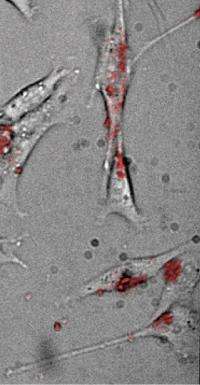
Using a modern version of open-wide-and-keep-this-under-your-tongue, scientists today reported taking the temperature of individual cells in the human body, and finding for the first time that temperatures inside do not adhere to the familiar 98.6 degree Fahrenheit norm. They presented the research at the 242nd National Meeting & Exposition of the American Chemical Society (ACS), being held here this week.
Haw Yang and Liwei Lin, who collaborated on the research, did not use a familiar fever thermometer to check the temperature of cells, the 100 trillion or so microscopic packages of skin, nerve, heart, liver and other material that make up the human body. Cells are so small that almost 60,000 would fit on the head of a common pin. Yang is with Princeton University and Lin is with the University California-Berkeley.
“We used ‘nano-thermometers’,” Yang explained. “They are quantum dots, semiconductor crystals small enough to go right into an individual cell, where they change color as the temperature changes. We used quantum dots of cadmium and selenium that emit different colors (wavelengths) of light that correspond to temperature, and we can see that as a color change with our instruments.”
Yang said that information about the temperatures inside cells is important, but surprisingly lacking among the uncountable terabytes of scientific data available today.
“The inside of a cell is so complicated, and we know very little about it,” he pointed out. “When one thinks about chemistry, temperature is one of the most important physical factors that can change in a chemical reaction. So, we really wanted to know more about the chemistry inside a cell, which can tell us more about how the chemistry of life occurs.”
Scientists long have suspected that temperatures vary inside individual cells. Yang explained that thousands of biochemical reactions at the basis of life are constantly underway inside cells. Some of those reactions produce energy and heat. But some cells are more active than others, and the unused energy is discharged as heat. Parts of individual cells also may be warmer because they harbor biochemical power plants termed mitochondria for producing energy.
The researchers got that information by inserting the nano-thermometers into mouse cells growing in laboratory dishes. They found temperature differences of a few degrees Fahrenheit between one part of some cells and another, with parts of cells both warmer and cooler than others. Their temperature measurements are not yet accurate enough to give an exact numerical figure. Yang’s team also intentionally stimulated cells in ways that boosted the biochemical activity inside cells and observed temperature changes.
Yang says that those temperature changes may have body-wide impacts in determining health and disease. Increases in temperature inside a cell, for instance, may change the way that the genetic material called DNA works, and thus the way that the genes, which are made from DNA, work. Changing the temperature will also change how protein molecular machines operate. At higher temperatures, some proteins may become denatured, shutting down production.
“With these nano thermometer experiments, I believe we are the first to show that the temperature responses inside individual living cells are heterogeneous — or different,” said Yang. “This leads us to our next hypothesis, which is that cells may use differences in temperature as a way to communicate.”
Yang’s team is now conducting experiments to determine what regulates the temperature inside individual cells. One goal is to apply the information in improving prevention, diagnosis and treatment of diseases.
Provided by American Chemical Society


