Micro-explosion reveals new super-dense aluminium
August 24, 2011 By Janet Rae-Dupree

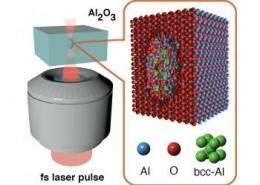
Creating the heart of a planet in the heart of a gem

Enlarge

Credit: Arturas Vailionis.

(PhysOrg.com) -- Although materials scientists have theorized for years that a form of super-dense aluminum exists under the extreme pressures found inside a planet’s core, no one had ever actually seen it. Until now.

A team including researcher Arturas Vailionis of SLAC and Stanford blasted tiny bits of sapphire with a new table-top laser device that penetrates crystals and sets off micro-explosions inside them, creating powerful shock waves that compress the surrounding material. Under these extreme conditions – terapascals of pressure and temperatures of 100,000 Kelvin – warm dense matter forms, the state of matter between a solid and a plasma.

Because sapphire is a form of aluminum oxide, or alumina, researchers expected to find evidence of various phases of high-pressure alumina inside the gem. Instead, they observed minuscule amounts of a surprisingly stable, highly-compressed form of elemental aluminum called body-centered cubic aluminum.

Their results appear in yesterday’s edition of Nature Communications. The team included scientists from Australia, Japan, and the Carnegie Institution of Washington.

Vailionis, a researcher with the Geballe Laboratory for Advanced Materials and Stanford Institute for Materials & Energy Sciences, examined the interior of the sapphire and found the novel form of aluminum with a beam of X-ray light from the Advanced Photon Source at Argonne National Laboratory. The laser experiment itself was performed at Shizuoka University in Japan.

“High pressure experiments generally are done either with big equipment or with a diamond anvil cell where two diamonds are squeezing a tiny bit of material, but even diamond gives up at a certain point with those pressures,” Vailionis said. “But this very short pulse of laser light actually ionizes all the material within a very small volume over a short time and creates a plasma which is under enormous pressure and temperature” without fracturing the outer shell of the sapphire.

Of particular note, the paper says, is that the team “demonstrated that high energy density produced in a simple tabletop experiment makes it possible to form an exotic high-density material phase which could not be produced by other means.”

While scientists long have predicted that new classes of materials with unusual combinations of physical properties should exist under extreme and temperature conditions, only hcp-Al, the hexagonal close-packed aluminum phase, had been observed previously.  The form made in this experiment is bcc-Al, or body-centered cubic aluminum.

Vailionis said he doesn’t expect the research to result in production of new materials in large quantities any time soon, but he believes the equipment used in the experiment offers a new strategy for synthesizing nanoscale amounts of new materials in the laboratory, and opens new possibilities for tabletop research into warm dense matter – the state of matter between a solid and a plasma. Such work could bring scientists a step closer to understanding Earth’s early history.

“Now we’re thinking about different materials we could use to recreate some of the environments that existed deep in the Earth’s core when the planet was forming,” he said.

More information: Evidence of Superdense Aluminium Synthesized by Ultrafast Microexplosion, Nature Communications (2011).

Provided by SLAC National Accelerator Laboratory search and more info website

4.9 /5 (18 votes)  

Filter


Move the slider to adjust rank threshold, so that you can hide some of the comments.


Display comments: newest first

hard2grep
Aug 24, 2011

Rank: not rated yet
I wonder what kind of properties this state of aluminum has.
jkbgbr
Aug 24, 2011

Rank: 5 / 5 (5)
let's hope it is transparent
Isaacsname
Aug 24, 2011

Rank: 1 / 5 (1)
I bet it has applications for rocket propulsion.
NeptuneAD
Aug 24, 2011

Rank: not rated yet
@jkbgbr
Transparent Aluminum, another Star Trek item that could end up being reality eh.
Isaacsname
Aug 24, 2011

Rank: not rated yet
@jkbgbr
Transparent Aluminum, another Star Trek item that could end up being reality eh.


Like Aluminium oxynitride ?
Sonhouse
Aug 25, 2011

Rank: 5 / 5 (1)
I bet it has applications for rocket propulsion.

Maybe for a nano rocket. They are not going to be making industrial quantities with this technique any time soon.
Ricochet
Aug 25, 2011

Rank: not rated yet
I bet it has applications for rocket propulsion.

Or batteries
Graeme
Aug 25, 2011

Rank: 1 / 5 (1)
It will still be metallic and not transparent, it is 40% denser than normal aluminium si that is why it is called superdense.
This has potential to make other even more superdense materials, and possibly stronger as well. They could be denser than the currently known densest material on earth.
Getting the aluminium to part with oxygen is unusual, and ti would be interesting to see the thermodynamics of that!
Vendicar_Decarian
Aug 29, 2011

Rank: not rated yet
I can't wait to see how exploding buildings reveal how super-dense American TeaPublican are.
Rank 4.9 /5 (18 votes)
Relevant PhysicsForums posts
  • Water flow question
    created2 hours ago
  • [Drift velocity] Factors affecting velocity
    created5 hours ago
  • does cold gasoline have less energy
    created6 hours ago
  • distribution of molecules throughout the atmosphere
    created8 hours ago
  • The Global Positioning System !
    created9 hours ago
  • A Question relating Power
    created10 hours ago
  • More from Physics Forums - General Physics

More news stories

Is a classical electrodynamics law incompatible with special relativity?

(Phys.org) -- The laws of classical electromagnetism that were developed in the 19th century are the same laws that scientists use today. They include Maxwell’s four equations along with the Lorentz la ...

Physics / General Physics

created May 24, 2012 | popularity 4.7 / 5 (17) | comments 43 | with audio podcast feature

Landmark calculation clears the way to answering how matter is formed

(Phys.org) -- An international collaboration of scientists, including Thomas Blum, associate professor of physics, is reporting in landmark detail the decay process of a subatomic particle called a kaon – ...

Physics / General Physics

created May 25, 2012 | popularity 4.3 / 5 (22) | comments 50 | with audio podcast

Lying in wait for WIMPs: Researchers seek to dramatically increase sensitivity of Large Underground Xenon detector

Although it's invisible, dark matter accounts for at least 80 percent of the matter in the universe. No one knows what it is, but most scientists would bet on weakly interacting massive particles, or WIMPs.

Physics / General Physics

created May 23, 2012 | popularity 4 / 5 (7) | comments 15 | with audio podcast

Hawaii lab turns laser-powered bubbles into microrobots

(Phys.org) -- A team of scientists from the University of Hawaii are working on microrobots created from bubbles of air in a saline solution. The bubbles take on their title of “robots” as a laser ...

Physics / General Physics

created May 23, 2012 | popularity 5 / 5 (4) | comments 2 | with audio podcast weblog

Sound increases the efficiency of boiling

Scientists at the Georgia Institute of Technology achieved a 17-percent increase in boiling efficiency by using an acoustic field to enhance heat transfer. The acoustic field does this by efficiently removing vapor bubbles ...

Physics / Soft Matter

created May 24, 2012 | popularity 5 / 5 (2) | comments 2


Change in developmental timing was crucial in the evolutionary shift from dinosaurs to birds: study

At first glance, it's hard to see how a common house sparrow and a Tyrannosaurus Rex might have anything in common. After all, one is a bird that weighs less than an ounce, and the other is a dinosaur that ...

Computer model used to pinpoint prime materials for efficient carbon capture

When power plants begin capturing their carbon emissions to reduce greenhouse gases – and to most in the electric power industry, it's a question of when, not if – it will be an expensive undertaking.

'Unzipped' carbon nanotubes could help energize fuel cells, batteries

Multi-walled carbon nanotubes riddled with defects and impurities on the outside could replace some of the expensive platinum catalysts used in fuel cells and metal-air batteries, according to scientists at ...

T cells 'hunt' parasites like animal predators seek prey, study shows

By pairing an intimate knowledge of immune-system function with a deep understanding of statistical physics, a cross-disciplinary team at the University of Pennsylvania has arrived at a surprising finding: T cells use a movement ...

Manufacturing genes to attack flu virus

An international research team has manufactured a new protein that can combat deadly flu epidemics.

Yale study concludes public apathy over climate change unrelated to science literacy

Are members of the public divided about climate change because they don't understand the science behind it? If Americans knew more basic science and were more proficient in technical reasoning, would public consensus match ...