Lava rocks from three continents and oceanic plateau traced to same lava plume
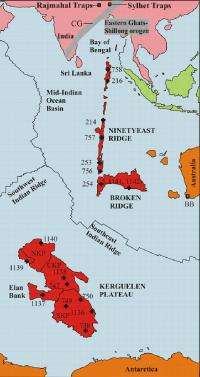
(PhysOrg.com) -- The Sylhet Traps lava flows of the Shillong Plateau in northeastern India lie some 340 miles to the east of the Rajmahal Traps at the bend of the Ganges River as it flows south to the Bay of Bengal. Almost 1,000 miles to the south is the 3,000 mile-long Ninetyeast Ridge rising a mile above the surrounding Indian Ocean floor, still beneath the seawater. To the east from the southern edge of this Ridge, some 1,600 miles away is the edge of western Australia. And finally, 2,500 miles to the southwest is the underwater Kerguelen Plateau, just off of Antarctica.
Despite these vast distances, research by University of Rochester Geochemistry Professor Asish Basu shows great similarities in the chemical and isotopic signatures of lava rock samples from all these regions.
Basu, whose findings were recently published in the journal Earth and Planetary Science Letters, says the samples all came from the same lava plume that seems to have broken apart the Gondwana supercontinent—which formed some 500 million years ago by the amalgamation of the continental landmasses of Antarctica, South America, Africa, Madagascar, Australia, the Arabian Peninsula, and the Indian subcontinent. And Basu says his findings confirm the plume's role in breaking up this Gondwana supercontinent.
The fragmenting of Gondwana started when three plumes—Kerguelen, Marion, and Reunion—heated the lithosphere (the earth's crust and upper mantle). The Kerguelen plume began as heated deep mantle rocks, which rose 1,800 miles from the core-mantle boundary and spread out near the Earth's surface. As the tectonic plates moved north, the head of the plume remained attached to the core by its stem, while a north-south plume-tail developed, tracking the northward movement of the Indian plate. Basu's work shows the plate also took with it part of the broken plume-head, which ended up in disjointed fragments at the foothills of the Himalayas, Rajmahal Hills and in the Shillong Plateau, as well as beneath the Bengal Basin, all in the northeastern part of India.
The rest of the plume-head can be found in Australia, Antarctica, and the Kerguelen Plateau. Basu's findings are based on the detailed chemical and isotopic analysis of lava rock samples from all the locations, which show similar geochemical concentrations of 25 trace elements, as well as isotopes of the elements strontium, neodymium, and lead.
"It's important to understand large regions of igneous rock formations—called large igneous provinces," said Basu, "because they often break apart continents and are sometimes associated with environmental catastrophes, like mass extinctions."
Basu says the Ninetyeast Ridge, which lies in a north-south direction and points to the Sylhet and Rajmahal Traps, shows the direction of the plate movement that broke up the supercontinent into today's configuration.
Provided by University of Rochester


