Fossils of forest rodents found in highland desert
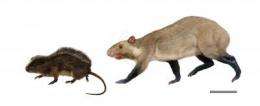
Two new rodent fossils were discovered in the arid highlands of southern Bolivia by researchers from Case Western Reserve University School of Medicine and Universidad Autónoma Tomás Frías.
The larger of the two rodents, named Mesoprocta hypsodus, probably looked something like a guinea pig on stilts, said Darin Croft, an anatomy professor at Case Western Reserve. The smaller, Quebradahondomys potosiensis, was a spiny rat.
An online article in the Journal of Mammalian Evolution describes the new species, a possible third, and two known species that are new inhabitants to that location.
"The two new species are pretty rare," said Croft. Various teams have been working the Bolivian site, called Quebrada Honda, on and off since the late 1970s. Croft's team has been working there for the past five years and has identified only one fossilized piece of jawbone from each animal.
Croft has been working this remote area, about 12,000 feet above sea level, as well as largely understudied areas in the mountains of northern and central Chile, for 14 years. The research sites are among the highest in the Western Hemisphere.
He and his colleagues have found and documented remains of more than two-dozen new species of mammals, ranging from mouse-sized marsupials to giant armadillos and hoofed, sheep-sized grazers in that time.
Prior research using radiometric and paleomagnetic dating techniques puts the age of the fossils at Quebrada Honda in the range of 12.5 to 13 million years ago.
Though the finds were limited to one fossil each, the teeth provide the telltale features needed to determine their kin and identify them as unique.
Mesoprocta hypsodus is related to agoutis and acouchis, two types of current and common rodents found from Costa Rica to Brazil. Tall, complex teeth are typical of these rodents, which are known for their flatish face, long legs and quickness.
Based on the dimensions of the jawbone and teeth, Croft estimates the extinct rodent was about 18 to 20 inches long, 8 inches to a foot at the shoulder and weighed 8 to 10 pounds.
Croft said that although it probably ate fruits and nuts and spent much of its time foraging among the trees, like its modern relatives, its durable teeth indicate that it may also have ventured into more open areas. Forested habitats no longer exist in the Quebrada Honda area.
Quebradahondomys potosiensis is a rat-sized relative of extant spiny rats, which are mostly tree-dwelling relatives of guinea pigs and chinchillas that have spiny coats and tails that easily break off to help them escape from predators. Currently, spiny rats are found throughout Central America and most of South America.
The molar teeth, which are shaped like a "3" or an "E", are typical of a particular subgroup of spiny rats and indicate the extinct rodent fed on a leafy diet. The researchers say it was at least partially arboreal and may have been living in the same trees among which Mesoprocta hypsodus foraged on the ground.
In addition to the two new species above, Croft's group found a number of fossils from the genus Acarechimys.
The remains indicate the animal was about hamster-sized, lived in rocky or bushy environs and fed on leaves and seeds.
Fossils from the genus have been found from Colombia to the southern tip of Argentina, but close analysis is needed to break them down into species. The researchers hope to work with others to define species found.
The most common fossils at the site are from relatives of chinchillas, all of the genus Prolagostomus. They were found in such high numbers that the researchers believe the animals were highly social and, like some of their current relatives, lived in communities much as prairie dogs do today.
Again, closer analysis of known fossils from here and other locations is needed to determine species. Studies of variation in modern relatives will also aid these studies.
Lastly, the investigators found fossils of Guiomys unica, a relative of the guinea pig. The species, estimated to be about the size of a large rabbit but proportioned like a cat, was previously found only in the Patagonia region of Argentina, well over 1,000 miles away.
The animal was likely a grass and leaf eater that frequented both open and more sheltered habitats, the researchers said.
The group is continuing to analyze other fossils it has found in this and other Bolivian sites. They plan to return to the field next year to continue searching for fossils and a clearer picture of the past.
"We're a step closer to pulling the whole fauna together," Croft said. "I fully expect we'll get some more new stuff in the next few years."
Provided by Case Western Reserve University


