Ethane levels yield information about changes in greenhouse gas emissions
August 15, 2011

Ethane levels yield information about changes in greenhouse gas emissions

Enlarge

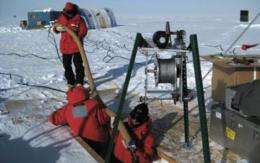
Researchers sample ice to investigate the history of fossil-fuel emissions of methane, based on measurements of another hydrocarbon, ethane, in air trapped in the polar ice sheets in Antarctica. The ancient air resides close to the surface, within the perennial snowpack, and can be used to study changes in the atmosphere that occurred during the twentieth century. Credit: National Science Foundation

Recent data from NSF-funded research in both Greenland and Antarctica demonstrate that fossil-fuel related emissions of both methane and ethane, two of the most abundant hydrocarbons in the atmosphere, declined at the end of the twentieth century, according to a paper published Thursday in the journal Nature.

The causes of the decline in methane emission rates to the atmosphere have been puzzling scientists for some time. This new study shows that a change in human activities may have played a key role in the recent leveling off of methane, which, being a contributes to .

Murat Aydin from the University of California, Irvine is the lead author of the paper. Other researchers include Kristal Verhulst, Eric Saltzman, Donald Blake, Qi Tang, and Michael Prather from UCI, Mark Battle from Bowdoin College, and Stephen Montzka from the National Oceanic and Atmospheric Administration.

The team investigated the history of fossil-fuel emissions of methane, based on measurements of another , ethane, in air trapped in the in Greenland and Antarctica. The ancient air resides close to the surface, within the perennial snowpack, and can be used to study changes in the atmosphere that occurred during the twentieth century.

"Fossil fuels are a common source of both ethane and methane. Methane has many other sources, but we know most of the ethane in the atmosphere today is from . If ethane changes, it is easier to figure out the cause" said Aydin. "After carbon dioxide, methane is the second most important . This research was conducted to track ethane and to see what it could tell us about methane. We found that ethane emissions declined at the same time as the rise in methane dramatically slowed, suggesting a common cause." At the end of the 20th century, methane and ethane were deemed valuable ; collected and consumed as natural gas they are converted to carbon dioxide. The researchers' results for this time frame indicate that the leveling off in atmospheric methane in recent years is likely linked to this change in energy use.

"This research helps explain why atmospheric methane levels stabilized at the end of the twentieth century" said co-author Eric Saltzman. "Methane levels are important for global climate and understanding how human activities affect methane is a key part of predicting how much warming we may expect in the future."

"We still have more research to conduct, but this discovery is significant to our efforts in determining the link between ethane and and what it may tell us about climate change," said Julie Palais, NSF program director. "We must work together to continue to find ways to further our research on this very important subject."

Provided by National Science Foundation search and more info website

Filter


Move the slider to adjust rank threshold, so that you can hide some of the comments.


Display comments: newest first

NotParker
Aug 15, 2011

Rank: 1 / 5 (1)
Methane follows temperature. It stopped warming.
SemiNerd
Aug 15, 2011

Rank: 5 / 5 (1)
Methane follows temperature. It stopped warming.

I wish the data actually confirmed your wild speculation. Unfortunately, it doesn't. You might want to have theories based on actual data before proposing them here. Speculations without data belong in religious or political forums, not in a scientific one.
Skepticus_Rex
Aug 16, 2011

Rank: not rated yet
An hypothesis does not require data. A theory must. And, on earth at least, methane does follow temperature.

Microbes generate more of the stuff when it is warmer than they do when it is colder. More methane is released into the atmosphere from various sources during times of warming than otherwise. That is well-known science.

It is entirely possible that it might not be getting much warmer, or it could be another cause entirely. It is time to look at the isotopes and try to figure out what really is going on.
3432682
Aug 16, 2011

Rank: not rated yet
There are lots of methane hydrates frozen in the oceans. Warming drives them out, cooling the reverse. (Same for CO2 in the oceans.) Earth is in a cooling phase of the PDO-AO (Pacific and Atlantic) oscillations, a 60-year cycle.
Rank 5 /5 (1 vote)
Relevant PhysicsForums posts

More news stories

Sophisticated simulations predict future warming

The chances of our planet being hit by a global warming of 3 degrees Celsius by 2050 is as likely as it being hit by an increase of 1.4 degrees, new research shows. Presented in the journal Nature Geoscience, the British study ...

Space & Earth / Earth Sciences

created May 22, 2012 | popularity 4.4 / 5 (9) | comments 51

Kyoto Protocol architect 'frustrated' by climate dialogue

UN climate talks are going nowhere, as politicians dither or bicker while the pace of warming dangerously speeds up, one of the architects of the Kyoto Protocol told AFP.

Space & Earth / Environment

created May 23, 2012 | popularity 3.7 / 5 (7) | comments 39

Aliens don't want to eat us, says former SETI director

Alien life probably isn’t interested in having us for dinner, enslaving us or laying eggs in our bellies, according to a recent statement by former SETI director Jill Tarter.

Space & Earth / Space Exploration

created May 25, 2012 | popularity 4.4 / 5 (13) | comments 38

Dragon arrives at space station in historic 1st (Update 2)

The privately bankrolled Dragon capsule made a historic arrival at the International Space Station on Friday, triumphantly captured by astronauts wielding a giant robot arm.

Space & Earth / Space Exploration

created May 25, 2012 | popularity 5 / 5 (10) | comments 19

What's the big deal about private space launches?

(AP) -- The first private spaceship is headed to the International Space Station. Some questions and answers about the cargo mission by Space Exploration Technologies, known as SpaceX:

Space & Earth / Space Exploration

created May 22, 2012 | popularity 5 / 5 (6) | comments 35


Nvidia trumpets Tegra 3 phone design wins for 2012

(Phys.org) -- Nvidia’s competitive war paint has a name, Tegra 3. On the heels of Nvidia announcements about lowering costs of its Tegra 3 processors and Nvidia-enabled tablets running Android Ice Cream ...

Browser wars flare in mobile space

The browser wars are heating up again, but this time the fight is for dominance of the mobile Internet.

Scientist: Evolution debate will soon be history

(AP) -- Richard Leakey predicts skepticism over evolution will soon be history. Not that the avowed atheist has any doubts himself.

Dell tablet leak: 10.1-inch display, two-battery choice

(Phys.org) -- Headline after headline talks about vendors’ tablets in the wings as likely number-one contenders for the iPad. Such claims have justifiably been taken with a grain of salt, considering ...

Keep food safety in mind this memorial day weekend

(HealthDay) -- Picnics, parades and cookouts are as much a part of Memorial Day weekend as tributes to the United States' war veterans.

Social welfare cuts ultimately come with heavy price, researchers say

(Phys.org) -- Slashing government funding for Medicaid, food stamps and other programs that serve the poor – while politically popular with some lawmakers and many conservatives – may do more harm ...