Researchers detail how a distant black hole devoured a star
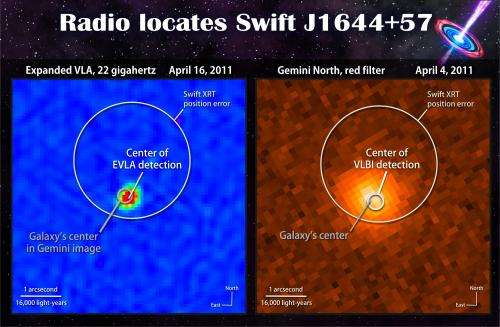
Positions from Swift's XRT constrained the source to a small patch of sky that contains a faint galaxy known to be 3.9 billion light-years away. But to link the Swift event to the galaxy required observations at radio wavelengths, which showed that the galaxy's center contained a brightening radio source. Analysis of that source using the Expanded Very Large Array and Very Long Baseline Interferometry (VLBI) shows that it is still expanding at more than half the speed of light. Credit: NRAO/CfA/Zauderer et al.
(PhysOrg.com) -- Two studies appearing in the Aug. 25 issue of the journal Nature provide new insights into a cosmic accident that has been streaming X-rays toward Earth since late March. NASA's Swift satellite first alerted astronomers to intense and unusual high-energy flares from the new source in the constellation Draco.
"Incredibly, this source is still producing X-rays and may remain bright enough for Swift to observe into next year," said David Burrows, professor of astronomy at Penn State University and lead scientist for the mission's X-Ray Telescope instrument. "It behaves unlike anything we've seen before."
Astronomers soon realized the source, known as Swift J1644+57, was the result of a truly extraordinary event -- the awakening of a distant galaxy's dormant black hole as it shredded and consumed a star. The galaxy is so far away, it took the light from the event approximately 3.9 billion years to reach Earth.
Burrows' study included NASA scientists. It highlights the X- and gamma-ray observations from Swift and other detectors, including the Japan-led Monitor of All-sky X-ray Image (MAXI) instrument aboard the International Space Station.
The second study was led by Ashley Zauderer, a post-doctoral fellow at the Harvard-Smithsonian Center for Astrophysics in Cambridge, Mass. It examines the unprecedented outburst through observations from numerous ground-based radio observatories, including the National Radio Astronomy Observatory's Expanded Very Large Array (EVLA) near Socorro, N.M.
Most galaxies, including our own, possess a central supersized black hole weighing millions of times the sun's mass. According to the new studies, the black hole in the galaxy hosting Swift J1644+57 may be twice the mass of the four-million-solar-mass black hole in the center of the Milky Way galaxy. As a star falls toward a black hole, it is ripped apart by intense tides. The gas is corralled into a disk that swirls around the black hole and becomes rapidly heated to temperatures of millions of degrees.
The innermost gas in the disk spirals toward the black hole, where rapid motion and magnetism create dual, oppositely directed "funnels" through which some particles may escape. Jets driving matter at velocities greater than 90 percent the speed of light form along the black hole's spin axis. In the case of Swift J1644+57, one of these jets happened to point straight at Earth.
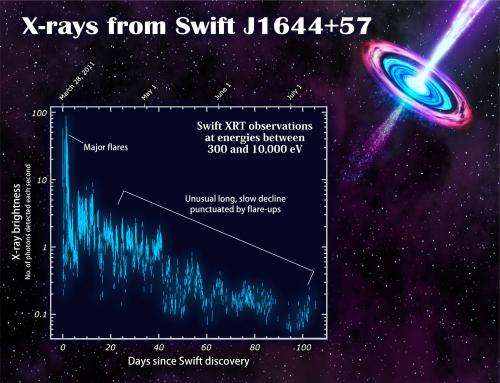
Swift's X-Ray Telescope continues to record high-energy flares from Swift J1644+57 more than three months after the source's first appearance. Astronomers believe that this behavior represents the slow depletion of gas in an accretion disk around a supermassive black hole. The first flares from the source likely coincided with the disk's creation, thought to have occurred when a star wandering too close to the black hole was torn apart. Credit: NASA/Swift/Penn State
"The radio emission occurs when the outgoing jet slams into the interstellar environment," Zauderer explained. "By contrast, the X-rays arise much closer to the black hole, likely near the base of the jet."Theoretical studies of tidally disrupted stars suggested they would appear as flares at optical and ultraviolet energies. The brightness and energy of a black hole's jet is greatly enhanced when viewed head-on. The phenomenon, called relativistic beaming, explains why Swift J1644+57 was seen at X-ray energies and appeared so strikingly luminous.
When first detected March 28, the flares were initially assumed to signal a gamma-ray burst, one of the nearly daily short blasts of high-energy radiation often associated with the death of a massive star and the birth of a black hole in the distant universe. But as the emission continued to brighten and flare, astronomers realized that the most plausible explanation was the tidal disruption of a sun-like star seen as beamed emission.
By March 30, EVLA observations by Zauderer's team showed a brightening radio source centered on a faint galaxy near Swift's position for the X-ray flares. These data provided the first conclusive evidence that the galaxy, the radio source and the Swift event were linked.
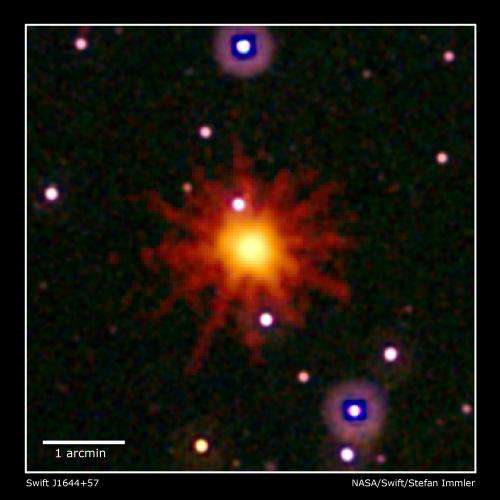
Images from Swift's Ultraviolet/Optical (white, purple) and X-Ray telescopes (yellow and red) were combined to make this view of Swift J1644+57. Evidence of the flares is seen only in the X-ray image, which is a 3.4-hour exposure taken on March 28, 2011. Credit: NASA/Swift/Stefan Immler
"Our observations show that the radio-emitting region is still expanding at more than half the speed of light," said Edo Berger, an associate professor of astrophysics at Harvard and a coauthor of the radio paper. "By tracking this expansion backward in time, we can confirm that the outflow formed at the same time as the Swift X-ray source."Swift, launched in November 2004, is managed by NASA's Goddard Space Flight Center in Greenbelt, Md. It is operated in collaboration with Penn State, the Los Alamos National Laboratory in N.M. and Orbital Sciences Corp., in Dulles, Va., with international collaborators in the U.K., Italy, Germany and Japan. MAXI is operated by the Japan Aerospace Exploration Agency as an external experiment attached to the Kibo module of the space station. For images and animations related to the studies, visit: http://www.nasa.gov/swift
Provided by
NASA's Goddard Space Flight Center
-
From lemons to lemonade: Reaction uses carbon dioxide to make carbon-based semiconductor,
32 comments
-
Thioridazine kills cancer stem cells in human while avoiding toxic side-effects of conventional cancer treatments,
3 comments
-
SpaceX private rocket blasts off for space station (Update),
42 comments
-
Climate scientists say they have solved riddle of rising sea,
31 comments
-
SpaceX capsule has 'new car' smell, astronauts say (Update),
2 comments
-
revamping general concept and cosmological principle
May 25, 2012
-
Transiting Exoplanet Light Curve
May 25, 2012
-
Math behind Theoretical Physics
May 24, 2012
-
Do we know whats at the center of galaxies yet?
May 23, 2012
-
Structure of the Milky Way?
May 20, 2012
-
What would it take to terraform Pluto and Charon?
May 19, 2012
- More from Physics Forums - General Astronomy
More news stories
Sophisticated simulations predict future warming
The chances of our planet being hit by a global warming of 3 degrees Celsius by 2050 is as likely as it being hit by an increase of 1.4 degrees, new research shows. Presented in the journal Nature Geoscience, the British study ...
Space & Earth / Earth Sciences
May 22, 2012 |
4.4 / 5 (9) |
51
Kyoto Protocol architect 'frustrated' by climate dialogue
UN climate talks are going nowhere, as politicians dither or bicker while the pace of warming dangerously speeds up, one of the architects of the Kyoto Protocol told AFP.
May 23, 2012 |
3.7 / 5 (7) |
39
Aliens don't want to eat us, says former SETI director
Alien life probably isnt interested in having us for dinner, enslaving us or laying eggs in our bellies, according to a recent statement by former SETI director Jill Tarter.
Space & Earth / Space Exploration
May 25, 2012 |
4.4 / 5 (13) |
38
Dragon arrives at space station in historic 1st (Update 2)
The privately bankrolled Dragon capsule made a historic arrival at the International Space Station on Friday, triumphantly captured by astronauts wielding a giant robot arm.
Space & Earth / Space Exploration
May 25, 2012 |
5 / 5 (10) |
19
What's the big deal about private space launches?
(AP) -- The first private spaceship is headed to the International Space Station. Some questions and answers about the cargo mission by Space Exploration Technologies, known as SpaceX:
Space & Earth / Space Exploration
May 22, 2012 |
5 / 5 (6) |
35
Nvidia trumpets Tegra 3 phone design wins for 2012
(Phys.org) -- Nvidias competitive war paint has a name, Tegra 3. On the heels of Nvidia announcements about lowering costs of its Tegra 3 processors and Nvidia-enabled tablets running Android Ice Cream ...
Browser wars flare in mobile space
The browser wars are heating up again, but this time the fight is for dominance of the mobile Internet.
Scientist: Evolution debate will soon be history
(AP) -- Richard Leakey predicts skepticism over evolution will soon be history. Not that the avowed atheist has any doubts himself.
Dell tablet leak: 10.1-inch display, two-battery choice
(Phys.org) -- Headline after headline talks about vendors tablets in the wings as likely number-one contenders for the iPad. Such claims have justifiably been taken with a grain of salt, considering ...
Keep food safety in mind this memorial day weekend
(HealthDay) -- Picnics, parades and cookouts are as much a part of Memorial Day weekend as tributes to the United States' war veterans.
Social welfare cuts ultimately come with heavy price, researchers say
(Phys.org) -- Slashing government funding for Medicaid, food stamps and other programs that serve the poor while politically popular with some lawmakers and many conservatives may do more harm ...


Aug 24, 2011
Rank: 3.8 / 5 (4)
Aug 24, 2011
Rank: 1.9 / 5 (12)
If that turns out to be the case, then this is incidentally the characteristic shape of a Faraday (or homopolar) motor, and very similar to x-ray imagery of the center of our own galaxy, which we see at a different angle.
The notion that an invisible black hole is what ultimately causes the rotation is neither demonstrable nor even necessary. The black hole is itself unnecessary if cosmic plasmas are permitted to transfer electrical energies as their laboratory cousins do.
Plasma physicists routinely create these morphologies within the lab, so it's not clear why astrophysicists insist upon inferring black holes, nor why they position the black hole inference as the only option. In doing so, they appear to ignore decades of plasma research, make sweeping assumptions about cosmic plasmas and arguably confuse the public
Aug 24, 2011
Rank: 5 / 5 (8)
@Hannes,
Sorry to disappoint you but those apparent filaments are (well known) instrumental artifacts produced by the optics of the XRT aboard the SWIFT satellite. Your convoluted presupposition that follows is thus in error for Swift J1644 57.
Aug 24, 2011
Rank: 5 / 5 (4)
Aug 24, 2011
Rank: not rated yet
Aug 24, 2011
Rank: 1 / 5 (4)
Early explanations of star consumption predicted the event lasting only weeks, and no more than a few months. That model seems to be harder to sustain at this point.
The clock continues to tic....
http://www.physor...ion.html
Aug 24, 2011
Rank: 5 / 5 (4)
Link please.
Aug 24, 2011
Rank: 1 / 5 (2)
http://starburstf...aveblog/
Aug 24, 2011
Rank: 5 / 5 (2)
Aug 24, 2011
Rank: 5 / 5 (8)
Thanks for the link. I see LaViolette understates the x-ray light output for average quasars and then claims that Swift 1644's energy output is near the top of the range for quasar outputs! Just out of the gate that's wrong (see my link above).
Gamma ray emission from Swift 1644 is nowhere near what is observed in QSOs. The high energy spectrum is a complete mismatch with a QSO' high enery spectrum. And no observational evidence is put forth to back up his claims, only his say so. Show me credible *observations* that show that Swift 1644 is a quasar. Any reference NOT associated with LaViolette would be most welcome.
Aug 25, 2011
Rank: 1 / 5 (6)
Expecting the blackhole to decay is inverse mathematics. The blackhole inwardly decays (it becomes larger) and the larger it becomes the greater its gravitational force (in other words the bigger the baby gets the more the baby can eat).
I know this may be the incorrect article to mention this under but I really hope there is a contingency plan in place (maybe something as simple as a containment orb and a rocket to shuttle the baby blackhole to a save location where it can feed on something other than me).
IMO the mini-blackhole will not evaporate, not likely. Blackhole dynamics show a no stop acceleration into singularity (aka Nowhere).
Aug 25, 2011
Rank: 1 / 5 (6)
Relativity becomes irrelative. This singular point which appears infinitely small may contain more particles than our whole universe holds (that is, if it hold any at all). Each black hole may be a whole other universe, or, perhaps a portal into another part of our own universe. Weirder still this blackhole may be our universe, the beginning and end of the universe. The blackhole may suck in energy & matter and as a whitehole (like big bang) it may blow this matter and energy and create replicas or alternate realities, the multiverse.
It is a weird world we live in. Let's keep it long enough to normalize it.
Aug 25, 2011
Rank: 1 / 5 (5)
Aug 25, 2011
Rank: 1 / 5 (4)
What does this mean? Electroweakforce stops = time stops. Strong force becomes so dominant (without *radiation, *as in em and weak force) that all particles merge into a singular, nonexistent point.
Aug 25, 2011
Rank: 1 / 5 (10)
I agree.
Black holes were proposed before neutron repulsion was discovered as the most powerful source of nuclear energy - releasing a greater fraction of rest mass as energy than fission or fusion [1].
That finding was also fatal to
a.) The AGW fable of Al Gore and the UN's IPCC, and
b.) The 1967 Bilderberg decision that Earth's heat source is a steady, homogeneous H-fusion reactor [2] that cannot cause climate change.
Black holes, AGW, and the SSM model of H-filled stars are falsified by information recorded in nuclear rest mass data [1].
Group-think Lysenkoism [3] directed by those who control research funds failed in the old USSR. Lysenkoism is also failing in the West now.
1. www.springerlink....6685079/
2. http://adsabs.har...oPh.3.5G
3. www.skepdic.com/lysenko.html
With kind regards,
Oliver K. Manuel
Former NASA Principal
Investigator for Apollo
Aug 25, 2011
Rank: 5 / 5 (3)
It will be interesting to see how common (or not) these events turn out to be (observed from Earth, that is, as opposed to their overall occurrence in the universe).
Aug 25, 2011
Rank: 5 / 5 (5)
Oliver, kindly link a published paper (by you or any competent astrophysicist) that contains *observations* conclusively showing that Sag A* ( http://en.wikiped...i/Sag_A* ) is a 4 million solar-mass "supermassive neutron star".
This might entail a quantitative discussion of your "nuclear rest mass data" and specifically how it compares with the *observed* spectrum and accretion disk properties of Sag A*.
Are you up for the heavy lifting?
Aug 25, 2011
Rank: 1 / 5 (1)
Your reference to the Sw J2058 05 paper acknowledges the possibility that this might turn out to be powered by an active AGN, if repeated outbursts are observed over the coming months and years. Still too soon to be sure. But a new class of objects is possible. (Love those classifications. Makes me feel like I have learned something!)
Aug 25, 2011
Rank: 5 / 5 (3)
Yeah, it could be an AGN. Why not compare with other published work (see comments below)? Too bad your "mentor" LaViolette only mentions that Sw J1644plus57 is noted as a putative disrupted star but goes no deeper in comparing and contrasting the expected EM emissions from the two scenarios (disrupted star vs young QSO), among other observed properties. How very scientific of him.
Do you really see no slant in his post(s)on this matter Tuxford? There are now over a half-dozen papers on this object alone now. I see he only cites one. Why is that, I wonder?
At least you "feel" you have learned something. Congrats.
Aug 26, 2011
Rank: 5 / 5 (2)
Agreed. Oliver its time you put up or shut up and provide some hard evidence and address the many questions ethelred has posed you run away from. hell, who am i kidding, we all know you are going to run away from this thread too or just answer with those same old tired links and papers that dont prove what you claim they do.
Aug 26, 2011
Rank: 5 / 5 (1)
Aug 27, 2011
Rank: 5 / 5 (1)
He's doing the same ole' evasion/denial deal over here: http://www.physor...firstCmt
Oliver can't answer simple questions by you, me, Ethel, barakan, and others, goes off on fantasy non-sequiturs about Kissinger & China, rambles on about conspiracies and ignores evidence. It's his M.O. I guess.
Someone posted he wants to talk science. I'm all ears.
Aug 28, 2011
Rank: 1 / 5 (2)
Aug 28, 2011
Rank: 5 / 5 (1)
LOL. Do your homework, rawa/Callipo/zephyr:
http://arxiv.org/...68v1.pdf
http://arxiv.org/...87v2.pdf
http://arxiv.org/...09v1.pdf
http://arxiv.org/...85v3.pdf
http://arxiv.org/...90v1.pdf
http://arxiv.org/...16v3.pdf
http://arxiv.org/...28v2.pdf
http://arxiv.org/...56v1.pdf
http://arxiv.org/...57v1.pdf
See the radio through gamma-ray SED of this object in in the last link, Fig. 1(pg 13). More than a few GR photons to go on, wouldn't you agree?