Researchers create first 3D invisibility cloak
August 11, 2011 by Bob Yirka
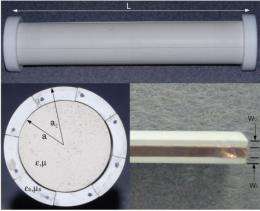
Photographs of: (top) the assembled cloak on the test cylinder with end caps; (bottom left) a cross-section view of the assembly with end cap removed; (bottom right) a shell segment edge with copper tape used to form the metallic strip for the metamaterial cloak. Image from arXiv:1107.3740v1
(PhysOrg.com) -- Science has taken one more step towards creating a true real-life cloaking device. Assistant Professor Andrea Alůin and his colleagues at the University of Texas at Austin have successfully created a cloaking device capable of "hiding" a 3D object in free space from microwaves. The team describes how they used a "plasmonic" shell to hide a cigar shaped object from one microwave polarization in their pre-printed paper on arXiv.
Cloaking devices are based on so-called metamaterials and follow up on the pioneering efforts of David Smith and his team at Duke University in North Carolina, who in 2006 first discovered it was possible through the use of metamaterials, to deflect microwave radiation around an object, thus rendering it, virtually invisible. Subsequent work by other research teams have led to 2D or 3D carpet cloaking devices that are able to cloak an object pressed against a plane. With this new research, Alůin and his team claim to have created a cloaking device able to hide an object in free space.
To create the device, the team used a plasmonic shell to cover the object being cloaked. Plasmonic materials (normally used when making solar cells) are able to bend electromagnetic radiation in unique ways, and in this case, cancel the light scattered by the object. The shell works because it is has a polarization opposite to the scattered light and thus cancels it out, effectively cloaking the object hidden within. The object in this case was a hollow dielectric (an electrical insulator that can be polarized) cylinder. The shell was comprised of the same material though it was constructed from segments separated by precision cut copper tape and held together by end-caps. The resultant cloaking device was able to suppress scattering all around the object and from more than one angle.
In the paper Alůin suggests that he knows of a way to create a similar cloaking device that would work with un-polarized light, which would allow more than just one frequency of microwaves to be used, but in this case went with just one for simplicitys sake. He also says simulations show that the same technique should work for other bandwidths, presumably infrared and optical wavelengths.
More information: Experimental 3D Plasmonic Cloaking in Free Space, David Rainwater, Aaron Kerkhoff, Kevin Melin, Andrea Alu, arXiv:1107.3740v1 [cond-mat.mtrl-sci] http://arxiv.org/abs/1107.3740
Abstract
We report the first experimental verification of a metamaterial cloak for a 3D object in free space. We apply the plasmonic cloaking technique, based on scattering cancellation, to suppress microwave scattering from a finite dielectric cylinder. We verify that scattering suppression is obtained all around the object and for different incidence angles, validating our measurements with analytical results and full-wave simulations. Our experiment confirms that realistic and robust plasmonic metamaterial cloaks may be realized for elongated 3D objects at microwave frequencies.
via PhysicsWorld
© 2011 PhysOrg.com
-
From lemons to lemonade: Reaction uses carbon dioxide to make carbon-based semiconductor,
32 comments
-
Thioridazine kills cancer stem cells in human while avoiding toxic side-effects of conventional cancer treatments,
3 comments
-
SpaceX private rocket blasts off for space station (Update),
42 comments
-
Climate scientists say they have solved riddle of rising sea,
31 comments
-
SpaceX capsule has 'new car' smell, astronauts say (Update),
2 comments
-
Water flow question
1 hour ago
-
[Drift velocity] Factors affecting velocity
4 hours ago
-
does cold gasoline have less energy
4 hours ago
-
distribution of molecules throughout the atmosphere
6 hours ago
-
The Global Positioning System !
7 hours ago
-
A Question relating Power
8 hours ago
- More from Physics Forums - General Physics
More news stories
Is a classical electrodynamics law incompatible with special relativity?
(Phys.org) -- The laws of classical electromagnetism that were developed in the 19th century are the same laws that scientists use today. They include Maxwell’s four equations along with the Lorentz la ...
Landmark calculation clears the way to answering how matter is formed
(Phys.org) -- An international collaboration of scientists, including Thomas Blum, associate professor of physics, is reporting in landmark detail the decay process of a subatomic particle called a kaon ...
May 25, 2012 |
4.3 / 5 (22) |
48
|
Lying in wait for WIMPs: Researchers seek to dramatically increase sensitivity of Large Underground Xenon detector
Although it's invisible, dark matter accounts for at least 80 percent of the matter in the universe. No one knows what it is, but most scientists would bet on weakly interacting massive particles, or WIMPs.
May 23, 2012 |
4 / 5 (7) |
15
|
Hawaii lab turns laser-powered bubbles into microrobots
(Phys.org) -- A team of scientists from the University of Hawaii are working on microrobots created from bubbles of air in a saline solution. The bubbles take on their title of robots as a laser ...
Sound increases the efficiency of boiling
Scientists at the Georgia Institute of Technology achieved a 17-percent increase in boiling efficiency by using an acoustic field to enhance heat transfer. The acoustic field does this by efficiently removing vapor bubbles ...
May 24, 2012 |
5 / 5 (2) |
2
Browser wars flare in mobile space
The browser wars are heating up again, but this time the fight is for dominance of the mobile Internet.
Nvidia trumpets Tegra 3 phone design wins for 2012
(Phys.org) -- Nvidias competitive war paint has a name, Tegra 3. On the heels of Nvidia announcements about lowering costs of its Tegra 3 processors and Nvidia-enabled tablets running Android Ice Cream ...
Scientist: Evolution debate will soon be history
(AP) -- Richard Leakey predicts skepticism over evolution will soon be history. Not that the avowed atheist has any doubts himself.
Dell tablet leak: 10.1-inch display, two-battery choice
(Phys.org) -- Headline after headline talks about vendors tablets in the wings as likely number-one contenders for the iPad. Such claims have justifiably been taken with a grain of salt, considering ...
Keep food safety in mind this memorial day weekend
(HealthDay) -- Picnics, parades and cookouts are as much a part of Memorial Day weekend as tributes to the United States' war veterans.
Social welfare cuts ultimately come with heavy price, researchers say
(Phys.org) -- Slashing government funding for Medicaid, food stamps and other programs that serve the poor while politically popular with some lawmakers and many conservatives may do more harm ...