Swimming tragedy sparks hi-tech safety drive
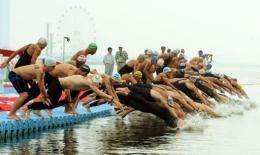
The death of a competitor in an open water race has prompted swimming chiefs to introduce high-tech sonar equipment to keep athletes safe at the world championships in Shanghai.
World governing body FINA invested $300,000 in two sonar units which are now in use for the first time, sweeping the course every 20 seconds to alert rescue boats if any competitor falls below a certain depth.
FINA was urged to make changes after the death of American swimmer Fran Crippen last October, during the final leg of the 10km Marathon Swimming World Cup in Fujairah in the United Arab Emirates.
The 26-year-old had won bronze in the 10km event at the Rome worlds in 2009. But in Fujairah he failed to complete the race and was found in the water two hours later, not far from the finish.
Dennis Miller, FINA liaison official for open water swimming, told AFP the new technology could scan an area up to 150 metres yards around the course.
"If we do have an issue with someone going down, we can pick it up by the colour of the screen," he added.
Two boats equipped with sonar monitors followed swimmers during this week's women's and men's 10km races, he said, adding that although the technology was still in the trial phase, it was working well in Shanghai.
"It's the first time we're using it. It's not compulsory, but it's something we thought was a safety concern. We thought we needed to do something new," Miller said.
The new sonar system was unveiled to teams only this week, but coaches welcomed the development.
"If something happens and a swimmer goes down, they can find him immediately," Germany's open water head coach, Stefan Lurz, said.
There are also more officials watching the competitors with four referee boats and 12 lifeguard boats, he added.
The sonar could be just the start of using technology to make athletes safer, said Pierre Lafontaine, Swimming Canada's CEO and head coach.
Each competitor already wears two transponders on their wrists in championship events to help decide photo finishes, but Lafontaine suggested they could be adapted to monitor athletes.
"We need to get to the point where we maybe have a beeper like an avalanche (beacon) or GPS, but it's really hard in the water. We need to keep improving the technology here," he said.
"The key importance is making sure that we have the safety procedures to make sure that if athletes get into trouble, there's a quick response," Lafontaine said.
In Shanghai, FINA is also paying close attention to the water temperature after an independent commission appointed by USA Swimming found Crippen's death was likely related to heat exhaustion.
FINA scheduled the open water events, which last about two hours, early to avoid the hottest parts of the day. The men's and women's 10km races both started at 9:00 am.
But the water temperature at Jinshan City Beach, where the open water races are taking place, was 29 degrees Celsius (84 degrees Fahrenheit) on Tuesday -- nearing the upper limit of 31 Celcius.
In a worrying sign, Italy's Giorgia Consiglio, a silver medallist at last year's open water worlds, pulled out during Tuesday's women's 10km with breathing problems, underlining the arduous nature of the sport.
"It was really hot," Britain's Keri-Anne Payne said, after winning the race. "I've not often gone into the race and after the first lap felt pretty warm already."
Organisers have moved the start time for Saturday's men's 25km race back from 8:00 am to 7:00 am, in an effort to keep athletes cool.
Water temperature and athletes' hydration were being closely monitored by the British team, said Britain's chef de mission, Michael Scott. But he added that exposure to the elements was part of open water swimming.
"You're exposed to jelly fish, you're exposed to hot water, to rough water. A good swimmer focuses on competing and doesn't worry about those things," he said.
"If you worry about those things than you've lost when you get up on the (starting) pontoon."
(c) 2011 AFP


