A better way to photo gray: New technology allows lenses to change color rapidly
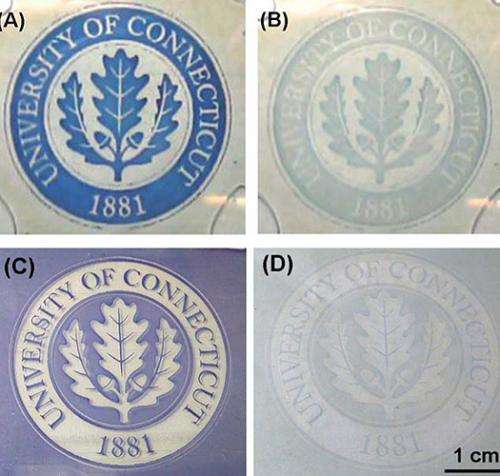
A University of Connecticut scientist has perfected a method for creating quick-changing, variable colors in films and displays, such as sunglasses, that could lead to the next hot fashion accessory.
The new technology also has captured the interest of the U.S. military as a way to assist soldiers who need to be able to see clearly in rapidly changing environments.
The process for creating the lenses, for which a patent is pending, also is less expensive and less wasteful to manufacturers than previous methods. The findings were published July 7 in the Journal of Materials Chemistry.
"This is the next big thing for transition lenses," says Greg Sotzing, a professor of chemistry in UConn's College of Liberal Arts and Sciences and a member of UConn's Polymer Program.
The typical material behind a transition lens is what's called a photochromic film, or a sheet of polymers that change color when light hits them. Sotzing's new technology does things slightly differently his electrochromic lenses are controlled by an electric current passing through them when triggered by a stimulus, such as light.
"They're like double pane windows with a gap between them," explains Sotzing. He and his colleagues squirt a mixture of polymers or as he calls it, "goop" in between the layers, creating the lens as it hardens. The mixture of polymers used in this lens, says Sotzing, creates less waste and is less expensive to produce than previous mixtures.
"The lifetime of sunglasses is usually very short," says Sotzing, who points out that people often misplace them. So by making the manufacturing less expensive, he says, commercial retailers will be able to produce more of them.
Another benefit of this material is that it can change colors as quickly as electricity passes through it which is virtually instantaneously. This process could be very useful for the military, Sotzing says. For example, if a person emerges from a dark passageway and into the desert, a lens that would alter its color instantly to complement the surroundings could mean life or death for some soldiers.
"Right now, soldiers have to physically change the lenses in their goggles," Sotzing says. "This will eliminate that need." Sotzing will begin a one-year sabbatical at the Air Force Academy in August, where he hopes to develop some of these ideas.
In November 2010, partially based on work supported by the Center for Science and Technology Commercialization's Prototype Fund, the UConn R&D Corporation started a company, called Alphachromics Inc., with Sotzing and colleague Michael Invernale, now a post-doctoral researcher at MIT, as founders. The university has a patent pending for this new technology, which is currently under option to the company. Alphachromics is also testing applications of these polymer systems for energy-saving windows and custom fabrics.
Currently in talks with sunglass manufacturers, Sotzing says that the world of Hollywood could have a market for this technology. He describes applications he calls "freaky," including colors that move back and forth across the glasses, evoking styles like those sported by Lady Gaga.
But Sotzing stresses that the best thing about this technology is the creation of business in Connecticut. Although the glasses won't be made here, the technology will be licensed out of the state and, he hopes, Alphachromics will continue to expand.
"We don't make the sunglasses," he says. "We make the formulation of what goes inside them."
Sotzing's collaborators on the paper are Invernale and Ph.D. students Yujie Ding, Donna Mamangun and Amrita Kumar. The research was funded by the tech/textile company ITP-GmbH.
More information: Paper online: http://pubs.rsc.or … m/c1jm11141h
Provided by
University of Connecticut
-
From lemons to lemonade: Reaction uses carbon dioxide to make carbon-based semiconductor,
32 comments
-
Thioridazine kills cancer stem cells in human while avoiding toxic side-effects of conventional cancer treatments,
3 comments
-
SpaceX private rocket blasts off for space station (Update),
42 comments
-
Climate scientists say they have solved riddle of rising sea,
31 comments
-
SpaceX capsule has 'new car' smell, astronauts say (Update),
2 comments
-
Gibbs Free Energy Change/Entropy
8 hours ago
-
What's the rule to covalent character
9 hours ago
-
Schwartz reagent-- NMR/MS/IR
May 26, 2012
-
High school chemistry EEI
May 25, 2012
-
oxidation of I- by KMnO4
May 25, 2012
-
Inversion temp
May 25, 2012
- More from Physics Forums - Chemistry
More news stories
Computer model used to pinpoint prime materials for efficient carbon capture
When power plants begin capturing their carbon emissions to reduce greenhouse gases and to most in the electric power industry, it's a question of when, not if it will be an expensive undertaking.
43 minutes ago |
not rated yet |
0
|
Scientists develop ultra-sensitive test that detects diseases in their earliest stages
Scientists have developed an ultra-sensitive test that should enable them to detect signs of a disease in its earliest stages, in research published today in the journal Nature Materials.
Chemistry / Analytical Chemistry
43 minutes ago |
not rated yet |
0
|
New CO2-removing catalyst can take the heat
(Phys.org) -- The current method of removing the greenhouse gas carbon dioxide (CO2) from the flues of coal-fired power plants uses so much energy that no one bothers to use it. So says Roger Aines, principal ...
May 24, 2012 |
5 / 5 (9) |
10
|
High-speed method to aid search for solar energy storage catalysts
Eons ago, nature solved the problem of converting solar energy to fuels by inventing the process of photosynthesis.
May 25, 2012 |
5 / 5 (3) |
4
|
Researchers demonstrate possible primitive mechanism of chemical info self-replication
(Phys.org) -- When scientists think about the replication of information in chemistry, they usually have in mind something akin to what happens in living organisms when DNA gets copied: a double-stranded molecule ...
May 25, 2012 |
5 / 5 (4) |
2
|
Change in developmental timing was crucial in the evolutionary shift from dinosaurs to birds: study
At first glance, it's hard to see how a common house sparrow and a Tyrannosaurus Rex might have anything in common. After all, one is a bird that weighs less than an ounce, and the other is a dinosaur that ...
'Unzipped' carbon nanotubes could help energize fuel cells, batteries
Multi-walled carbon nanotubes riddled with defects and impurities on the outside could replace some of the expensive platinum catalysts used in fuel cells and metal-air batteries, according to scientists at ...
T cells 'hunt' parasites like animal predators seek prey, study shows
By pairing an intimate knowledge of immune-system function with a deep understanding of statistical physics, a cross-disciplinary team at the University of Pennsylvania has arrived at a surprising finding: T cells use a movement ...
Manufacturing genes to attack flu virus
An international research team has manufactured a new protein that can combat deadly flu epidemics.
Yale study concludes public apathy over climate change unrelated to science literacy
Are members of the public divided about climate change because they don't understand the science behind it? If Americans knew more basic science and were more proficient in technical reasoning, would public consensus match ...
Same gene that stunts infants' growth also makes them grow too big: research
UCLA geneticists have identified the mutation responsible for IMAGe* syndrome, a rare disorder that stunts infants' growth. The twist? The mutation occurs on the same gene that causes Beckwith-Wiedemann syndrome, which makes ...
Jul 12, 2011
Rank: 1 / 5 (1)
Jul 12, 2011
Rank: not rated yet
Jul 13, 2011
Rank: not rated yet