Largest recorded tundra fire yields scientific surprises
July 27, 2011

Largest recorded tundra fire yields scientific surprises

Enlarge

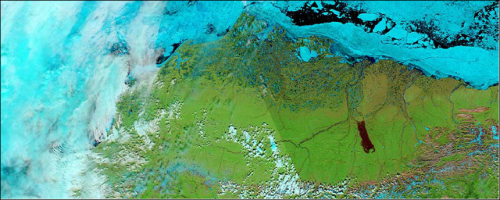
This NASA MODSIS image of the North Slope of the Brooks Range in Alaska shows the Anaktuvuk River fire scar in the lower right quarter of the image. Credit: NASA/GSFC, MODIS Rapid Response

In 2007 the largest recorded tundra fire in the circumpolar arctic released approximately as much carbon into the atmosphere as the tundra has stored in the previous 50 years, say scientists in the July 28 issue of the journal Nature. The study of the Anaktuvuk River fire on Alaska's North Slope revealed how rapidly a single tundra fire can offset or reverse a half-century worth of soil-stored carbon.

Tundra soils store huge amounts of carbon hundreds to thousands of years old. Intact, the layers of organic soil insulate the permanently frozen ground, called permafrost, below.

"Fire has been largely absent from tundra for the past 11,000 or so years, but the frequency of tundra fires is increasing, probably as a response to ," said co-author Syndonia "Donie" Bret-Harte, an ecosystem ecologist at the University of Alaska Fairbanks Institute of .

The Anaktuvuk River fire burned 1,039 square kilometers (401 square miles), an area roughly the size of Cape Cod and visible from space, and released more than 2.1 teragrams (2.3 million tons) of carbon into the atmosphere. Radiocarbon dating of the soils revealed the maximum age of the emitted from the fire was 50 years.

"The amount of carbon released into the atmosphere from this fire is equivalent to the amount of carbon stored by the global tundra biome," said lead author Michelle Mack, a biologist from the University of Florida. "This was a boreal forest-sized fire."

Little is known about the effects of fire on and cycling in tundra ecosystems. Cool, wet soils underlain by permafrost are thought to restrict fires to aboveground plants and ground-level leaving the carbon stored in soils relatively intact. As arctic summers get warmer and dryer, so too do the soils, which are highly flammable and able to burn more deeply when dry.

"If the frequency of these fires remains at long intervals, 80 to 150 years, then the tundra has time to recover," Bret-Hart said. "If these fires occur more frequently, say every 10 years or so, then the landscape cannot recover."

The Anaktuvuk River fire was started by a lightning strike in July 2007. "Normally we would expect the fire to go out in the moist soil, but this summer was so dry that the fire didn't go out and strong winds in September caused it to burn a very large area," said Bret-Harte, who noted that 40 percent of the fire was classified as a severe burn – high for a tundra fire. The fire was visible 24 kilometers south at the IAB Toolik Field Station, where the scientists were working, as a wall of smoke on the horizon.

In addition to the direct release of carbon into the atmosphere, tundra fires are important because of the potential feedbacks to global climate change. "These fires could be a radical and very rapid positive feedback to atmospheric carbon dioxide," said Mack.

Fire removes organic material that insulates permafrost from warm summer temperatures. Insufficient insulation can lead to thawing permafrost, destabilization of the ground surface and exposure of deep soil carbon to decomposition and release into the atmosphere – ultimately amplifying high-latitude warming.

According to the authors, their observations of carbon loss from the Anaktuvuk River support the idea that fires have the potential to release large amounts of carbon and decrease landscape carbon stocks, having an immediate impact on atmospheric and climate.

Provided by University of Alaska Fairbanks search and more info website

4.7 /5 (12 votes)  

Filter


Move the slider to adjust rank threshold, so that you can hide some of the comments.


Display comments: newest first

that_guy
Jul 27, 2011

Rank: 4 / 5 (4)
so too do the soils, which are highly flammable, and are able to burn more deeply when dry

Everything given in this article is interesting when you think about it. Far more carbon is stored in the soil than the plants. The soil is basically partially decayed plant matter down to the permafrost.

The soil itself burns! That must be an incredible sight, albeit sad as well.

Corollary: It sounds like global warming could make siberia and alaska the new breadbaskets of the world, with the tundra soil being that fertile.
omatumr
Jul 28, 2011

Rank: 1 / 5 (4)
In 2007 the largest recorded tundra fire in the circumpolar arctic released approximately as much carbon into the atmosphere as the tundra has stored in the previous 50 years, say scientists in the July 28 issue of the journal Nature. The study of the Anaktuvuk River fire on Alaska's North Slope revealed how rapidly a single tundra fire can offset or reverse a half-century worth of soil-stored carbon.


Thank you, editors of Nature, for publishing unvarnished truths about natural changes in atmospheric levels of CO2.

Western economies today face the consequences of decades of deceptive information about global warming induced by the release of CO2 by our once thriving industries:

http://dl.dropbox...oots.doc

http://dl.dropbox...oots.pdf

What a sad, sad day for science!

Oliver K. Manuel
Former NASA Principal
Investigator for Apollo

antonima
Jul 28, 2011

Rank: 5 / 5 (1)

Everything given in this article is interesting when you think about it. Far more carbon is stored in the soil than the plants. The soil is basically partially decayed plant matter down to the permafrost.

The soil itself burns! That must be an incredible sight, albeit sad as well.

Corollary: It sounds like global warming could make siberia and alaska the new breadbaskets of the world, with the tundra soil being that fertile.


Okay, I didn't get how the fire could have released more carbon than is stored in the entire biome - but apparently it is the soil which stores so much carbon, rather than the flora.

I agree that so much organic matter could be exploited in the future. Maybe it could be processed into oil? 400 miles squared released 2.1 million tons of CO2, thats a lot!
Rank 4.7 /5 (12 votes)
Relevant PhysicsForums posts

More news stories

SpaceX capsule has 'new car' smell, astronauts say (Update)

SpaceX's Dragon cargo vessel smells like a new car, said astronauts at the International Space Station after opening the hatches Saturday following the spacecraft's landmark mission to the orbiting lab.

Space & Earth / Space Exploration

created 23 hours ago | popularity 4.5 / 5 (21) | comments 2

Australia hails surprise super-telescope decision

Australia has hailed a surprise decision giving it a role in a radio telescope project aimed at revolutionising astronomy, vowing to draw on its decades of experience in space science.

Space & Earth / Astronomy

created 23 hours ago | popularity 5 / 5 (4) | comments 3

Astronomers seize last chance in lifetime for Venus Transit

Astronomers are gearing for one the rarest events in the Solar System: an alignment of Earth, Venus and the Sun that will not be seen for another 105 years.

Space & Earth / Astronomy

created 23 hours ago | popularity 5 / 5 (3) | comments 2

Astronauts enter world's 1st private supply ship

(AP) -- Space station astronauts floated into the Dragon on Saturday, a day after its heralded arrival as the world's first commercial supply ship.

Space & Earth / Space Exploration

created 23 hours ago | popularity 5 / 5 (6) | comments 0

Sophisticated simulations predict future warming

The chances of our planet being hit by a global warming of 3 degrees Celsius by 2050 is as likely as it being hit by an increase of 1.4 degrees, new research shows. Presented in the journal Nature Geoscience, the British study ...

Space & Earth / Earth Sciences

created May 22, 2012 | popularity 4.4 / 5 (9) | comments 51


Nvidia trumpets Tegra 3 phone design wins for 2012

(Phys.org) -- Nvidia’s competitive war paint has a name, Tegra 3. On the heels of Nvidia announcements about lowering costs of its Tegra 3 processors and Nvidia-enabled tablets running Android Ice Cream ...

Browser wars flare in mobile space

The browser wars are heating up again, but this time the fight is for dominance of the mobile Internet.

Scientist: Evolution debate will soon be history

(AP) -- Richard Leakey predicts skepticism over evolution will soon be history. Not that the avowed atheist has any doubts himself.

Dell tablet leak: 10.1-inch display, two-battery choice

(Phys.org) -- Headline after headline talks about vendors’ tablets in the wings as likely number-one contenders for the iPad. Such claims have justifiably been taken with a grain of salt, considering ...

SpotterRF debuts Radar Backpack Kit (w/ Video)

(Phys.org) -- SpotterRF has announced a special radar backpack kit designed to enhance situational awareness for soldiers on the ground. The company says its special radar is designed for warfighters as part ...

Thousands of shellfish found dead in Peru

Thousands of crustaceans were found dead off the coast of Lima following the mystery mass death of dolphins and pelicans, the Peruvian Navy said Friday.