Warming climate could give exotic grasses edge over natives
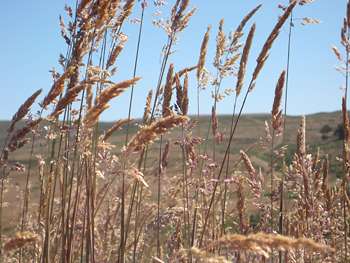
California’s native grasses, already under pressure from invasive exotic grasses, are likely to be pushed aside even more as the climate warms, according to a new analysis from the University of California, Berkeley.
In the study, which has been accepted for publication in the journal Global Change Biology and is now available online, UC Berkeley biologists catalogued the ranges of all 258 native grasses and 177 exotic grasses in the state and estimated how climate change – in particular, increased temperature and decreased rainfall – would change them.
They concluded that many of the traits that now make exotic grasses more successful than many natives also would allow them to adapt better to increased temperature and likely expand their ranges.
“When we looked at current patterns, we found that warmer temperatures favor certain traits, and these are the traits possessed by exotic species,” said coauthor Emily Dangremond, a graduate student in the UC Berkeley Department of Integrative Biology. “This led us to predict that, if the mean temperature increases in all zones in California, there is an increased likelihood of finding exotic species, and an increase in the proportion of species in a zone that are exotic.”
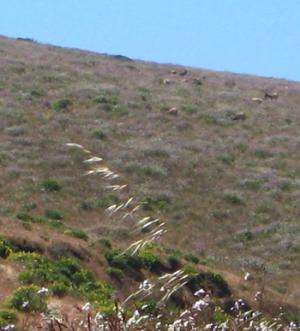
The study was inspired by a 2008 class run by David Ackerly, a UC Berkeley professor of integrative biology, that focused on the role plants play in their ecosystem and how those roles may alter with climate change. This area of study, called functional ecology, is being used more and more by ecologists to predict the consequences of global warming.
“The ‘trait-based’ approach lets us test hypotheses about plant distributions in relation to climate without tying them to the identity of particular species,” Ackerly wrote in an email from South Africa, where he is on sabbatical. “As a consequence, the analyses can be generalized beyond California to other grassland areas.”
With grasses, the increase in exotics could make the state more prone to wildfires, since invasive grasses dry out in the summer more than do native grasses. Some grasses serve as reservoirs for viruses and other pathogens that attack food crops, while others more efficiently suck up water that would normally be used by other grasses and plants,
Dangremond is involved in a study of European beachgrass (Ammophila arenaria), which she has found harbors deer mice that eat endangered lupines. The beachgrass has invaded sand dunes along much of the coast in California, Oregon and Washington, she said.
For the current study, Dangremond and postdoctoral fellow Brody Sandel, now at Aarhus University in Denmark, divided California into 800 zones, and characterized all the grasses in these zones according to 10 distinct traits related to growth, reproductive and light capture strategies. These traits included grasses’ maximum height; plant and leaf lifespan; seed mass; month of first flowering; length of flowering period; specific leaf area, leaf length and width; leaf nitrogen concentration per mass and per area; and the grass’s specific photosynthetic pathway. The data came primarily from the updated “Jepson Manual: Higher Plants of California” published by UC Press.
Some zones in the state contained as many as 163 grass species, while others had as few as three. In some zones, two-thirds of all grasses were exotics. The researchers found that, in general, the higher the average temperature in a zone, the greater the proportion of exotic grass species.
Exotics differed significantly from natives on seven of the 10 traits in ways that made them more adaptable to higher temperatures. For example, exotics tended to be taller, have longer and wider leaves, higher specific leaf area, higher nitrogen mass in the leaves and higher seed mass, and were less likely to be perennial. Noxious invasives were even more extremely adapted to warmer temperatures.
These traits account for the success of invasive exotic grasses, Dangremond said. Taller grasses, for example, give exotics more light-capturing ability and the ability to outcompete natives for light. Similarly, the larger seeds of exotic species could give these grasses a competitive advantage at the seedling stage.
“As climate changes in the coming century, which at this point is quite certain, this means we expect the distributions of the grasses to change as well,” Ackerly wrote. “Sadly, what this predicts is that the alien species that already dominate the Central Valley and other hotter regions of the state will become even more widespread in the future.”
“I hate to be a doomsayer, but the problem is getting worse because of humans,” Dangremond said. “Humans promote the spread of invasive species by disturbing areas and letting weedy species come in, and grazing herbivores like cows and elk tend to have a negative effect on native plants anyway. Native species really have a lot to contend with now.”
More information: DOI: 10.1111/j.1365-2486.2011.02480.x
Provided by University of California - Berkeley


