Celebrating 10 years of Artemis
July 13, 2011

Celebrating 10 years of Artemis

Enlarge

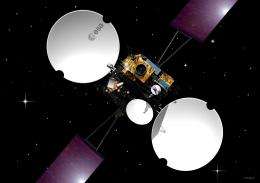
Carrying three payloads plus a number of experiments, Artemis (Advanced Relay and Technology Mission Satellite) has been developed to test and operate new telecommunications techniques. The L-band mobile payload will allow two-way voice and data communications via satellite, between fixed Earth stations and land mobiles - trucks, trains or cars - anywhere in Europe and North Africa. Artemis carries two payloads for communicating directly between satellites:a laser-optical relay terminal called SILEX, and a double S/Ka-band terminal called SKDR. Data will be received from low-Earth-orbiting satellites and then transmitted directly to Europe. Artemis was launched the 12 July 2001 from Europe's spaceport in Kourou from an Ariane 5 launcher. Credits: ESA - J.Huart

(PhysOrg.com) -- ESA’s pioneering Artemis satellite today marks a decade in space. The Advanced Relay and Technology Mission was a breakthrough in telecommunications satellites for Europe, packed with new technologies such as laser links and ion thrusters for proving in space.

A launch problem on 12 July 2001 almost ended the mission before it even began, when the rocket’s upper stage injected into a low transfer orbit. For any conventional satellite, this would have resulted in the loss of the mission.  

But thanks to the combination of the satellite’s advanced technologies and the unique recovery procedures devised by the control team, the satellite was slowly and carefully coaxed over 18 months into its intended operating position.

Dubbed ‘mission impossible’ at the time, and despite damaged onboard equipment, Artemis has demonstrated critical new technologies and continues in operation today.

Artemis clocked up a number of unique firsts in space during its recovery. It created the first laser data link between satellites in different orbits; it was the first telecommunications satellite to be extensively reprogrammed in orbit; it was the first to use ion propulsion to reach geostationary orbit, 36 000 km up, after surviving the longest-ever drift to its destination.
Celebrating 10 years of Artemis
Enlarge

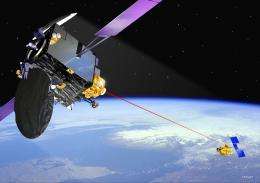
Carrying three payloads plus a number of experiments, Artemis (Advanced Relay and Technology Mission Satellite) has been designed to test and operate new telecommunications techniques. The L-band mobile payload allows two-way voice and data communications, via satellite, between fixed Earth stations and land mobiles - trucks, trains or cars - anywhere in Europe and North Africa. Artemis carries two payloads for communications directly between satellites, which receive data from low-Earth-orbiting satellites and transmit them directly to Europe: -a laser-optical relay terminal called SILEX -a double S/Ka-band terminal called SKDR. ARTEMIS was launched 12 July 2001 by Ariane 5. It was initially placed in the wrong orbit and recovery operations have been underway since then to bring it to its final position. Credits: ESA-J.Huart

Using an experimental radio-frequency payload, Earth images collected by ESA’s Envisat 35 000 km below Artemis were delivered to customers almost in real time at a high rate.

The same service was provided to France’s SPOT-4 observation together with a second link via laser relay.

Artemis also provided communications between ground controllers and Europe’s Automated Transfer Vehicles as the cargo ferries flew to the International Space Station.

In 2008, Artemis leapt into service at short notice during the ferry’s first mission when NASA’s system was shut down as Hurricane Ike struck the country.
 
The ATV team in Toulouse, France, and their Artemis counterparts in Redu, Belgium, sprang into action. With only a few hours to prepare, they held contact with the vessel throughout the night of 11 September.

While Artemis is controlled via Telespazio facilities in Fucino, Italy, ESA’s Redu centre houses its Mission Control Facility to schedule the services for users and to maintain the different payloads.

“Artemis has delivered tremendous service availability over its entire operational life at full satisfaction of final users,” says Daniele Galardini, Head of ESA Redu Centre and in charge of Artemis.

“The capability and professionalism of the teams in Fucino and Redu are the basis of the Artemis achievements.”

Provided by European Space Agency search and more info website


Rank not rated yet
Relevant PhysicsForums posts
  • revamping general concept and cosmological principle
    createdMay 25, 2012
  • Transiting Exoplanet Light Curve
    createdMay 25, 2012
  • Math behind Theoretical Physics
    createdMay 24, 2012
  • Do we know whats at the center of galaxies yet?
    createdMay 23, 2012
  • Structure of the Milky Way?
    createdMay 20, 2012
  • What would it take to terraform Pluto and Charon?
    createdMay 19, 2012
  • More from Physics Forums - General Astronomy

More news stories

Sophisticated simulations predict future warming

The chances of our planet being hit by a global warming of 3 degrees Celsius by 2050 is as likely as it being hit by an increase of 1.4 degrees, new research shows. Presented in the journal Nature Geoscience, the British study ...

Space & Earth / Earth Sciences

created May 22, 2012 | popularity 4.4 / 5 (9) | comments 51

Dragon arrives at space station in historic 1st (Update 2)

The privately bankrolled Dragon capsule made a historic arrival at the International Space Station on Friday, triumphantly captured by astronauts wielding a giant robot arm.

Space & Earth / Space Exploration

created May 25, 2012 | popularity 5 / 5 (10) | comments 19

Kyoto Protocol architect 'frustrated' by climate dialogue

UN climate talks are going nowhere, as politicians dither or bicker while the pace of warming dangerously speeds up, one of the architects of the Kyoto Protocol told AFP.

Space & Earth / Environment

created May 23, 2012 | popularity 3.7 / 5 (7) | comments 39

Aliens don't want to eat us, says former SETI director

Alien life probably isn’t interested in having us for dinner, enslaving us or laying eggs in our bellies, according to a recent statement by former SETI director Jill Tarter.

Space & Earth / Space Exploration

created May 25, 2012 | popularity 4.4 / 5 (13) | comments 37

What's the big deal about private space launches?

(AP) -- The first private spaceship is headed to the International Space Station. Some questions and answers about the cargo mission by Space Exploration Technologies, known as SpaceX:

Space & Earth / Space Exploration

created May 22, 2012 | popularity 5 / 5 (6) | comments 32


Nvidia trumpets Tegra 3 phone design wins for 2012

(Phys.org) -- Nvidia’s competitive war paint has a name, Tegra 3. On the heels of Nvidia announcements about lowering costs of its Tegra 3 processors and Nvidia-enabled tablets running Android Ice Cream ...

Browser wars flare in mobile space

The browser wars are heating up again, but this time the fight is for dominance of the mobile Internet.

Scientist: Evolution debate will soon be history

(AP) -- Richard Leakey predicts skepticism over evolution will soon be history. Not that the avowed atheist has any doubts himself.

Dell tablet leak: 10.1-inch display, two-battery choice

(Phys.org) -- Headline after headline talks about vendors’ tablets in the wings as likely number-one contenders for the iPad. Such claims have justifiably been taken with a grain of salt, considering ...

Keep food safety in mind this memorial day weekend

(HealthDay) -- Picnics, parades and cookouts are as much a part of Memorial Day weekend as tributes to the United States' war veterans.

Family history of Alzheimer's affects functional connectivity

(HealthDay) -- Cognitively normal individuals with a family history of late-onset Alzheimer's disease (AD) may display lower resting state functional connectivity in the default mode network (DMN) of the brain, ...