An advance toward ultra-portable electronic devices
Jul 20, 2011

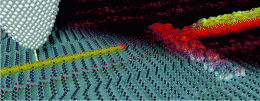
Scientists are reporting a key advance toward the long-awaited era of "single-molecule electronics," when common electronic circuits in computers, smart phones, audio players, and other devices may shrink to the size of a grain of sand. The breakthrough is a method for creating and attaching the tiny wires that will connect molecular components, reports a new study in the Journal of the American Chemical Society.

Yuji Okawa and colleagues write that the "key to single-molecule electronics is connecting functional molecules to each other using conductive nanowires. This involves two issues: how to create conductive nanowires at designated positions, and how to ensure chemical bonding between the nanowires and functional molecules." That challenge has stymied many researchers, who have struggled to produce wires small enough to use in molecular circuits.

The scientists now demonstrate a method that uses the tip of a to jump-start the formation of a molecule chain. The chain or "wire" spontaneously chemically bonds with other molecular components in the circuit under construction, a process that Okawa and colleagues dub "chemical soldering." The wiring method can be used to connect molecular switches, memory bits, and transistors. The scientists say their technique "will enable us to develop cheaper, higher-performance, and more ecological alternatives to conventional silicon-based devices."

Explore further: Tailoring optical processors: Arranging nanoparticles in geometric patterns allows for control of light with light

More information: “Chemical Wiring and Soldering toward All-Molecule Electronic Circuitry”, J. Am. Chem. Soc., 2011, 133 (21), pp 8227–8233
DOI: 10.1021/ja111673x

Abstract
Key to single-molecule electronics is connecting functional molecules to each other using conductive nanowires. This involves two issues: how to create conductive nanowires at designated positions, and how to ensure chemical bonding between the nanowires and functional molecules. Here, we present a novel method that solves both issues. Relevant functional molecules are placed on a self-assembled monolayer of diacetylene compound. A probe tip of a scanning tunneling microscope is then positioned on the molecular row of the diacetylene compound to which the functional molecule is adsorbed, and a conductive polydiacetylene nanowire is fabricated by initiating chain polymerization by stimulation with the tip. Since the front edge of chain polymerization necessarily has a reactive chemical species, the created polymer nanowire forms chemical bonding with an encountered molecular element. We name this spontaneous reaction “chemical soldering”. First-principles theoretical calculations are used to investigate the structures and electronic properties of the connection. We demonstrate that two conductive polymer nanowires are connected to a single phthalocyanine molecule. A resonant tunneling diode formed by this method is discussed.

add to favorites email to friend print save as pdf

Related Stories

Single molecule electronics and 'chemical soldering'

May 13, 2011

(PhysOrg.com) -- Single molecule electronics is a division of nanotechnology utilizing single molecules as electronic components and its study has the ultimate goal of reducing the size of common electrical ...

New "Molecular Wires" Nanotechnology to Replace Silicon

Aug 23, 2004

Scientists from the U.S. Department of Energy's Brookhaven National Laboratory and the University of Florida have uncovered information that may help "molecular wires" replace silicon in micro-electronic circuits and/or co ...

Single polymer chains as molecular wires

Feb 27, 2009

The research team of Leonhard Grill at Freie Universität Berlin - in collaboration with the synthetic chemistry group of Stefan Hecht from Humboldt University of Berlin and the theoretical physics group of Christian ...

Theorist helps develop first single molecule transistor

Jun 07, 2005

A scientist at the University of Liverpool has helped to create the world's smallest transistor - by proving that a single molecule can power electric circuits Dr Werner Hofer, from the University's Surface Science Research ...

Recommended for you

Engineers' nanoantennas improve infrared sensing

May 20, 2013

(Phys.org) —A team of University of Pennsylvania engineers has used a pattern of nanoantennas to develop a new way of turning infrared light into mechanical action, opening the door to more sensitive infrared ...

Stacking 2-D materials produces surprising results

May 16, 2013

(Phys.org) —Graphene has dazzled scientists, ever since its discovery more than a decade ago, with its unequalled electronic properties, its strength and its light weight. But one long-sought goal has proved ...

User comments : 3

Adjust slider to filter visible comments by rank

Display comments: newest first

gmurphy
not rated yet Jul 20, 2011
This "article" is little more than an abstract, interesting all the same though.
Sebas
not rated yet Jul 20, 2011
Sounds great, but I wonder if they want this technology to succeed how they want to scale it up (considering there are millions of interconnects and a STM tip can only catalyze one at a time)
Burnerjack
not rated yet Jul 25, 2011
I wonder how fragile these circuits would be as far as shock or static electricity etc. goes. That being said, what effects on propagation delays? Possibly much faster operations?

More news stories

How gold nanoparticles can help fight ovarian cancer

Positively charged gold nanoparticles are usually toxic to cells, but cancer cells somehow manage to avoid nanoparticle toxicity. Mayo Clinic researchers found out why, and determined how to make the nanoparticles effective ...

Radioactive nanoparticles target cancer cells

Cancers of all types become most deadly when they metastasize and spread tumors throughout the body. Once cancer has reached this stage, it becomes very difficult for doctors to locate and treat the numerous tumors that can ...

If you can remember it, you can remember it wrong

(Medical Xpress)—Native peoples in regions where cameras are uncommon sometimes react with caution when their picture is taken. The fear that something must have been stolen from them to create the photo ...

B vitamins could delay dementia

(Medical Xpress)—Despite spending billions of dollars on research and development, drug companies have been unable to come up with effective treatments for dementia and Alzheimer's Disease (AD). Now, A. ...

New method for producing clean hydrogen

Duke University engineers have developed a novel method for producing clean hydrogen, which could prove essential to weaning society off of fossil fuels and their environmental implications.