World’s first 3D plasmon ruler: Taking the 3-D measure of macromolecules
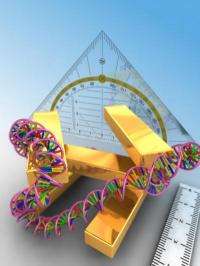
(PhysOrg.com) -- The world's first three-dimensional plasmon rulers, capable of measuring nanometer-scale spatial changes in macrmolecular systems, have been developed by researchers with the U.S. Department of Energy (DOE)'s Lawrence Berkeley National Laboratory (Berkeley Lab), in collaboration with researchers at the University of Stuttgart, Germany. These 3D plasmon rulers could provide scientists with unprecedented details on such critical dynamic events in biology as the interaction of DNA with enzymes, the folding of proteins, the motion of peptides or the vibrations of cell membranes.
"We've demonstrated a 3D plasmon ruler, based on coupled plasmonic oligomers in combination with high-resolution plasmon spectroscopy, that enables us to retrieve
the complete spatial configuration of complex macromolecular and biological processes, and to track the dynamic evolution of these processes," says Paul Alivisatos, director of Berkeley Lab and leader of this research.
Alivisatos, who is also the Larry and Diane Bock Professor of Nanotechnology at the University of California (UC), Berkeley, is the senior author of a paper in the journal Science describing this research. The paper is titled "Three-Dimensional Plasmon Rulers." Co-authoring this paper were Laura Na Liu, who at the time the work was done was a member of Alivisatos' research group but is now with Rice University, and Mario Hentschel, Thomas Weiss and Harald Giessen with the University of Stuttgart.
The nanometer scale is where the biological and materials sciences converge. As human machines and devices shrink to the size of biomolecules, scientists need tools by which to precisely measure minute structural changes and distances. To this end, researchers have been developing linear rulers based on the electronic surface waves known as "plasmons," which are generated when light travels through the confined dimensions of noble metal nanoparticles or structures, such as gold or silver.
"Two noble metallic nanoparticles in close proximity will couple with each other through their plasmon resonances to generate a light-scattering spectrum that depends strongly on the distance between the two nanoparticles," Alivisatos says. "This light-scattering effect has been used to create linear plasmon rulers that have been used to measure nanoscale distances in biological cells."
Compared to other types of molecular rulers, which are based on chemical dyes and fluorescence resonance energy transfer (FRET), plasmon rulers neither blink nor photobleach, and also offer exceptional photostability and brightness. However, until now plasmon rulers could only be used to measure distances along one dimension, a limitation that hampers any comprehensive understanding of all the biological and other soft-matter processes that take place in 3D.
"Plasmonic coupling in multiple nanoparticles placed in proximity to each other leads to light scattering
spectra that are sensitive to a complete set of 3D motions," says Laura Na Liu, corresponding author of the Science paper. "The key to our success is that we were able to create sharp spectral features in the otherwise broad resonance profile of plasmon-coupled nanostructures by using interactions between quadrupolar and dipolar modes."

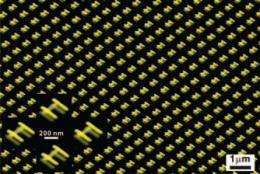
Liu explains that typical dipolar plasmon resonances are broad because of radiative damping. As a result, the simple coupling between multiple particles produces indistinct spectra that are not readily converted into distances. She and her co-authors overcame this problem with a 3D ruler constructed from five gold nanorods of individually controlled length and orientation, in which one nanorod is placed perpendicular between two pairs of parallel rod nanorods to form a structure that resembles the letter H.
"The strong coupling between the single nanorod and the two parallel nanorod pairs suppresses radiative damping and allows for the excitation of two sharp quadrupolar resonances that enable high-resolution plasmon spectroscopy," Liu says. "Any conformational change in this 3D plasmonic structure will produce readily observable changes in the optical spectra."
Not only did conformational changes in their 3D plasmon rulers alter light scattering wavelengths, but the degrees of spatial freedom afforded its five nanorod structure also enabled Liu and her colleagues to distinguish the direction as well as the magnitude of structural changes.
"As a proof of concept, we fabricated a series of samples using high-precision electron beam lithography and layer-by-layer stacking nanotechniques, then embedded them with our 3D plasmon rulers in a dielectric medium on a glass substrate," Liu says. "Experimental results were in excellent agreement with the calculated spectra."
Alivisatos, Liu and their Stuttgart collaborators envision a future in which 3D plasmon rulers would, through biochemical linkers, be attached to a sample macromolecule, for example, to various points along a strand of DNA or RNA, or at different positions on a protein or peptide. The sample macromolecule would then be exposed to light and the optical responses of the 3D plasmon rulers would be measured via dark field microspectroscopy.
"The realization of 3D plasmon rulers using nanoparticles and biochemical linkers is challenging, but 3D nanoparticle assemblies with desired symmetries and configurations have been already been demonstrated," Liu says. "We believe these exciting experimental achievements along with the introduction of our new concept will pave the road toward the realization of 3D plasmon rulers in biological and other soft-matter systems."
Provided by Lawrence Berkeley National Laboratory


