Tropical Birds Return to Harvested Rainforest Areas in Brazil
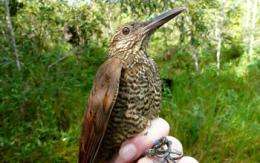
(PhysOrg.com) -- Bird species in rainforest fragments in Brazil that were isolated by deforestation disappeared then reappeared over a quarter-century, according to research results published today in the journal PLoS (Public Library of Science) ONE.
Scientists thought many of the birds had gone extinct.
The research was funded by the National Science Foundation (NSF), and conducted in cooperation with Projeto Dinâmica Biológica de Fragmentos Florestais, Instituto Nacional de Pesquisas da Amazônia and the Smithsonian Tropical Research Institute in Manaus, Brazil.
Lead author Philip Stouffer, an ornithologist at Louisiana State University and co-authors of the paper--Erik Johnson at the National Audubon Society; Richard Bierregaard at the University of North Carolina, Charlotte; and Thomas Lovejoy at The Heinz Center in Washington, D.C.--measured bird populations over 25 years in 11 forest fragments ranging from 2.5 acres to 250 acres in the Amazon rainforest near Manaus, Brazil.
In the first decade of the long-term study, birds abandoned forest fragments and, ornithologists believed, went extinct. Then in the past 20 years, many bird species returned, while others went extinct or remained extinct.
"Through long-term observations of fragmentation in tropical forests, this study provides verification that local extinction is accompanied by continual recolonization, dependent on habitat size," said Saran Twombly, program director in NSF's Division of Environmental Biology, which funded the research.
Although species loss following habitat changes can be inferred, long-term observations are necessary to accurately identify the fate of bird populations, said Stouffer.
As the project began, bird populations were tracked before the forests were cut.
During the first year after cutting, bird species disappeared in what the researchers call "localized extinction," meaning a species has disappeared from a particular area.
The area was fragmented in "cookie cutter chunks" as a result of policies that encouraged use of the land--mostly for cattle--but required landowners to leave a portion of the area uncleared.
Bird populations were measured before the deforestation process began, then again in 1985, 1992, 2000 and 2007.
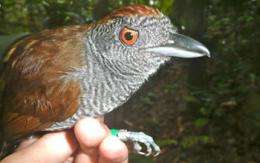
Now agriculture has diminished, and areas where fragments meet nearby forests are recovering, Stouffer said. "Early on, the small fragments lost most of their understory birds, and the area that was cut had no forest birds at all."
Between the time the forest fragments were created and 2007, when the most recent measurements were taken, all fragments lost bird species, Stouffer said.
Losses ranged from below 10 percent in the largest, least fragmented areas to around 70 percent in the smallest, most fragmented spots.
Both extinction and colonization occurred in every interval. In the last two samples--taken in 2000 and 2007--extinction and colonization were approximately balanced.
The extinction process started with birds leaving or dying out. Now, they're coming back.
Of the 101 species netted--trapped with a fine-mesh "mist net"--before deforestation, the researchers detected 97 in at least one forest fragment in 2007.
"A handful of species have ‘gone extinct,' but many more species are in flux," Stouffer said. "They come and go."
The project measured only understory, resident birds and not those that live in the forest canopy or may migrate.
"Our samples are snapshots in time," said Stouffer. "They show that forest fragments have the potential to recover their biodiversity if they're in a landscape that can rebound.
"They're not doomed."
The research demonstrates some of the ways birds exist in a human-modified environment, as well as the effects of allowing a forest to regenerate.
"If we consider a balance of abandoned and returned forests--within a 20-year window--birds will begin to treat the fragments as continuous forest," Stouffer said.
"Although a small subset of species is extremely vulnerable to fragmentation and predictably goes extinct, developing second-growth forest around fragments encourages recolonization."
Species biodiversity in today's forest fragments reflects local turnover, not long-term attrition of species, the scientists found.
They think similar processes could be operating in other fragmented ecosystems, expecially ones that show unexpectedly low extinction rates.
Provided by National Science Foundation


