One tough microscope
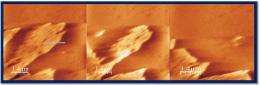
When it comes to seeing how carbon dioxide behaves in a geologic storehouse, most instruments can't take the pressure. But, a new apparatus created by scientists at Pacific Northwest National Laboratory, Wright State University and Lawrence Berkeley National Laboratory can handle the pressures that the stored greenhouse gas would encounter. Using their newly developed atomic force microscope, scientists can now get sharp pictures and movies of reactions as they happen, under conditions you'd find at a carbon sequestration site.
"The information from the new apparatus is key to more fully understanding geochemical processes under a much wider range of geologically relevant conditions—especially those relevant to carbon sequestration," said Dr. Kevin Rosso, a PNNL Fellow who worked on this project.
Why it matters: global climate change
Carbon dioxide is a key culprit. But, removing it from industrial emissions and storing it deep underground requires answers to some fundamental questions about how carbon dioxide interacts with neighboring mineral surfaces. The new apparatus helps provide answers.
Methods
Captured carbon dioxide, CO2, is injected underground in porous rock formations to depths of greater than half a mile. At this depth, the temperature and pressure keep the CO2 in a supercritical fluid state. A supercritical fluid has a mixture of the properties of a liquid and a gas. The researchers wanted to see the reactions in real time under conditions present in the native environment. The images could lead to better understanding of the chemical interactions between the supercritical CO2 and minerals in potential host rocks.
So, the team designed an apparatus that allows an atomic force microscope to handle pressures of 100 atmospheres and temperatures up to ~350 Kelvin, the conditions found a half a mile underground in certain rock formations. Conventional atomic force microscopes couldn't take the pressure. Among the very few AFMs that can handle pressures higher than 1 atmosphere, the best can only handle pressures of 50 atmospheres, still not enough to maintain the CO2 in a supercritical state.
With their high-pressure enabled microscope, they captured images and a real-time movie if supercritical CO2 interacting with a hydrated calcite surface. Calcite is a common mineral, and it is easy to prepare clean flat calcite surfaces for AFM studies. The new apparatus is available through EMSL's user proposal system. In addition to studying geochemical processes, it can be used to study other reactions that occur at high pressures.
While calcite is a good baseline to demonstrate the performance of the new device, the team isn't stopping there. They are using the new apparatus to investigate reactions more directly relevant to carbon sequestration.
More information: Lea AS, et al. 2011. "A High-Pressure Atomic Force Microscope for Imaging in Supercritical Carbon Dioxide." Review of Scientific Instruments 82, 043709. DOI:10.1063/1.3580603.
Provided by Pacific Northwest National Laboratory


