'Super sand' for better purification of drinking water (Update)
June 23, 2011

'Super sand' for better purification of drinking water

Enlarge

(PhysOrg.com) -- Scientists have developed a way to transform ordinary sand -- a mainstay filter material used to purify drinking water throughout the world -- into a "super sand" with five times the filtering capacity of regular sand. The new material could be a low-cost boon for developing countries, where more than a billion people lack clean drinking water, according to the report in the ACS journal Applied Materials & Interfaces.

Researchers at Rice University are spinning a bit of nano-based magic to create "coated sand" that has enhanced properties for water purification. The breakthrough may benefit where more than a billion people lack .

Beds of sand are commonly used throughout the world to filter . The particle size of sand and surface modifications determine the efficiency of sand in removing contaminants from water.

This video is not supported by your browser at this time.

Beds of sand are commonly used throughout the world to filter drinking water. The particle size of sand and surface modifications determine the efficiency of sand in removing contaminants from water. Researchers at Rice University are spinning a bit of nano-based magic to created "coated sand" that has enhanced properties for purification. The breakthrough may benefit developing countries where more than a billion people lack clean drinking water.

The Rice researchers’ technique makes use of graphite oxide, a product in the chemical exfoliation process of graphite (aka pencil lead) that leads to single-atom sheets known as graphene via subsequent reduction.
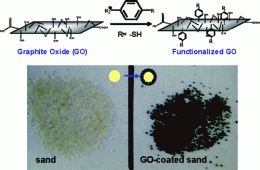
A team from the Rice lab of Professor Pulickel Ajayan published a report in the American Chemical Society journal and Interfaces describing a process to coat coarse grains of sand in graphite oxide; the resulting material is several times more efficient at removing contaminants than sand alone.

Nanosheets of graphite oxide can be tailored to have hydrophobic (water-hating) and hydrophilic (water-loving) properties. When mixed in a solution with sand, they self-assemble into coatings around the grains and keep the hydrophilic parts exposed. Adding aromatic thiol molecules to the coatings enhances their ability to sequester water-soluble contaminants.

Ajayan, a Rice professor in mechanical engineering and materials science and of chemistry, and his collaborators from Australia and Georgia conducted experiments to compare this coated sand with plain sand and activated carbon granules used by municipalities and in-home systems.

'Super sand' for better purification of drinking water (Update)
Enlarge

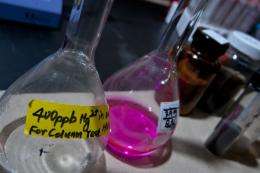
Beakers of solution containing mercury and Rhodamine B dye await purification through a new process developed at Rice University. (Credit: Jeff Fitlow/Rice University)

The researchers ran two model contaminants -- mercury (at 400 parts per billion) and Rhodamine B dye (10 parts per million) -- through sand and coated sand placed into filtration columns. They found coarse sand's adsorption capacity of mercury was saturated within 10 minutes.

The coated sand continued removing mercury for more than 50 minutes and resulted in filtered water with less than one part per billion. (The Environmental Protection Agency's maximum contaminant level goal for mercury in drinking water is two parts per billion.)

Results for water treated with Rhodamine B dye were similar.

The researchers found coated sequestered contaminants just as well as the commercially available active carbon filtration systems they tested.

The lab is looking at ways to further functionalize graphite oxide shells to enhance contaminant removal. "By attaching different functional moieties onto graphite oxide, we could engineer some form of a 'super sand' to target specific contaminants species, like arsenic, trichloroethylene and others," said Rice graduate student Wei Gao, primary author of the paper.

More information: "Engineered Graphite Oxide Materials for Application in Water Purification" ACS Appl. Mater. Interfaces, 2011, 3 (6), pp 1821–1826
DOI: 10.1021/am200300u

Abstract
Retaining the inherent hydrophilic character of GO (graphite-oxide) nanosheets, sp2 domains on GO are covalently modified with thiol groups by diazonium chemistry. The surface modified GO adsorbs 6-fold higher concentration of aqueous mercuric ions than the unmodified GO. “Core–shell” adsorbent granules, readily useable in filtration columns, are synthesized by assembling aqueous GO over sand granules. The nanostructured GO-coated sand retains at least 5-fold higher concentration of heavy metal and organic dye than pure sand. The research results could open avenues for developing low-cost water purification materials for the developing economies.

Provided by American Chemical Society search and more info website

Filter


Move the slider to adjust rank threshold, so that you can hide some of the comments.


Display comments: newest first

that_guy
Jun 22, 2011

Rank: 5 / 5 (2)
but...I'd like to know how how much cheaper it would be to coat sand with nanographite oxide than it would be just to give poor people activated carbon...and how it would compare with say...a mix of sand and activated carbon.
gmurphy
Jun 23, 2011

Rank: 5 / 5 (2)
what on earth can't graphene be used for?, we'll be stirring it into our tea next :)
Royale
Jun 24, 2011

Rank: 1 / 5 (1)
My only guess is thinking ahead and saving on our coal deposits, by using just a bit of it and sand (which there is plenty of all over). I guess it could only save money if you could make an easy low power consuming process to create it; otherwise you'd just be burning the coal for the power required to make the nano-carbon-sand.
emsquared
Jun 24, 2011

Rank: not rated yet
I guess it could only save money if you could make an easy low power consuming process to create it; otherwise you'd just be burning the coal for the power required to make the nano-carbon-sand.

It sounded like the graphite oxide is a by-product of another process ("the chemical exfoliation process of graphite") so it's not like it'd be a devoted production. And if it's a process that is gonna be conducted anyway and it's something that was formerly waste and can now be re-purposed, can't complain about that, no? I would hope the "low-cost boon" statement would mean it can be made cheaper than present filtration products.
Dug
Jun 27, 2011

Rank: not rated yet
Once again an author fails to cover his subject adequately. All filtration technology necessarily has two modes - attraction/capture and then the purposeful release of attached contaminants. If the graphite oxide coating doesn't effectively release contaminants, then it's essentially a waste of time. Why wasn't this info in the article?
Royale
Jun 28, 2011

Rank: not rated yet
Dug, why would they need to be reusable? Sure it would be great if the were, but activated carbon filters aren't now and they still work well. So if we could reduce the amount of carbon used by adding some desert, why not?
that_guy
Jun 28, 2011

Rank: not rated yet
My only guess is thinking ahead and saving on our coal deposits, by using just a bit of it and sand (which there is plenty of all over). I guess it could only save money if you could make an easy low power consuming process to create it; otherwise you'd just be burning the coal for the power required to make the nano-carbon-sand.

I kind of want to be mean to you, but I'll refrain. Activated charcoal is commonly made from coconut husks or wood. It is not made from coal. There is coal in abundance compared to any other fossil fuel, and the only concern about coal in almost any scenario is environmental.
Royale
Jun 29, 2011

Rank: not rated yet
Sure that_guy. You're right, no need to be mean. Saying coal supply like that would make it seem that that's the only way I thought it could be made. And that is simply wrong. So sorry for my un-clearness. We do not need coal to make activated charcoal, just something carbon based that is sufficiently burned will do the trick. My only question with this whole thing is do the benefits of this new process outweigh the strain? As of now, probably no. But perhaps the process can be made simpler and it would be great to be able to make this product cheap and on a mass scale. Then we won't have to burn coconut husks to fill our shoes to take the stink out, we'd then just need add this special 'sand' to an Odor Eaters.
Rank 5 /5 (20 votes)
Relevant PhysicsForums posts
  • Gibbs Free Energy Change/Entropy
    created2 hours ago
  • What's the rule to covalent character
    created3 hours ago
  • Schwartz reagent-- NMR/MS/IR
    created22 hours ago
  • High school chemistry EEI
    createdMay 25, 2012
  • oxidation of I- by KMnO4
    createdMay 25, 2012
  • Inversion temp
    createdMay 25, 2012
  • More from Physics Forums - Chemistry

More news stories

New CO2-removing catalyst can take the heat

(Phys.org) -- The current method of removing the greenhouse gas carbon dioxide (CO2) from the flues of coal-fired power plants uses so much energy that no one bothers to use it. So says Roger Aines, principal ...

Chemistry / Materials Science

created May 24, 2012 | popularity 5 / 5 (7) | comments 7 | with audio podcast

High-speed method to aid search for solar energy storage catalysts

Eons ago, nature solved the problem of converting solar energy to fuels by inventing the process of photosynthesis.

Chemistry / Materials Science

created May 25, 2012 | popularity 5 / 5 (3) | comments 4 | with audio podcast

Researchers demonstrate possible primitive mechanism of chemical info self-replication

(Phys.org) -- When scientists think about the replication of information in chemistry, they usually have in mind something akin to what happens in living organisms when DNA gets copied: a double-stranded molecule ...

Chemistry / Materials Science

created May 25, 2012 | popularity 5 / 5 (4) | comments 2 | with audio podcast

Building a better solar panel -- one molecule at a time

(Phys.org) -- One of the fundamental building blocks in modern chemistry, an organometallic chemical compound called ferrocene, has never been structurally defined - until now.

Chemistry / Materials Science

created May 25, 2012 | popularity 5 / 5 (3) | comments 0 | with audio podcast

Discarded data may hold the key to a sharper view of molecules

(Phys.org) -- There's nothing like a new pair of eyeglasses to bring fine details into sharp relief. For scientists who study the large molecules of life from proteins to DNA, the equivalent of new lenses have come in the ...

Chemistry / Biochemistry

created May 24, 2012 | popularity 4.7 / 5 (3) | comments 0 | with audio podcast


Nvidia trumpets Tegra 3 phone design wins for 2012

(Phys.org) -- Nvidia’s competitive war paint has a name, Tegra 3. On the heels of Nvidia announcements about lowering costs of its Tegra 3 processors and Nvidia-enabled tablets running Android Ice Cream ...

Browser wars flare in mobile space

The browser wars are heating up again, but this time the fight is for dominance of the mobile Internet.

Scientist: Evolution debate will soon be history

(AP) -- Richard Leakey predicts skepticism over evolution will soon be history. Not that the avowed atheist has any doubts himself.

Dell tablet leak: 10.1-inch display, two-battery choice

(Phys.org) -- Headline after headline talks about vendors’ tablets in the wings as likely number-one contenders for the iPad. Such claims have justifiably been taken with a grain of salt, considering ...

SpotterRF debuts Radar Backpack Kit (w/ Video)

(Phys.org) -- SpotterRF has announced a special radar backpack kit designed to enhance situational awareness for soldiers on the ground. The company says its special radar is designed for warfighters as part ...

SpaceX capsule has 'new car' smell, astronauts say (Update)

SpaceX's Dragon cargo vessel smells like a new car, said astronauts at the International Space Station after opening the hatches Saturday following the spacecraft's landmark mission to the orbiting lab.