Student pursues breakthrough in supercomputing
Jun 29, 2011
Student pursues breakthrough in supercomputing
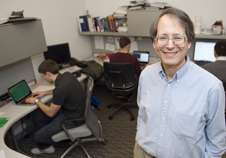
Junior computer science major Greg Kerr (left) worked with Prof. Gene Cooperman (right) to develop a system to save progress on supercomputer computations. Credit: Mary Knox Merrill

A Northeastern University undergraduate is leading the development of a new process that will make it possible for certain supercomputers to save their data midway through a computation, preventing the loss of progress due to a computer crash or bug that would otherwise require the machine to be restarted from the beginning.

“Computers are like a car engine — the more complicated they are, the more likely they are to break,” said Greg Kerr, a sophomore computer science major. 

Kerr said that his protocol applies to high-performance machines known as InfiniBand supercomputers.

Next month, he will present his research at REcon, a computer science conference held annually in Montreal, Canada. He has been selected to give an hour-long talk on the first day of the conference, an honor, for an undergraduate, said Gene Cooperman, a professor in the College of Computer and Information Science, where Kerr is a research assistant.

“If you give your talk on the first day, it means everyone who is there for the conference knows who you are and can talk about your work in the later days,” said Kerr. “It shows that the organizers believe this work is very important and will generate a lot of interest among the attendees.” 

InfiniBand is a relatively new computer system that has made high-performance computing more open and accessible since it was developed and released in the early 2000s.  Because the system is scalable, it can be used on systems ranging from small clusters to some of the world’s largest and most advanced supercomputers.

“This is the networking technology behind some of the worlds largest computers, and yet the number of people who understand the internals of the InfiniBand technology is very small, largely because it is relatively new,” said Cooperman, who urged Kerr to reach out to some of the top InfiniBand experts in the world as he began developing his new process.

No one has been able restart an InfiniBand process midstream. This new work would allow scientists to more efficiently complete massive calculations on expensive computers in high demand. 

This summer, Cooperman and several of his doctoral students are working at the Oak Ridge National Laboratory, where some of the nation’s most advanced supercomputers are located, and Kerr believes his work will soon be ready to be applied to those computations. 

“I think we’re close,” Kerr said. “We’ve got the main points proven and now we need the summer to iron everything out and work out the bugs.”

Explore further: Researchers develop fast, economical method for high-definition video compositing

add to favorites email to friend print save as pdf

Related Stories

For software developers, more speed and mobility

Dec 14, 2010

Across the globe, technology and innovation are becoming increasingly more reliant on mobility and accessibility. For software developers working on highly complex projects, that means being able to save their ...

Locating the impossible with 'lightening fast' speed

Dec 20, 2010

A terrorist plants a time bomb along a gas line in a residential neighborhood. He e-mails a photo of the death trap to law enforcement officials, but no one can tell exactly where the bomb is located. 

A brainy innovation takes flight

Jun 02, 2011

A team of Northeastern University engineering students has developed a system that allows a pilot to fly a simulated airplane using nothing more than his or her brainwaves — a program that has piqued military and private-sector ...

Recommended for you

The brain as a model for future supercomputers

May 14, 2013

(Phys.org) —The brain's repute took a big hit in 1997 when an IBM supercomputer defeated world chess champion Gary Kasparov in a match reported around the world. But in the second round, the brain is back.

User comments : 0

More news stories

Patented system better secures digitally stored data

(Phys.org) —Arizona State University computer scientist Gail-Joon Ahn has been granted a U.S. patent for a novel identity management system that helps protect personal identity information stored on digital devices.

Sprint to listen to Dish offer

(AP)—Wireless company Sprint Nextel Corp. says it can now let Dish Network Corp. see its books and talk with Dish to see whether its competing offer to buy Sprint is better than its current deal with Japan's SoftBank.

Seniors are attractive targets for online fraud

Victims of online fraud need greater support to help them overcome the often serious health effects that follow discovery of the deception, QUT cybersecurity researcher Cassandra Cross says.

Making quantum encryption practical

One of the many promising applications of quantum mechanics in the information sciences is quantum key distribution (QKD), in which the counterintuitive behavior of quantum particles guarantees that no one can eavesdrop on ...

Evaluating a new way to open clogged arteries

Over the past few decades, scientists have developed many devices that can reopen clogged arteries, including angioplasty balloons and metallic stents. While generally effective, each of these treatments ...