Satellite looks down the eye of erupting Nabro Volcano
Jun 28, 2011 By Nancy Atkinson
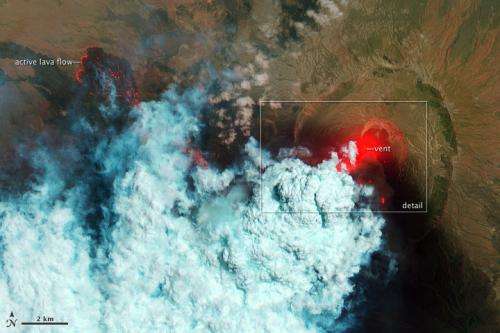
This false color satellite image shows active lava flows of the Nabro volcano in Eritrea on June 24, 2011. Credit: the Advanced Land Imager (ALI) aboard the Earth Observing-1 (EO-1) satellite.

Wow! What an amazing and detailed top-down view of an active volcano! This is the Nabro Volcano, which has been erupting since June 12, 2011. It sits in an isolated region on the border between Eritrea and Ethiopia and satellite remote sensing is currently the only reliable way to monitor the ongoing eruption, according to the NASA Earth Observatory website. The bright red portions of the false-color image (above) indicate hot surfaces. See below for a zoomed-in look. Both images were taken by the Advanced Land Imager (ALI) aboard the Earth Observing-1 (EO-1) satellite.

Robert Simmon of the Earth Observatory website describes the scenes:

Hot volcanic ash glows above the vent, located in the center of Nabro’s caldera. To the west of the vent, portions of an active lava flow (particularly the front of the flow) are also hot. The speckled pattern on upstream portions of the flow are likely due to the cool, hardened crust splitting and exposing fluid lava as the flow advances. The bulbous blue-white cloud near the vent is likely composed largely of escaping water vapor that condensed as the plume rose and cooled. The whispy, cyan clouds above the lava flow are evidence of degassing from the lava.

The natural-color image (lower) shows a close-up view of the volcanic plume and eruption site. A dark ash plume rises directly above the vent, and a short, inactive (cool) lava flow partially fills the crater to the north. A gas plume, rich in water and sulfur dioxide (which contributes a blue tint to the edges of the plume) obscures the upper reaches of the active lava flow. Black ash covers the landscape south and west of Nabro.
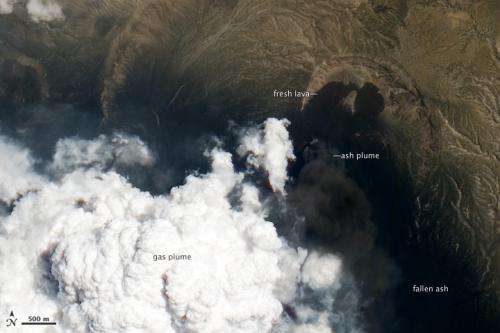
This natural-color image shows a close-up view of the volcanic plume and eruption site of the Nabro volcano. Credit: the Advanced Land Imager (ALI) aboard the Earth Observing-1 (EO-1) satellite

Limited reports from the region say that at least 3,500 people and up to 9,000 that have been effected by the eruption, with at least 7 deaths caused by the erupting . The ash has also disrupted flights in the region.

Explore further: Alaska volcano shoots ash 15,000 feet into the air

add to favorites email to friend print save as pdf

Related Stories

NASA Satellite Eyes Iceland Volcano Cauldron

Apr 19, 2010

(PhysOrg.com) -- On Saturday, April 17, 2010, the Hyperion instrument onboard NASA's Earth Observing-1 (EO-1) spacecraft obtained this pair of images of the continuing eruption of Iceland's Eyjafjallajökull ...

Volcano taming

Jun 05, 2008

Could macro-scale chemical engineering be used to stop a volcanic lava flow in its tracks and save potentially thousands of lives and homes when the next eruption occurs? That's the question R.D. Schuiling of Geochem Research ...

Scientists eye glowing volcano crater in Hawaii

Jun 07, 2009

(AP) -- The summit of Hawaii's Kilauea volcano is glowing brightly as molten lava swirls 300 feet below its crater's floor, bubbling near the surface after years of spewing from the volcano's side.

Recommended for you

Alaska volcano shoots ash 15,000 feet into the air

6 hours ago

(AP)—One of Alaska's most restless volcanoes has shot an ash cloud 15,000 feet into the air in an ongoing eruption that has drawn attention from a nearby community but isn't expected to threaten air traffic.

NASA sees Cyclone Mahasen hit Bangladesh

17 hours ago

NASA's Tropical Rainfall Measuring Mission satellite known as TRMM measured Cyclone Mahasen's rainfall rates from space as it made landfall on May 16. Mahasen has since dissipated over eastern India.

Rapid climate change ruled out ice age trees

23 hours ago

Short, sharp fluctuations in the Earth's climate throughout the last ice age may have stopped trees from getting a foothold in Europe and northern Asia, scientists say.

Earth's iron core is surprisingly weak, researchers say

May 17, 2013

The massive ball of iron sitting at the center of Earth is not quite as "rock-solid" as has been thought, say two Stanford mineral physicists. By conducting experiments that simulate the immense pressures deep in the planet's ...

User comments : 0

More news stories

Alaska volcano shoots ash 15,000 feet into the air

(AP)—One of Alaska's most restless volcanoes has shot an ash cloud 15,000 feet into the air in an ongoing eruption that has drawn attention from a nearby community but isn't expected to threaten air traffic.

Chinese, Indian airlines face EU pollution fines

Eight Chinese and two Indian airlines face fines of up to several million euros for not paying for their greenhouse gas emissions during flights within the bloc, the European Commission said on Friday.

Bright explosion on the Moon

For the past 8 years, NASA astronomers have been monitoring the Moon for signs of explosions caused by meteoroids hitting the lunar surface. "Lunar meteor showers" have turned out to be more common than anyone ...

US seizes Bitcoin operator accounts

US authorities seized the accounts of a Bitcoin digital currency exchange operator, claiming it was functioning as an "unlicensed money service business," court documents showed Friday.